As restaurants sought to enhance their customer experience, they turned to vintage Coca-Cola menu boards to capture the essence of this iconic brand. The 1970s were a golden age for American diners. Stainless steel counters, jukeboxes humming Fleetwood Mac, and families gathering around orange vinyl booths defined an era. But a quiet revolution was happening on the walls of these establishments, led by Coca-Cola. Enter the Marketeer Menu Boards, Coca-Cola’s mid-1970s innovation that promised versatility, style, and increased sales for restaurants of all sizes and transformed diner menus forever.
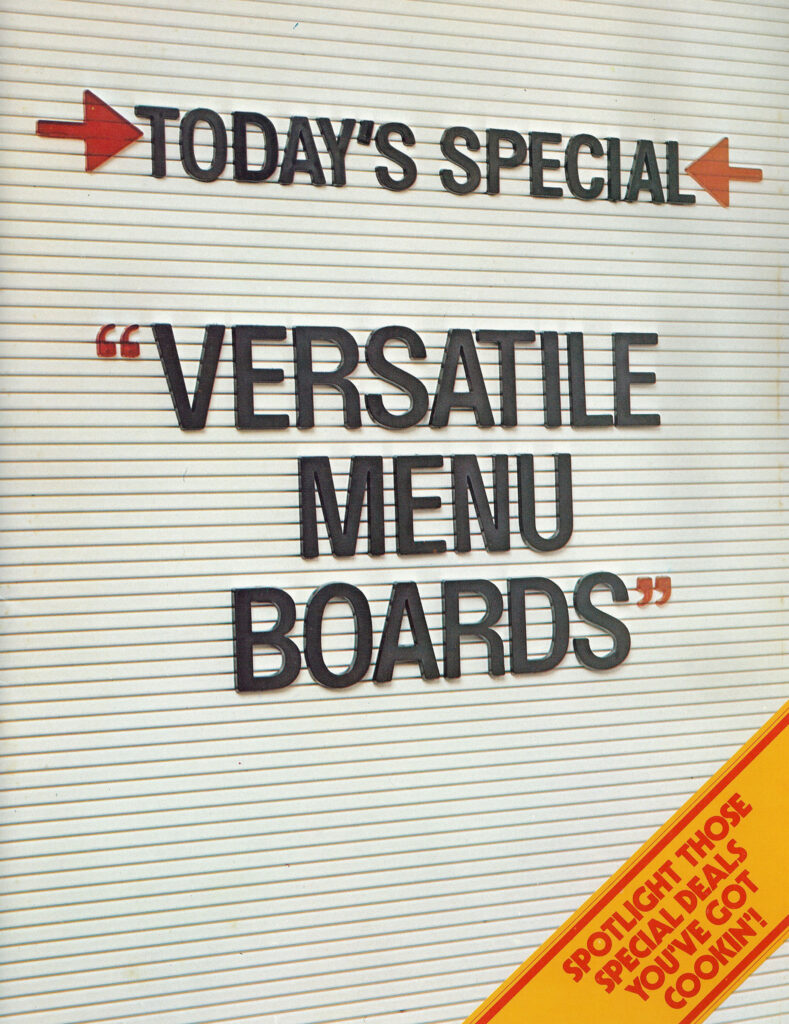
Today’s Special: Versatile Menu Boards
Coca-Cola’s trade catalog from the era proudly declared:
“Today’s Special: Versatile Menu Boards”
These were more than just static signs. Designed with interchangeable panels and crisp typography, they allowed restaurateurs to update menus daily, without needing a new board.
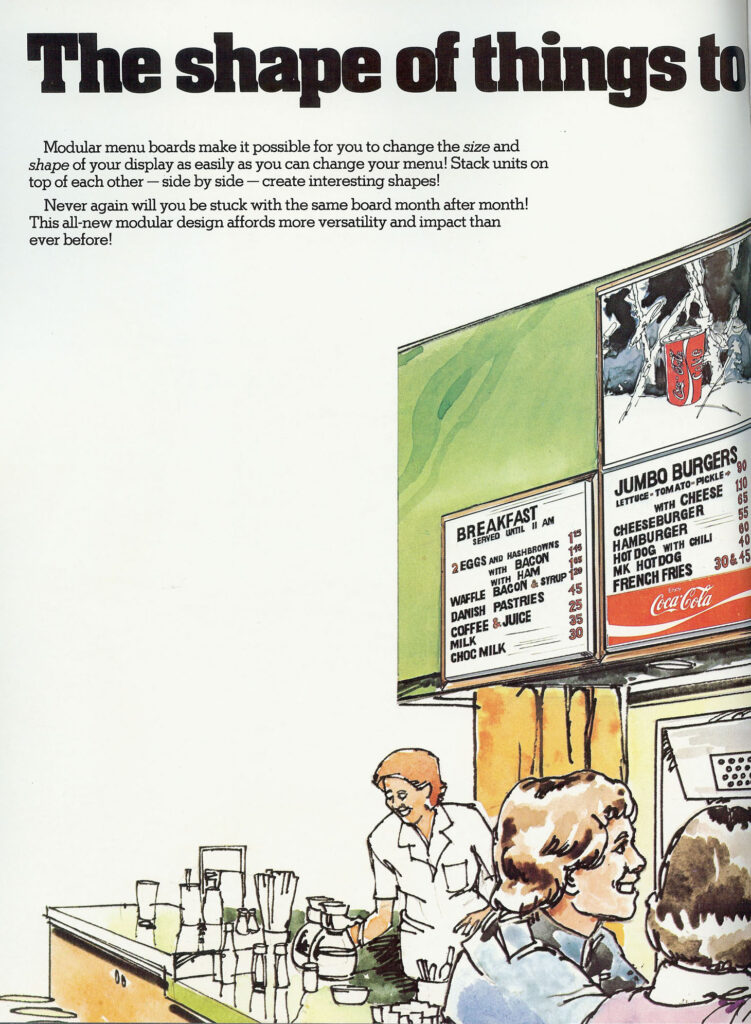
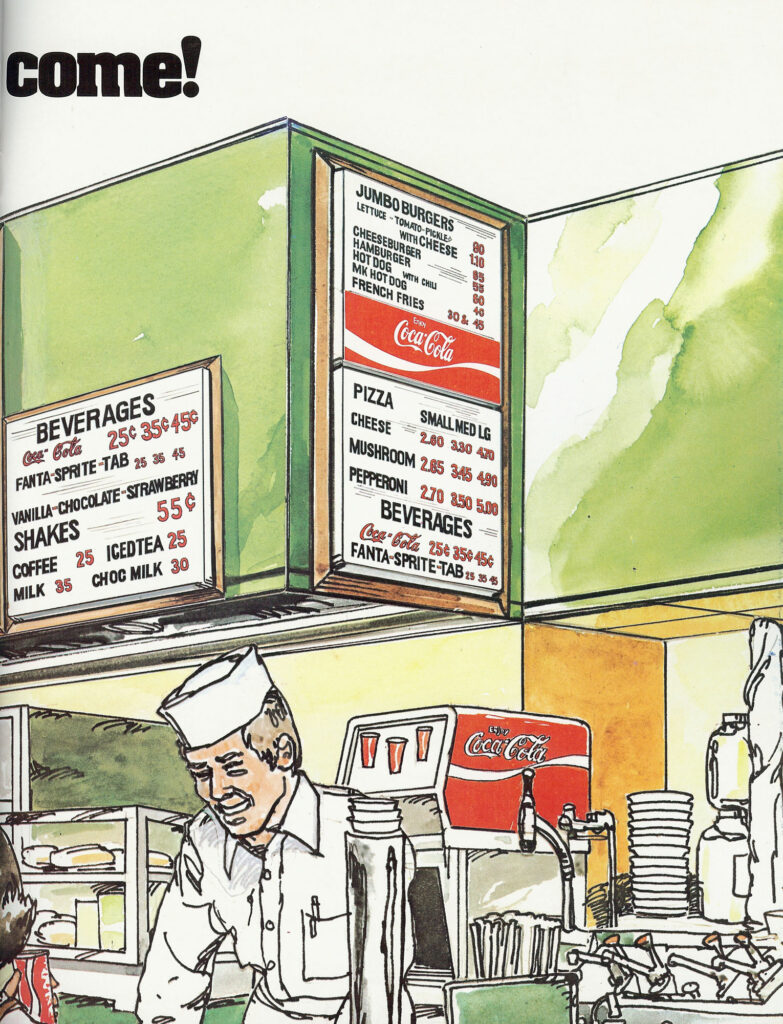
The Shape of Things to Come
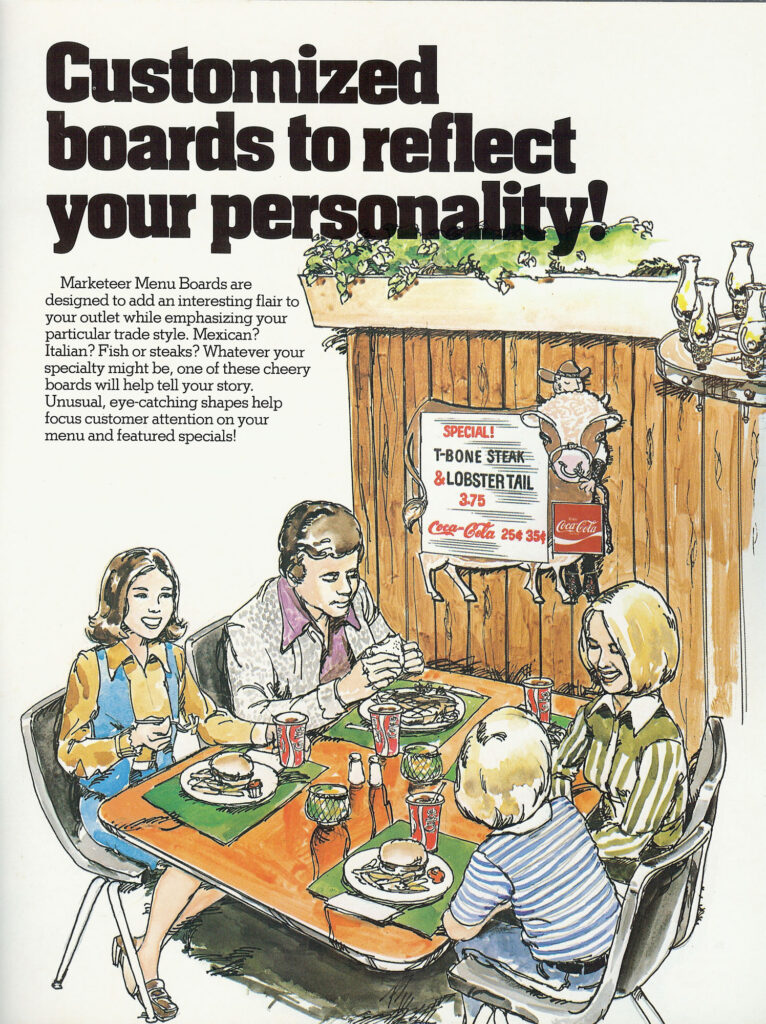
Illustrations in the catalog showed families enjoying burgers and fries under gleaming white menu boards with prices like:
- Jumbo Burger – 90¢
- Cheeseburger – $1.10
- French Fries – 30¢
The Coca-Cola logo, in its bold red script, anchored every board, linking quality beverages to hearty meals.
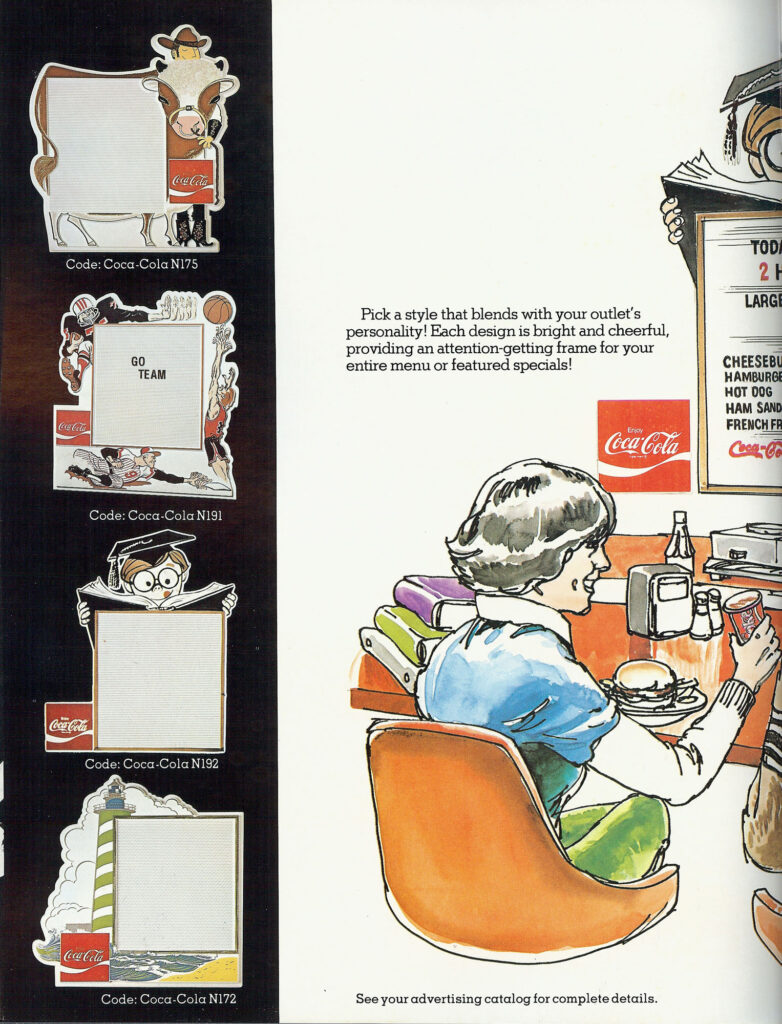
Customized Boards to Reflect Personality
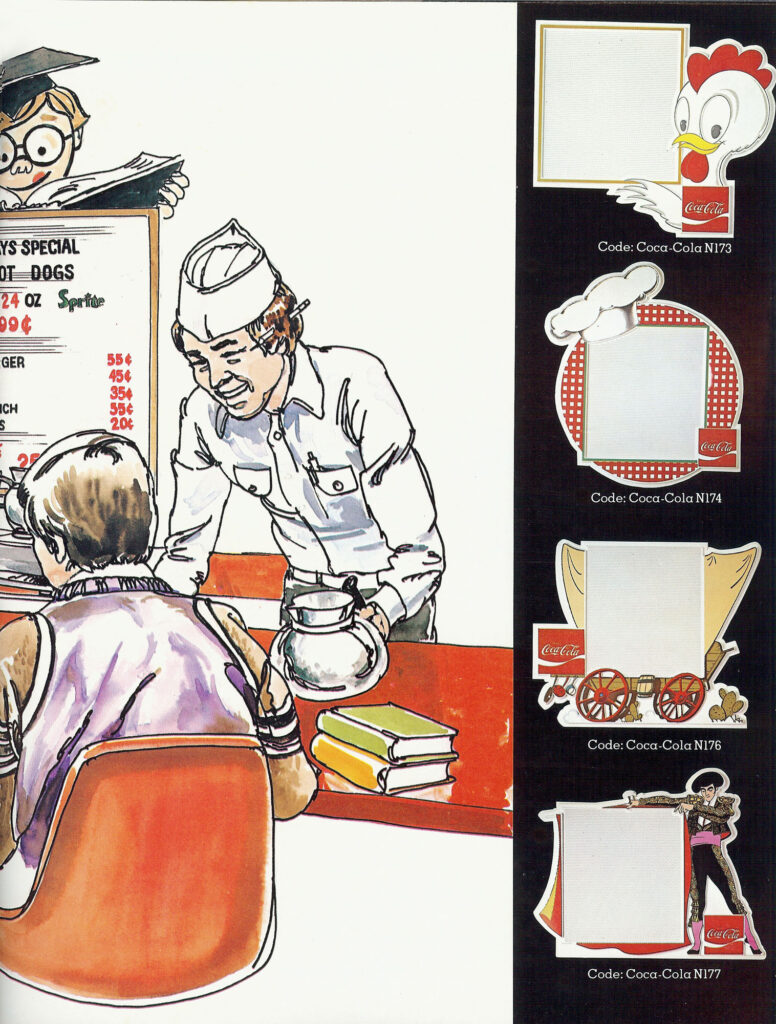
Themed frames gave eateries personality:
- 🐮 Cow-shaped boards for steakhouses
- 🏖️ Lighthouse motifs for coastal diners
- 🎓 Graduation caps for college cafés
- 🤠 Covered wagons for western BBQ joints
These designs weren’t just functional, they were marketing tools.
Quick Promotions, Big Returns
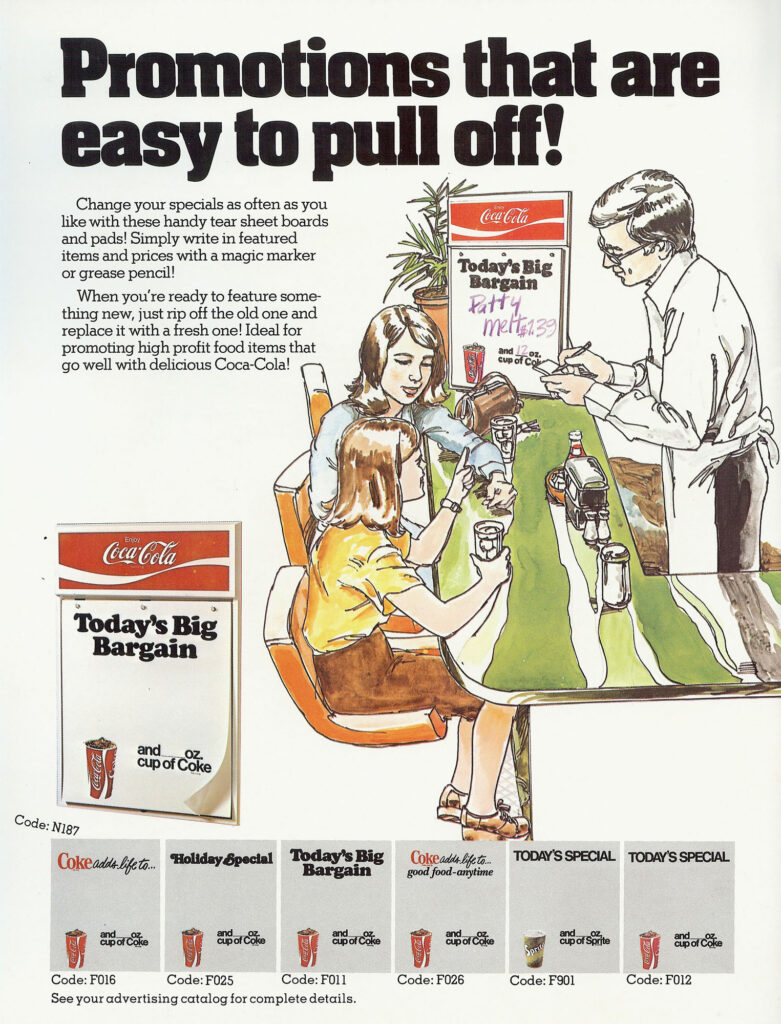
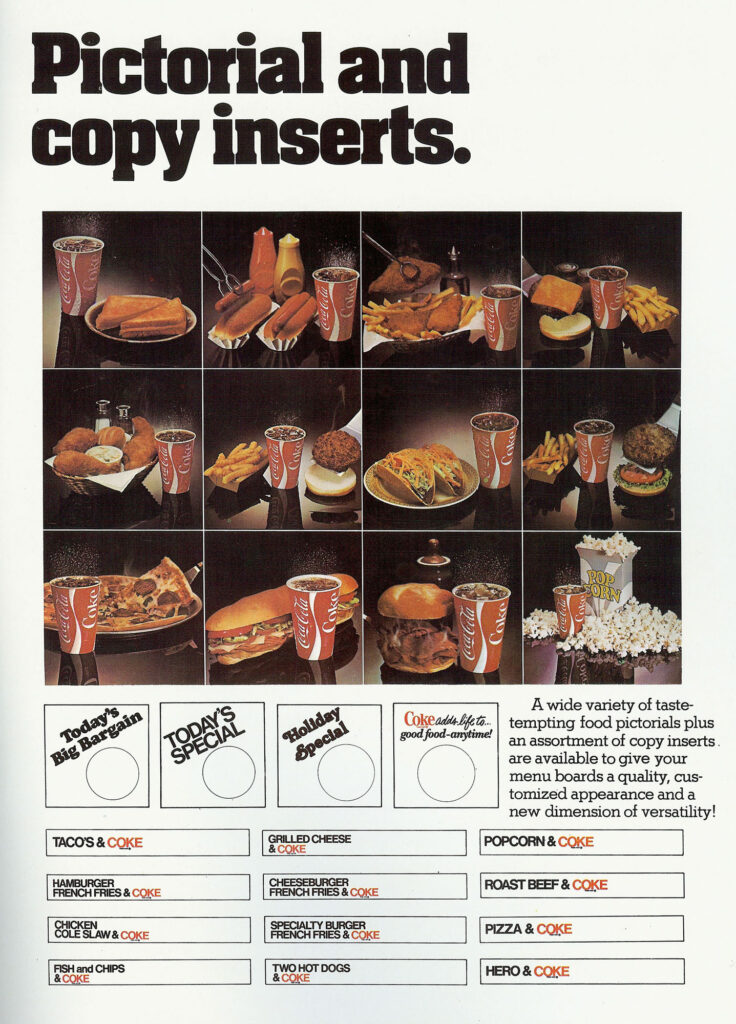
With tear-sheet boards and grease-pencil inserts, specials could be written and erased daily. A few of the combos featured:
- 🍗 Fried Chicken & Coke
- 🌮 Tacos & Coke
- 🍔 Patty Melt & Coke
Coca-Cola wasn’t just selling soda; they were selling higher margins and a branded experience.
Pictorial Inserts: Selling the Meal With the Drink
High-quality photo inserts showed:
- Golden fried chicken next to an ice-cold Coke.
- Pepperoni pizza paired with Coca-Cola.
- Burgers, fries, and paper Coke cups under bright diner lights.
These inserts helped even small diners look as professional as rising fast-food chains.
A Cultural Snapshot: Diners and Drive-Ins in the 1970s
Molded chairs, chrome soda fountains, paper hats, these visuals captured more than menus. They documented an era of community, affordability, and Americana, where a family meal out cost under $5.
Why the Mid-to-Late 1970s?
“Coke adds life” slogan debuted in 1976.
- TAB and Fanta branding mirror Coca-Cola’s 70s product lineup.
- Prices match pre-inflation dining costs.
- Soft watercolor illustrations echo 1970s advertising styles.
By 1982, digital menus and Diet Coke would usher in a new era. But in these pages, Coca-Cola reigned supreme.
Legacy of the Marketeer Menu Boards
Today, surviving examples of these boards are rare collectibles. Yet their influence lives on in digital menu systems and co-branded promotions worldwide.
Final Reflection: Today’s Special Forever
The Marketeer Menu Boards remind us of an age where even the simplest diner could feel modern, professional, and enticing, thanks to Coca-Cola.
“Today’s Special isn’t just on the plate, it’s on the wall, sparking cravings and sealing the deal with a Coca-Cola.”
Learn More About the Company Brand Featured in this Promotion
Discover the history of Coca-Cola’s iconic 2-liter Bonus Bottle campaign from the late 1970s. Learn how this bold marketing strategy changed beverage packaging forever and explore the point-of-sale (POS) materials that brought it to life in grocery stores across America. As part of this campaign, the Coca-Cola 2 liter bottle became a symbol of consumer value.
The Spark of Innovation
The introduction of the Coca-Cola 2 liter bottle marked a significant shift in beverage packaging.
In 1979, America was in transition. The vibrant optimism of the early 1970s had given way to economic challenges, energy crises, and shifting consumer priorities. Amidst these changes, Coca-Cola prepared to launch one of its most ambitious innovations yet: the 2-liter glass Bonus Bottle.
Shoppers quickly recognized the benefits of the Coca-Cola 2 liter bottle for family gatherings.It offered a practical solution for families, making the coca-cola 2 liter bottle a staple in homes.

It became synonymous with festive gatherings, where the Coca-Cola 2 liter bottle was often the drink of choice.
By the late 1970s, Coca-Cola had been a household name for nearly a century, but the beverage industry was evolving. Competitors like Pepsi were advancing with campaigns such as the “Pepsi Generation,” while private-label sodas chipped away at Coca-Cola’s market share with aggressive pricing.
The coca-cola 2 liter bottle quickly became a favorite for parties and events.
People loved the Coca-Cola 2 liter bottle for its affordability and convenience.
Consumers were also seeking more convenience and value, larger packages for family use, bulk savings, and products designed for a home-centered lifestyle. Coca-Cola needed a marketing strategy that could address these needs and cement its position as the market leader.
The solution was the 2-liter glass bottle, unprecedented in size for soft drinks. Heavy and substantial, it offered 5% more soda than the popular 64-ounce size for the same price, appealing to value-conscious shoppers.
The Marketing Campaign
The Coca-Cola 2 Liter Bottle: A Game Changer in Beverage Packaging
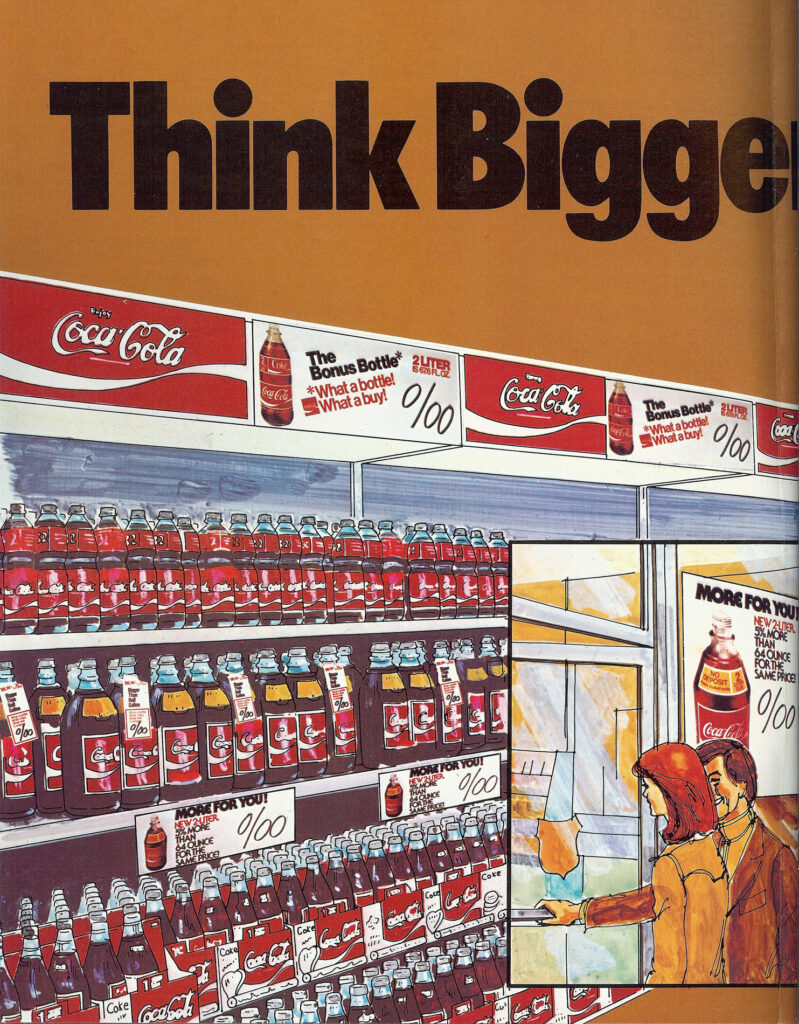
To introduce the Bonus Bottle, Coca-Cola launched a bold point-of-sale (POS) marketing campaign under the slogan “Think Bigger.”
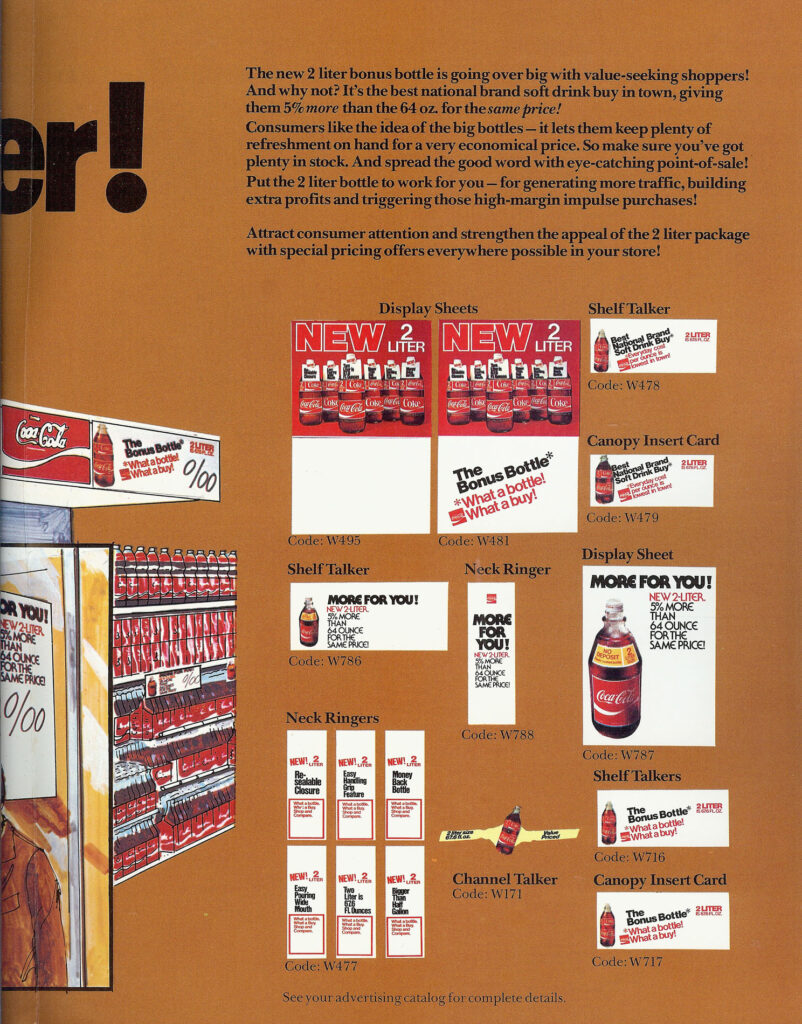
This was not just an advertising effort aimed at consumers; it was a comprehensive merchandising strategy for retailers. Coca-Cola provided an array of promotional materials to transform store displays into attention-grabbing marketing zones:
- Shelf Talkers – Eye-catching signs for grocery shelves.
- Neck Ringers – Promotional tags placed around bottle necks.
- Canopy Insert Cards – Visuals for coolers and aisles.
- Display Sheets – Posters and banners encouraging multi-bottle purchases.
Each item carried catalog codes like W478 (shelf talker), W479 (canopy insert), and W786 (the iconic “MORE FOR YOU!” signage).
Today, the Coca-Cola 2 liter bottle remains a nostalgic reminder of the past.
The messaging was designed to resonate with shoppers:
“The Bonus Bottle. What a bottle! What a buy!”
“More for you! New 2 Liter—5% more than 64 oz. for the same price!”
Supermarkets across North America were encouraged to create bold, high-visibility displays of 2-liter glass Coca-Cola bottles, ensuring the Bonus Bottle was impossible to overlook.
The Grocery Store Revolution
As the campaign rolled out, the 2-liter Coca-Cola bottles began appearing in aisles from coast to coast. They were stacked under large “Think Bigger” banners, creating a striking visual presence.
The bottles themselves were distinctive. Made of thick, returnable glass, each one featured an embossed message around its neck: “RETURN FOR DEPOSIT.” The substantial weight and cool surface gave the impression of quality and abundance.
This packaging wasn’t merely functional; it became a symbol of value and family togetherness during a period of rising grocery bills and cultural shifts toward bulk purchasing.
The POS advertising materials reinforced Coca-Cola’s branding at every shopper touch point, from store entrances to checkout lanes.
Cultural Shifts in Beverage Marketing
The appeal of the Coca-Cola 2 liter bottle transcended generations, remaining popular among new consumers.
As trends shifted, the Coca-Cola 2 liter bottle still held its ground as a consumer favorite.
It continues to represent value in the beverage market, the Coca-Cola 2 liter bottle is still recognized for its size and affordability.
The Bonus Bottle campaign wasn’t just a marketing triumph; it reflected broader changes in American consumer habits. The preference for larger sizes paralleled trends in other consumer goods as families sought to stretch budgets and reduce shopping frequency.
However, while the 2-liter glass bottle succeeded in creating impact, it also revealed challenges. Its weight and fragility complicated transportation and storage. By 1982–1983, Coca-Cola and competitors began transitioning to lighter, unbreakable PET plastic bottles, signaling another packaging revolution.
Despite its relatively short lifespan, the glass 2-liter left a strong impression. Its hefty, the sound of glass clinking in shopping carts, and the ritual of twisting open its cap became part of household memories.
The Legacy of Coca-Cola’s “Think Bigger” Campaign
Ultimately, the Coca-Cola 2 liter bottle has left an indelible mark on beverage history.
As we reflect on its legacy, the Coca-Cola 2 liter bottle will always be part of our collective memories.
Today, the “Think Bigger” campaign is remembered as a pivotal moment in Coca-Cola’s history. It showcased the company’s ability to innovate both in product packaging and retail merchandising.
Collectors prize original POS materials from the campaign, shelf talkers, neck ringers, and banners, as artifacts of a bygone era. These items reflect the design language of the late 1970s, with bold sans-serif fonts, warm earthy colors, and hand-drawn illustrations of bustling grocery aisles.
The Bonus Bottle also represents a time when glass dominated the beverage industry, just before plastic transformed into how the world consumed soft drinks.
A Snapshot in Coca-Cola History
The 2-liter Bonus Bottle and its accompanying POS marketing materials stand as snapshots of a cultural and commercial moment. They represent not just a new package size but a strategic response to a changing world.
In retrospect, the campaign’s success lies in its simplicity and boldness, proof that even a century-old brand could “Think Bigger” and redefine its place in the market.
Learn More About the Company Brand Featured in this Promotion
In August of 1959, the Outdoor Advertising Incorporated (OAI) company released its latest promotion for the Fall of 1959. This promotion aimed to promote Coca-Cola through outdoor advertising and billboards featuring the iconic 1959 Coke Billboards.
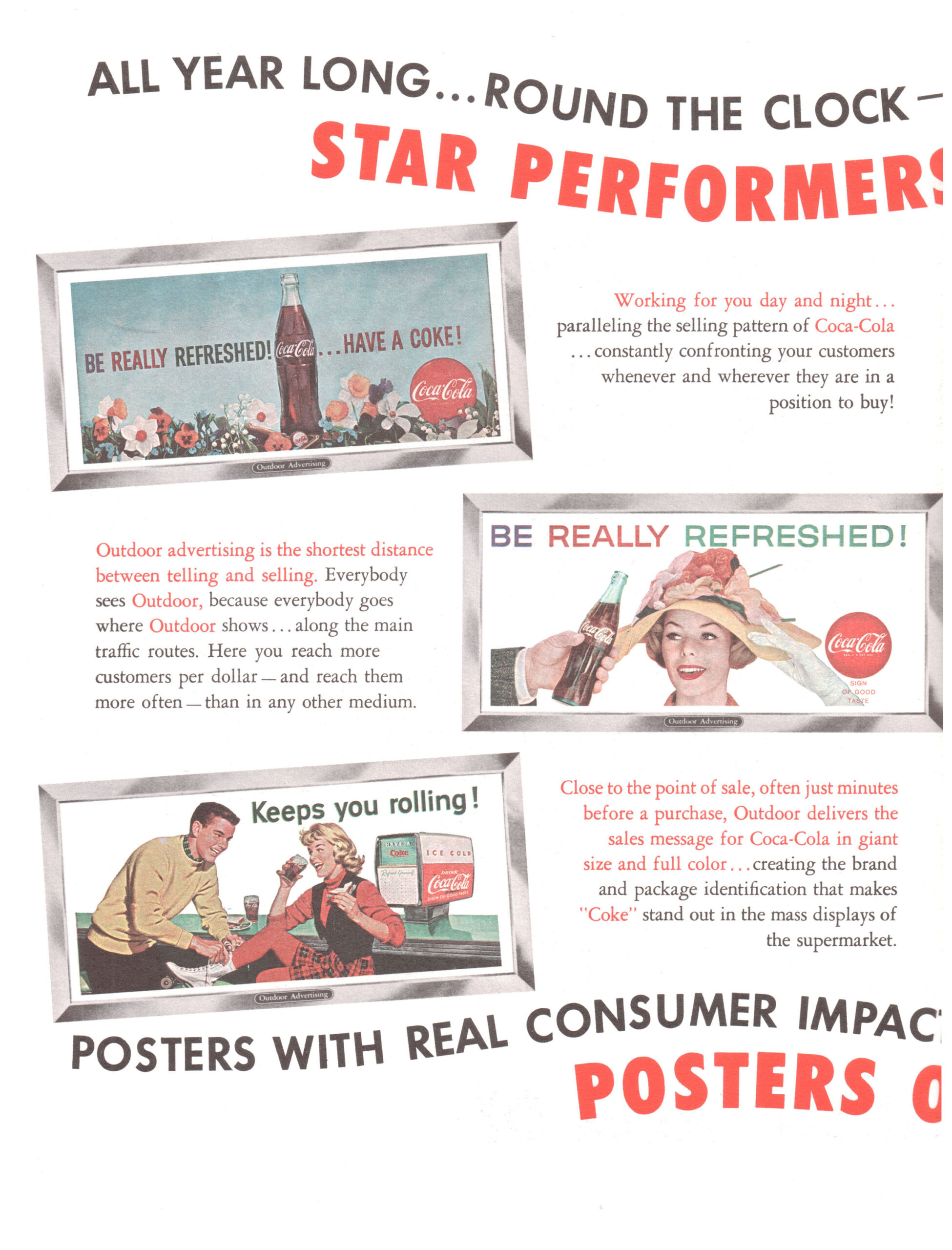
The promotion was called Star Performers Build Sales for You. It highlighted that in the Fall of 1959, the bright lights of the entertainment industry and outdoor advertising would team up as the McGuire Sisters to sell Coca-Cola to America.
By blending the 3 McGuire Sisters singers with the selling power of outdoor advertising, the Coca-Cola Company aimed to create a powerful combination for their outdoor posters.
Posters that Build Sales of Coca-Cola
The 1959 Coke Billboards became a symbol of the advertising strategies employed by Coca-Cola to capture the attention of consumers and create lasting impressions.
The promotion was targeted at Coca-Cola bottlers. An introduction to the promotion detailed the history of Coca-Cola using outdoor poster advertising.
Because their audience grows automatically with population increases, 24-sheet posters are uniquely inexpensive compared to other media.
In 1925, The Coca-Cola Company first offered Bottlers of Coca-Cola a chance to participate in an advertising medium. This medium consisted of 24-sheet posters, with total expenditure amounting to $453,886.76. This offer has never been withdrawn, and spending grew to $3,372,412.19 by 1958.
This history represents the most consistent use of any advertising medium, with expenses shared between The Coca-Cola Company and the Bottlers of Coca-Cola.
There must be some kind of reason for such consistency, and there was. Posters have proven to be unique in several respects and have successfully served Coca-Cola.
For instance, they are the only medium that allows advertisers to capture consumer attention while they move from inside their homes to the point-of-sale.
Their size gives advertisers like The Coca-Cola Company a highly desirable dominance and prestige. Their distribution allows the message to stay with consumers while they move about outdoors.
Additionally, their use of full-color printing presents the product in a realistic and appetizing manner.
The Outdoor Advertising Incorporated company felt that the decade of the fabulous 1960s would see disposable income growing by leaps and bounds and advertising’s responsibility to secure a fair share for Coca-Cola becoming increasingly heavy. Under such circumstances, they felt that any advertiser would find themselves particularly obligated to look at the poster medium as not only one of the most effective media but, in all probability, the most economical one for doing this kind of job.
The Outdoor Advertising Incorporated company anticipated that the fabulous 1960s would see disposable income growing significantly. They believed advertising’s responsibility to secure a fair share for Coca-Cola would become increasingly critical.
Under such circumstances, they felt any advertiser would find themselves particularly obligated to consider the poster medium as one of the most effective and economical options for this task.
All Year Long Around the Clock Star Performers Sell for You
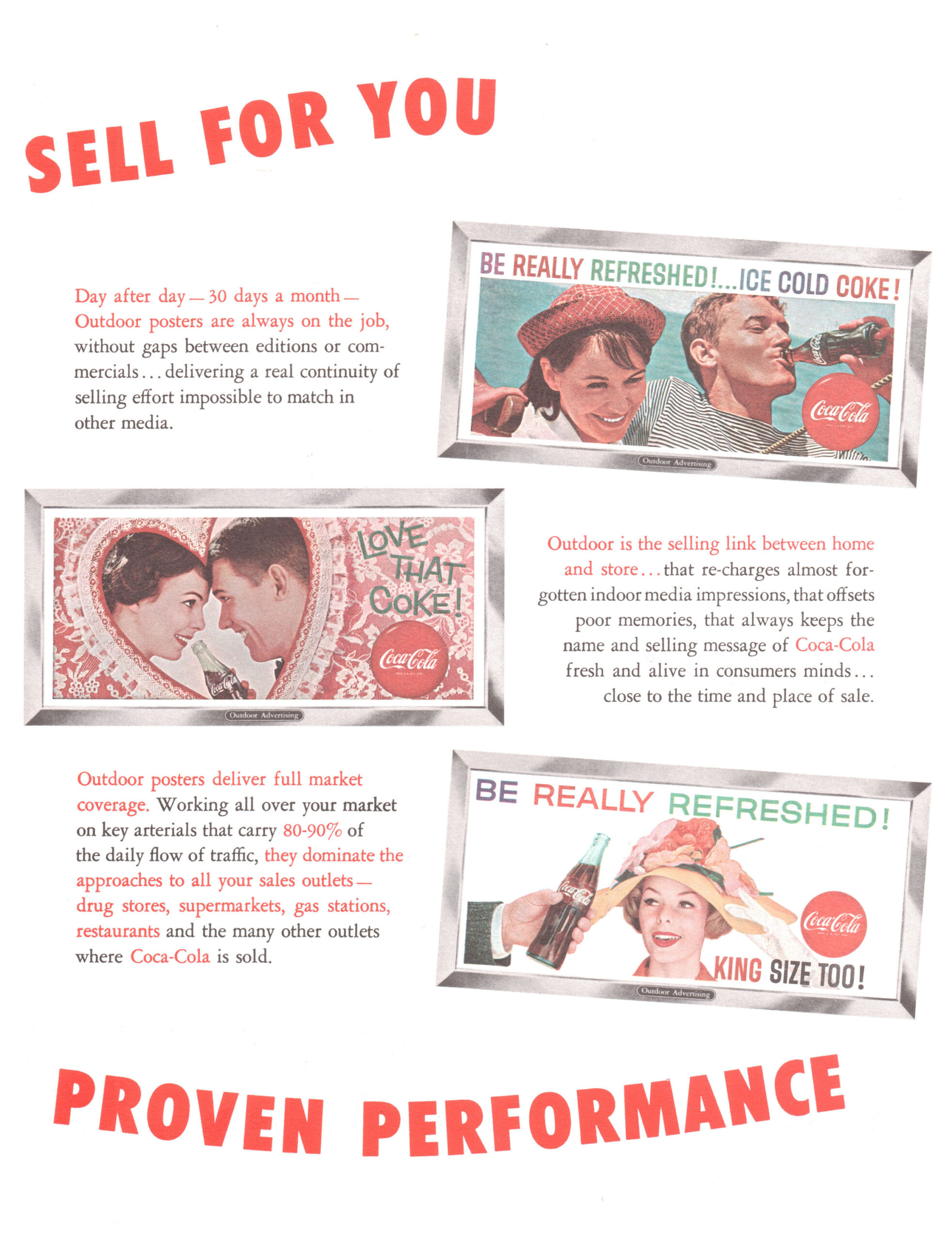
To encourage Coca-Cola bottlers to purchase the outdoor billboards in this promotion, the Outdoor Advertising Incorporated company used taglines like:
- “Working for you day and night”
- “Day after day, 30 days a month, outdoor posters are always on the job”
- “Outdoor advertising is the selling link between home and store”
Within these taglines, they showcased six new outdoor billboards.
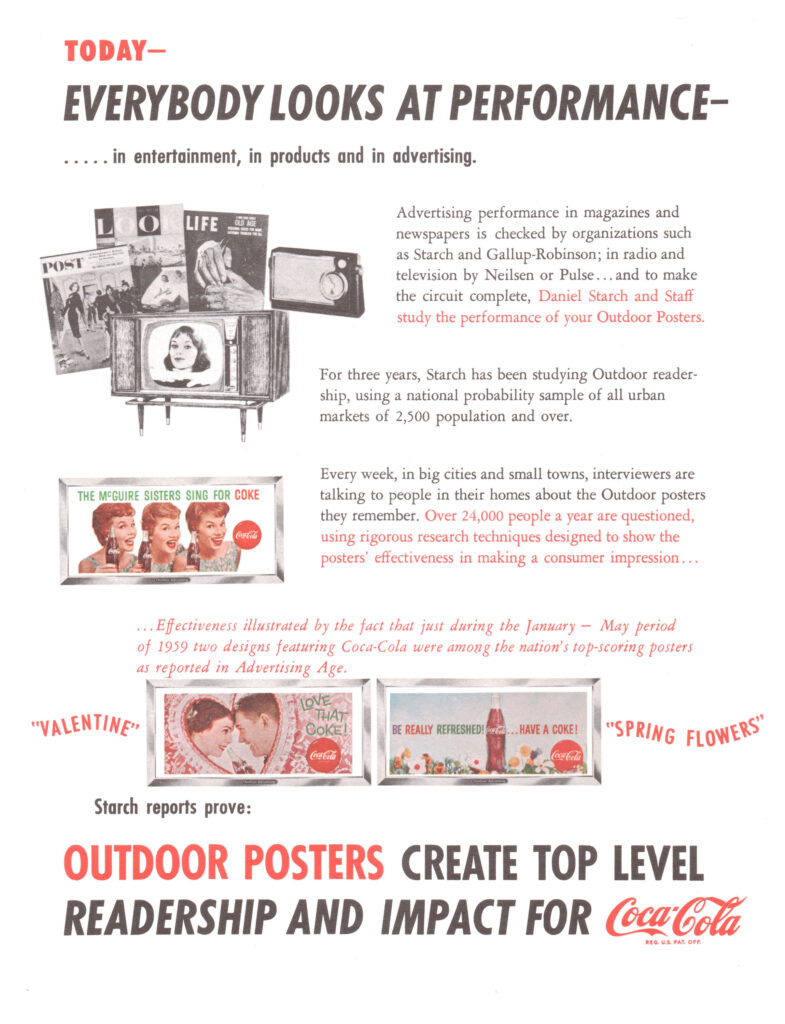
Outdoor Posters Create Top Level Readership
To further support why Coca-Cola bottlers should purchase the billboards in the “Star Performers Build Sales for You” promotion, information on outdoor readership was provided. This information demonstrated the benefits of outdoor performance.
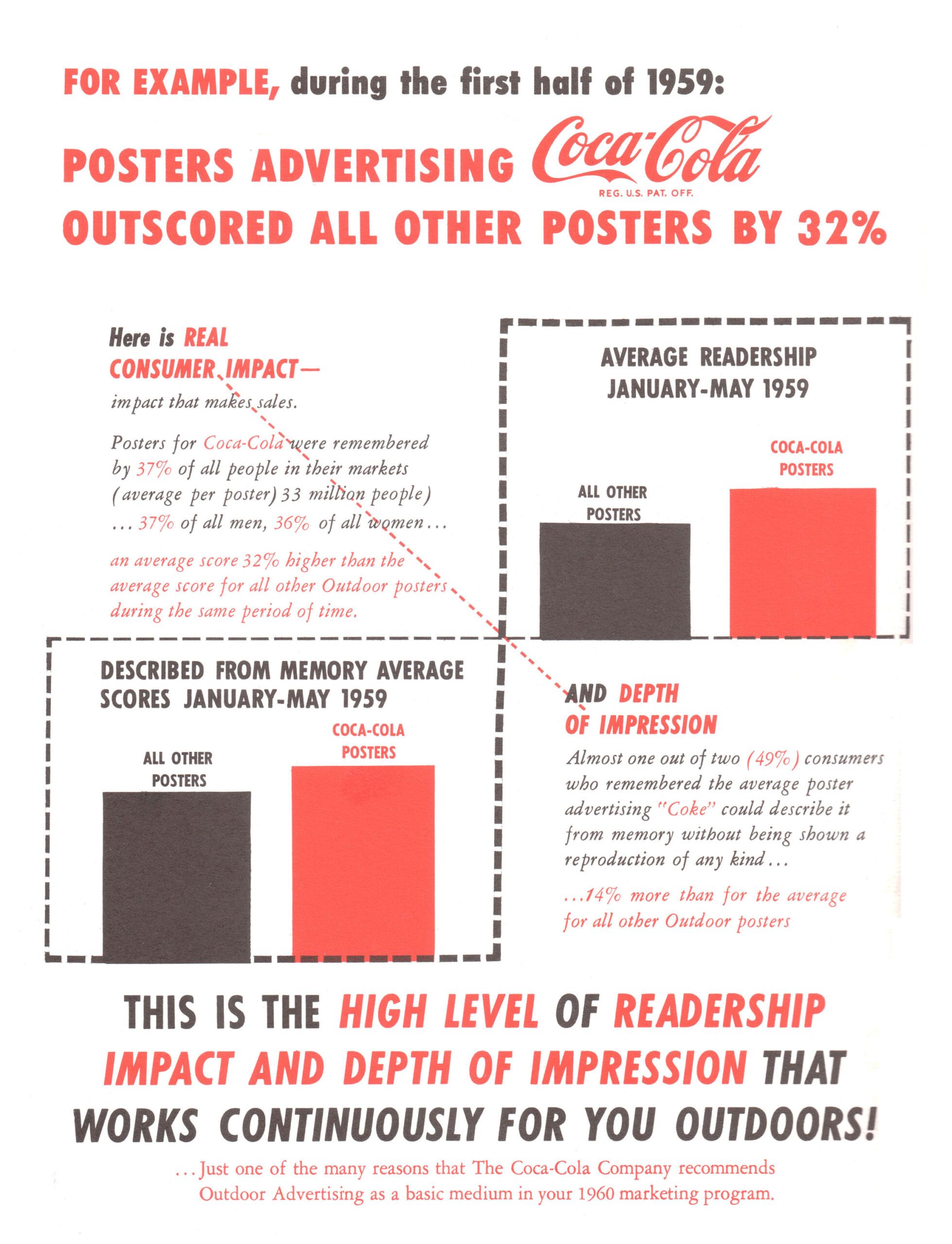
Posters Advertising Coca-Cola Outscored Other Posters by 32% in First Half of 1959
To further support why Coca-Cola bottlers should purchase the billboards in the promotion, information regarding readership impact and depth of impression was presented.
Posters with Real Consumer Impact – The 1959 Line Up
The following outdoor poster billboards were used in this promotion:
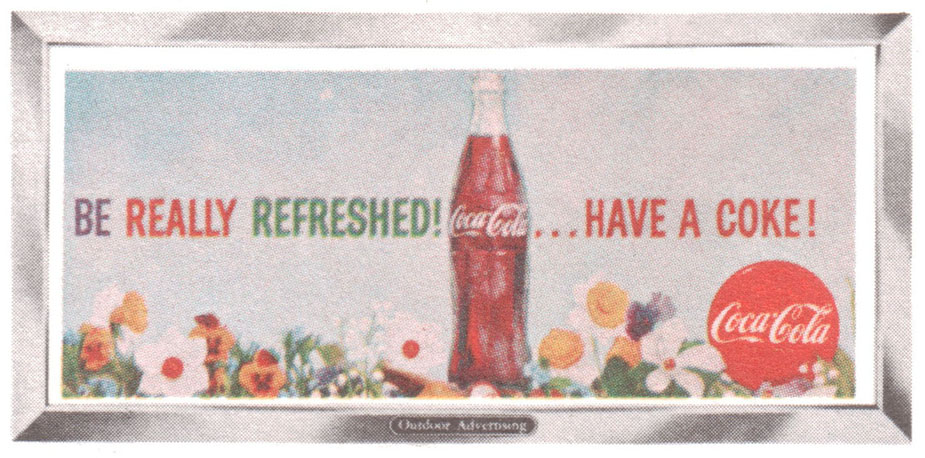
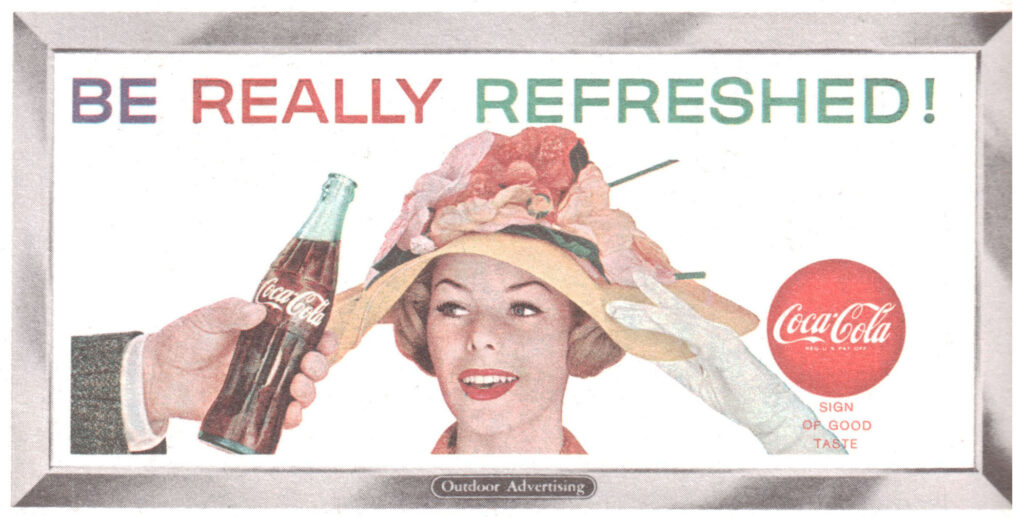
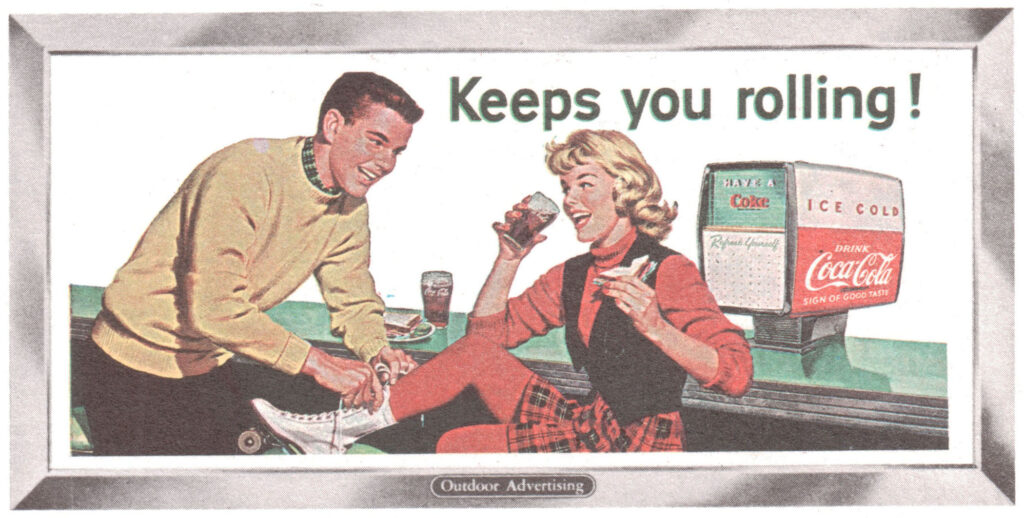
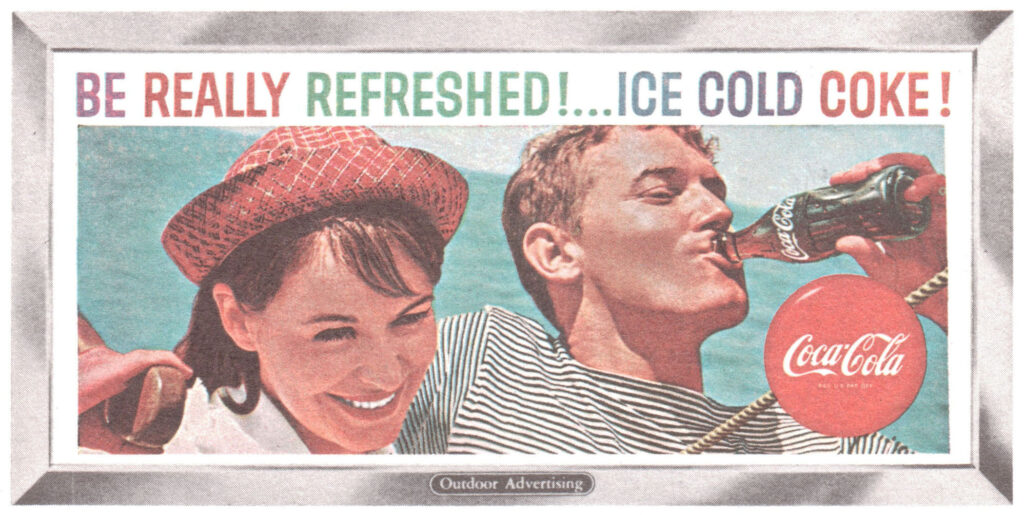
- The Be Really Refreshed Have a Coke outdoor advertising billboard featured a bottle of Coca-Cola sitting in a field of flowers with a trademark Coca-Cola disc in the lower right corner.
- The Be Really Refreshed outdoor advertising billboard featured a woman with a brown and pink hat being handed a regular size bottle of Coca-Cola with a trademark Coca-Cola disc in the lower right corner.
- The Keeps you Rolling outdoor advertising billboard featured a man and woman at an ice skating rink drinking glasses of Coca-Cola next to a fountain dispenser.
- The Be Really Refreshed Ice Cold Coke outdoor advertising billboard featured a man and woman on a boat with a trademark Coca-Cola disc in the lower right corner.
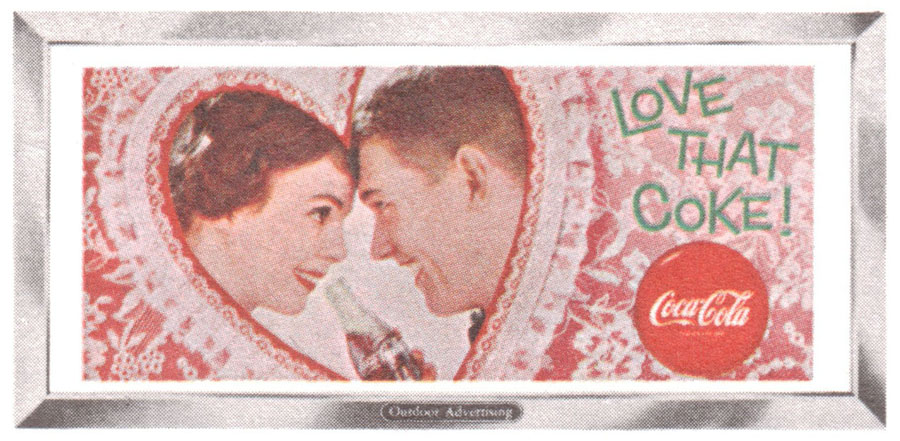
- The Love that Coke outdoor advertising billboard featured a man and woman drinking a bottle of Coca-Cola over a heart-shaped background with a trademark Coca-Cola disc in the lower right corner.
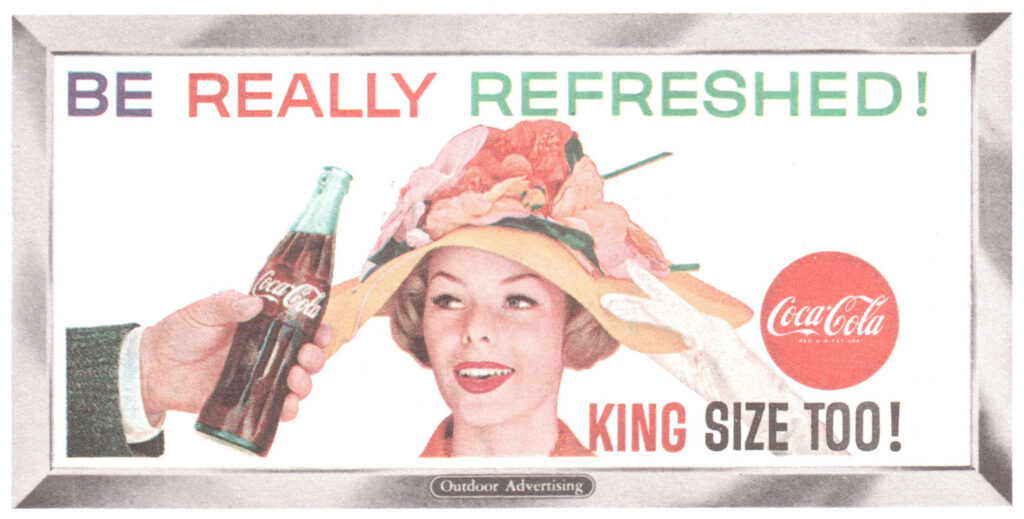
- The Be Really Refreshed King Size Too outdoor advertising billboard featured a the same woman with a brown and pink hat being handed a King size bottle of Coca-Cola with a trademark Coca-Cola disc in the lower right corner.
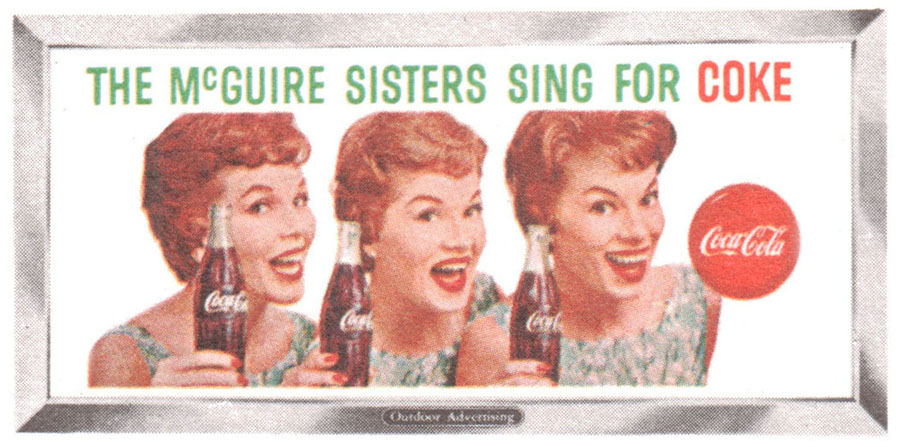
- The McGuire Sisters Sing for Coke outdoor advertising billboard featured the McGuire sisters singing group each holding a bottle of Coca-Cola with a trademark Coca-Cola disc to their right.
Learn More About the Company Brand Featured in this Promotion
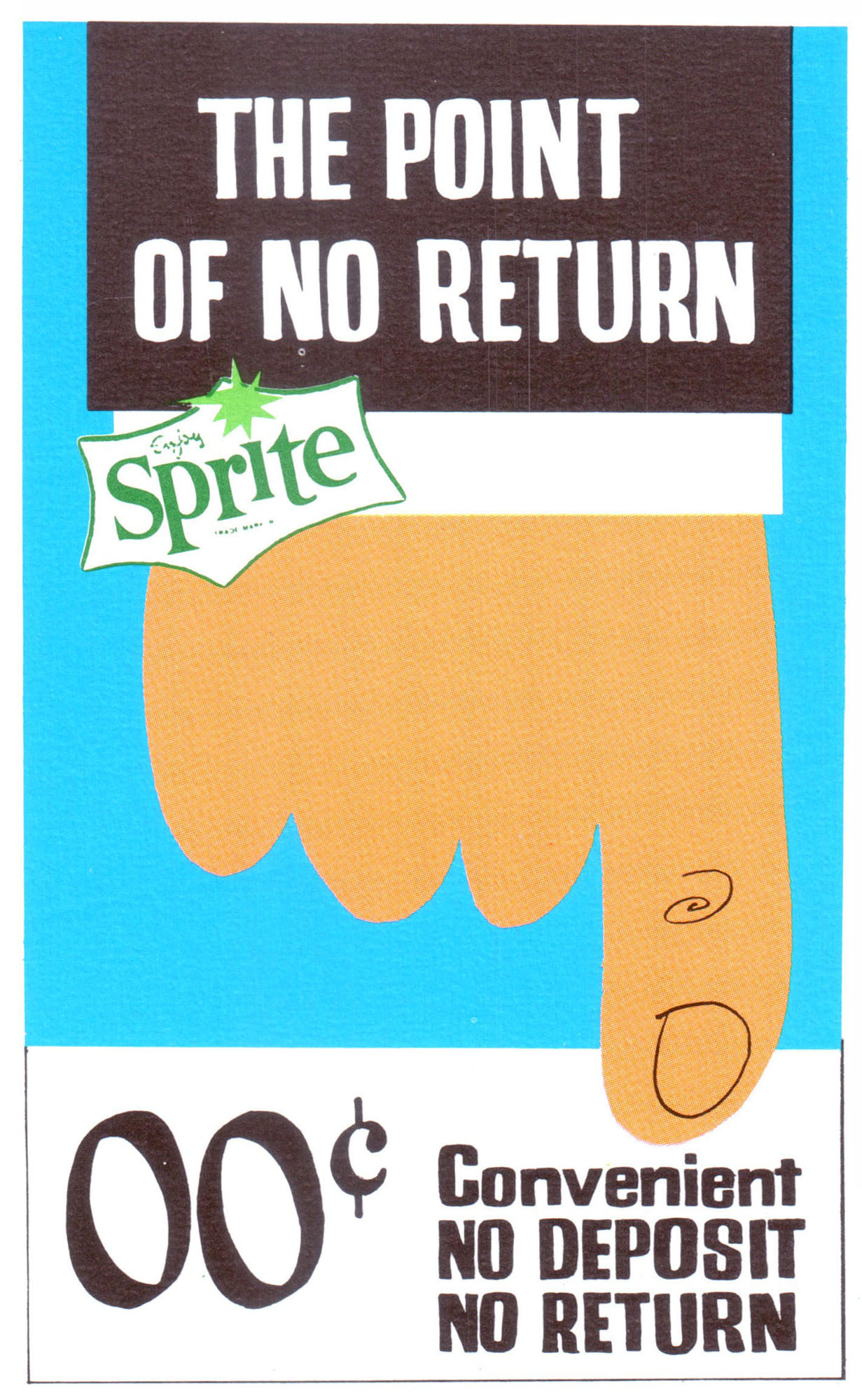
In July of 1968, The Coca-Cola Company introduced a promotion called “The Point of No Return” to attract outlets to increase sales of Sprite by offering them a convenience package message. The promotion appeared as part of the inside advertising promotions for the summer in the 1968 Advertising Price List.
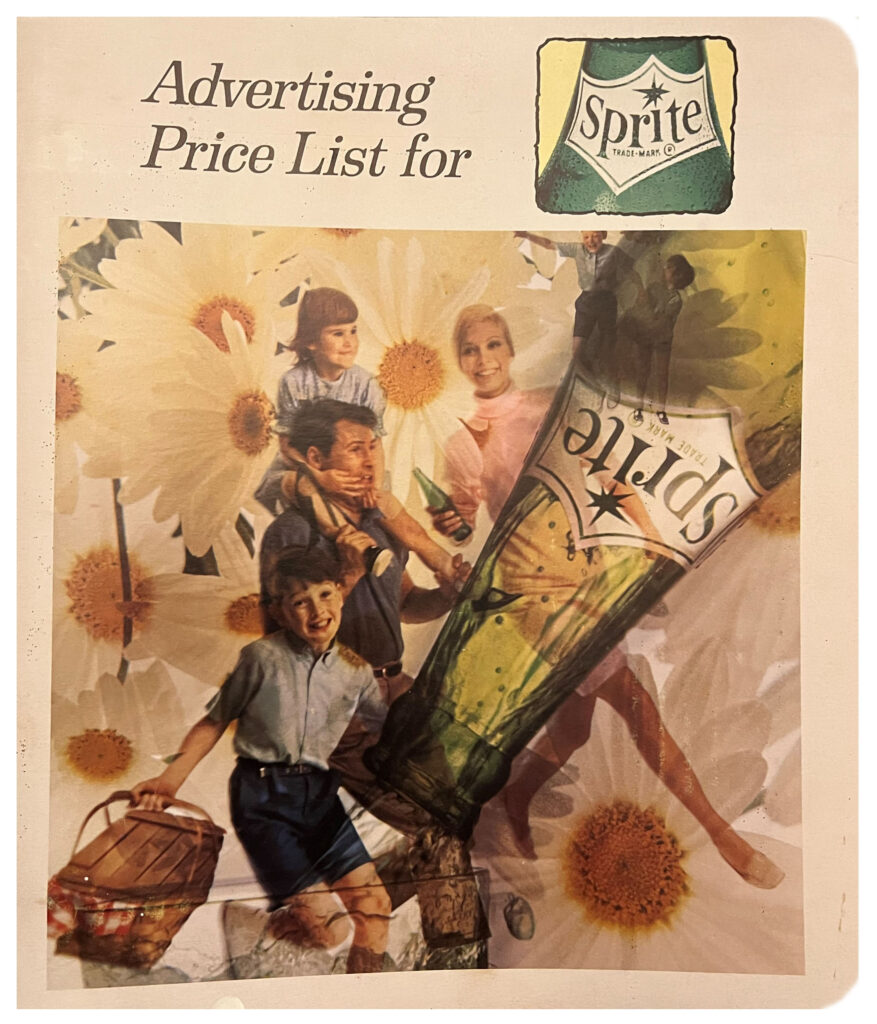
This summer, enjoy the refreshing taste of Sprite, perfect for any occasion!
Enjoy Sprite: It’s a Natural Refreshment!
The promotion featured a finger pointing in different directions over a blue background towards no deposit no return bottles and offered 4 different types of sales aids. The outlet could then write in their own pricing for each of the sales aids.
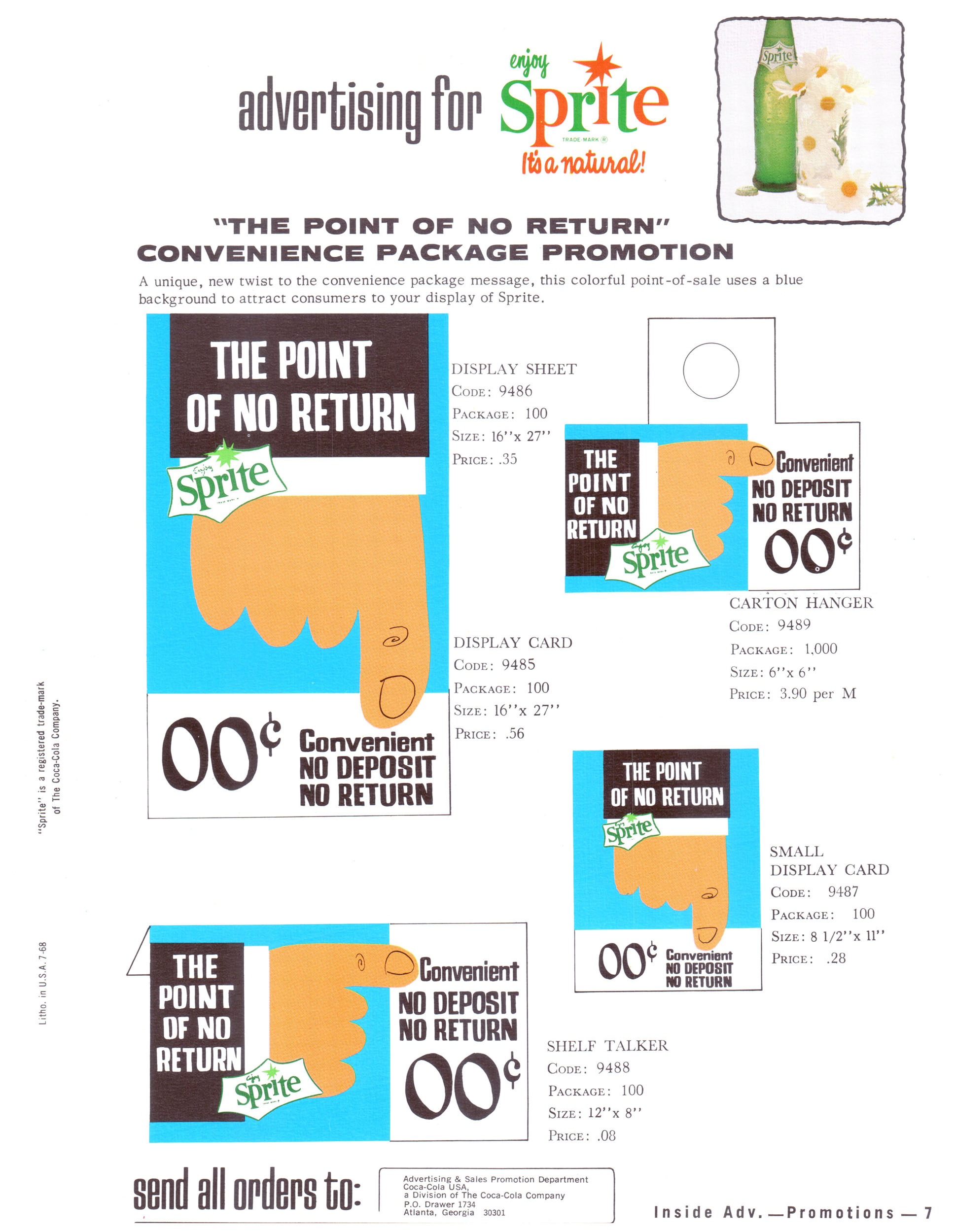
Types of Products Featured in this Promotion
This promotion featured 5 different types of sales aids (1 display sheet, 2 display cards, a shelf talker, and a carton hanger).
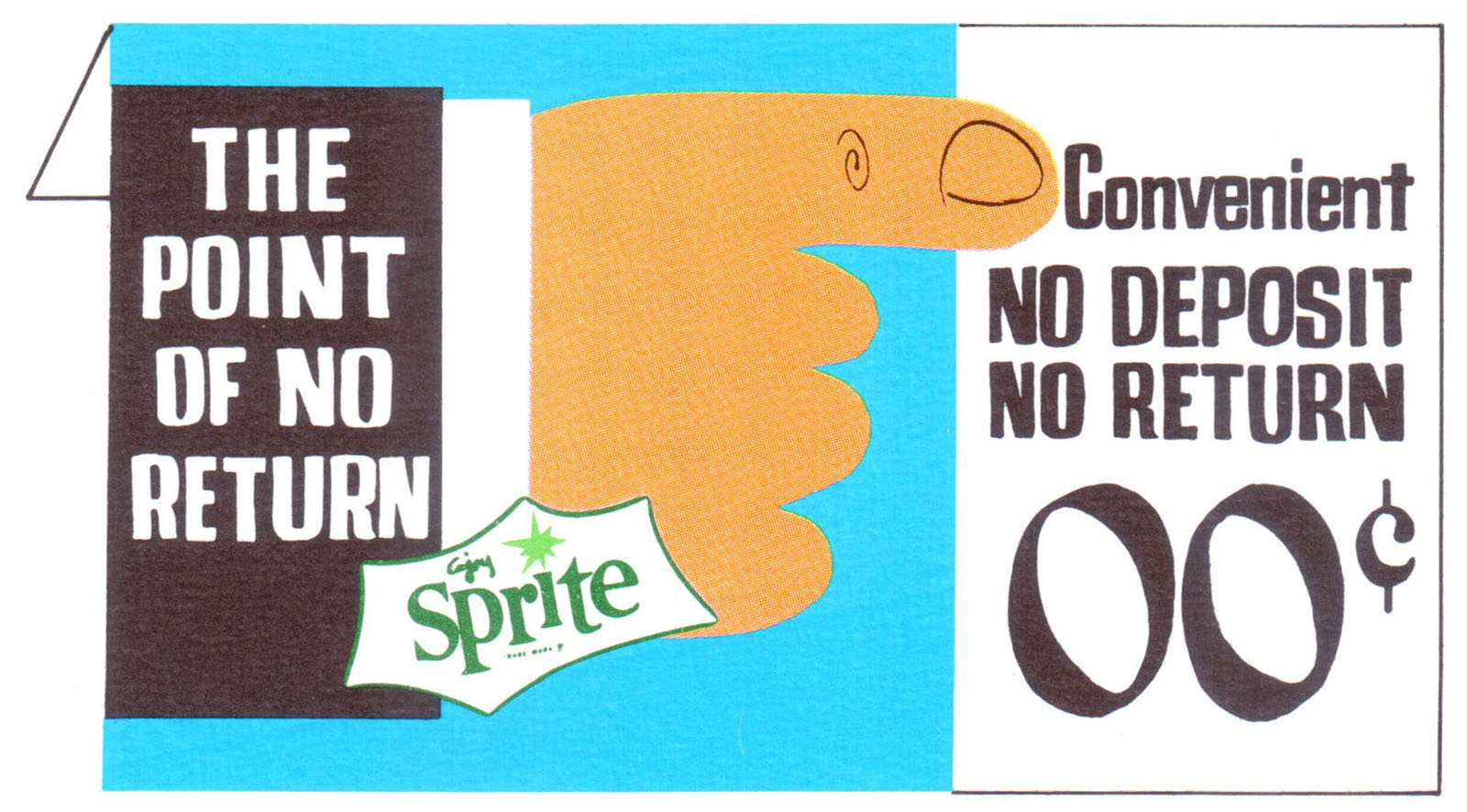
A shelf talker is a promotional tool used in retail environments, typically found in supermarkets, bookstores, or other retail outlets. It is a small sign or label attached to the edge of a shelf, usually near the product it promotes. Shelf talkers are designed to catch the attention of shoppers and provide additional information about the product, such as its benefits, special features, or promotional pricing. They often include eye-catching graphics, persuasive language, and sometimes customer reviews or endorsements to encourage purchases. Shelf talkers are effective in influencing consumer decisions at the point of purchase by highlighting key selling points directly where the product is displayed.
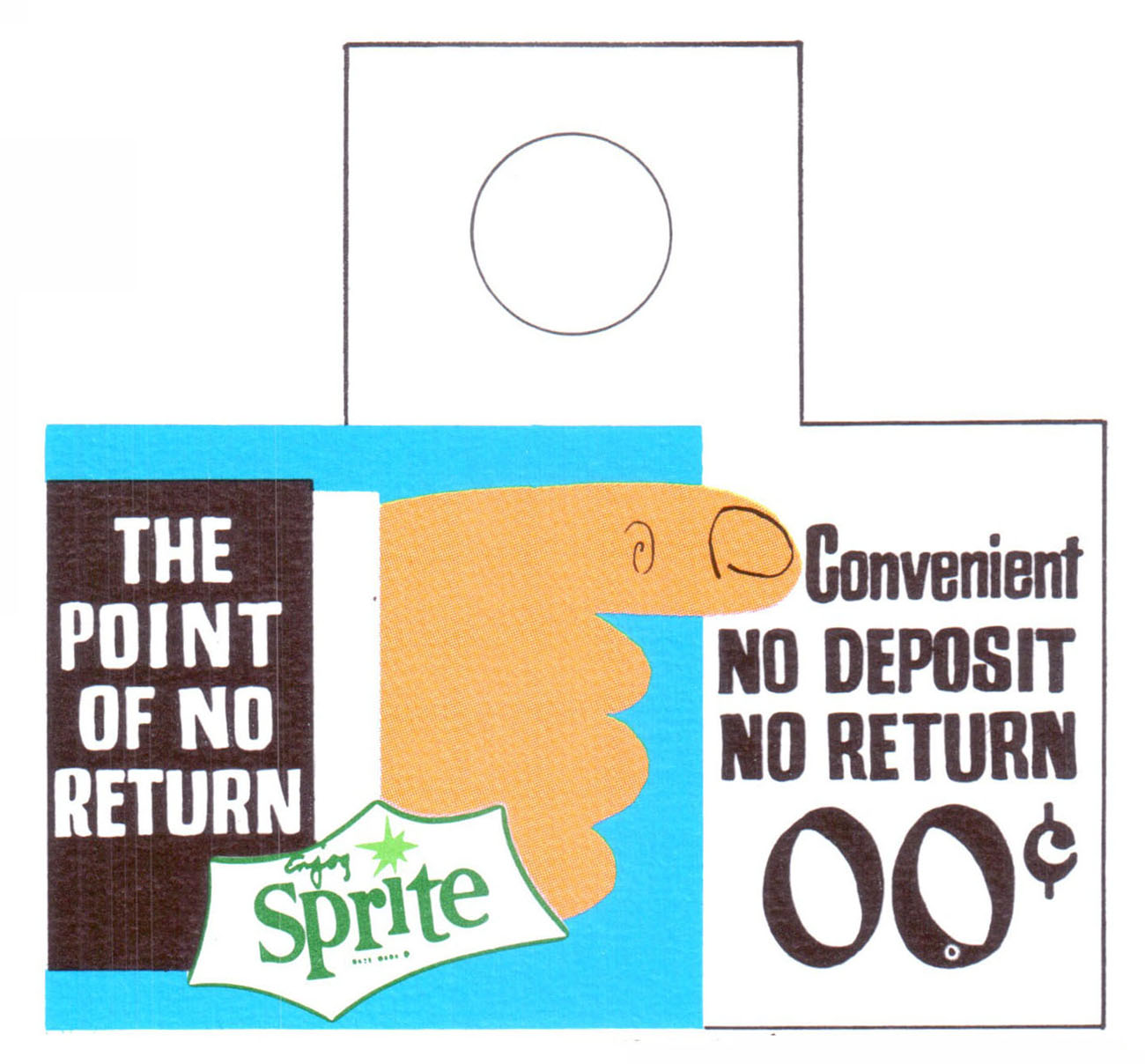
A carton hanger is a marketing and promotional tool used in retail environments, especially in supermarkets and stores where products are displayed on shelves. It is typically a cardboard or plastic piece that hangs from the edge of a shelf or a pegboard display, designed to hold and display a product’s packaging (carton) in a prominent position.
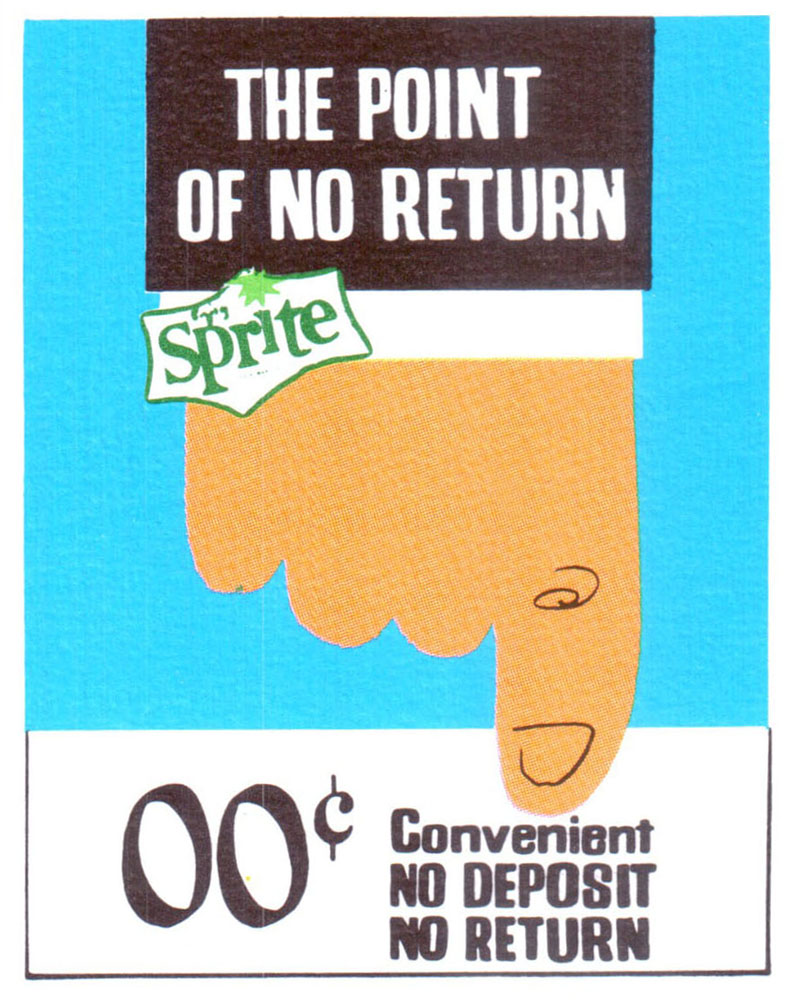
A display card is a promotional or informational tool used in retail settings to showcase products effectively. It typically consists of a sturdy piece of cardboard or paper, designed to be placed near or on a product display. Display cards can vary in size and shape but are generally larger than shelf talkers or carton hangers.
A display sheet is a promotional tool that provides details about a product or service, including pricing, features, benefits, and promotional messages. It is placed near the product to attract customer attention and inform potential buyers
Products Featured in this Promotion
The promotion was marketed as a way to offer a new twist to the convenience package message through a colorful point-of-sale blue background. The promotion specifics offered:
Learn More About the Company Brand Featured in this Story