As restaurants sought to enhance their customer experience, they turned to vintage Coca-Cola menu boards to capture the essence of this iconic brand. The 1970s were a golden age for American diners. Stainless steel counters, jukeboxes humming Fleetwood Mac, and families gathering around orange vinyl booths defined an era. But a quiet revolution was happening on the walls of these establishments, led by Coca-Cola. Enter the Marketeer Menu Boards, Coca-Cola’s mid-1970s innovation that promised versatility, style, and increased sales for restaurants of all sizes and transformed diner menus forever.
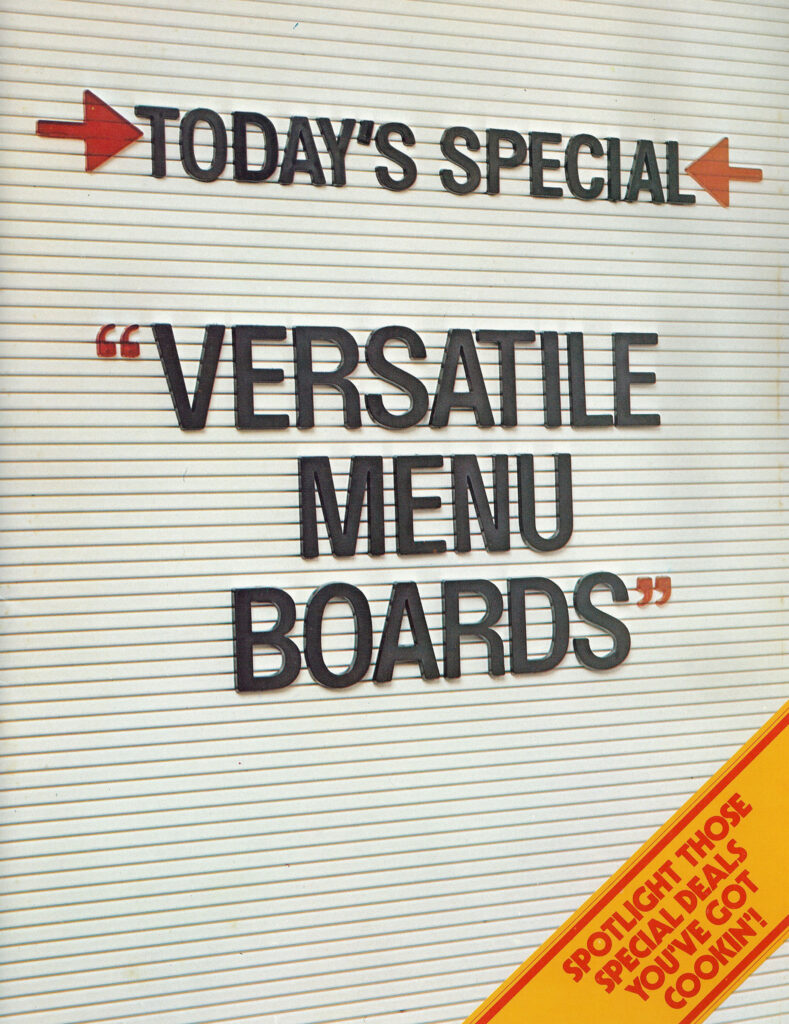
Table of Contents
- 1 Today’s Special: Versatile Menu Boards
- 2 The Shape of Things to Come
- 3 Customized Boards to Reflect Personality
- 4 Quick Promotions, Big Returns
- 5 Pictorial Inserts: Selling the Meal With the Drink
- 6 A Cultural Snapshot: Diners and Drive-Ins in the 1970s
- 7 Why the Mid-to-Late 1970s?
- 8 Legacy of the Marketeer Menu Boards
- 9 Final Reflection: Today’s Special Forever
- 10 Learn More About the Company Brand Featured in this Promotion
Today’s Special: Versatile Menu Boards
Coca-Cola’s trade catalog from the era proudly declared:
“Today’s Special: Versatile Menu Boards”
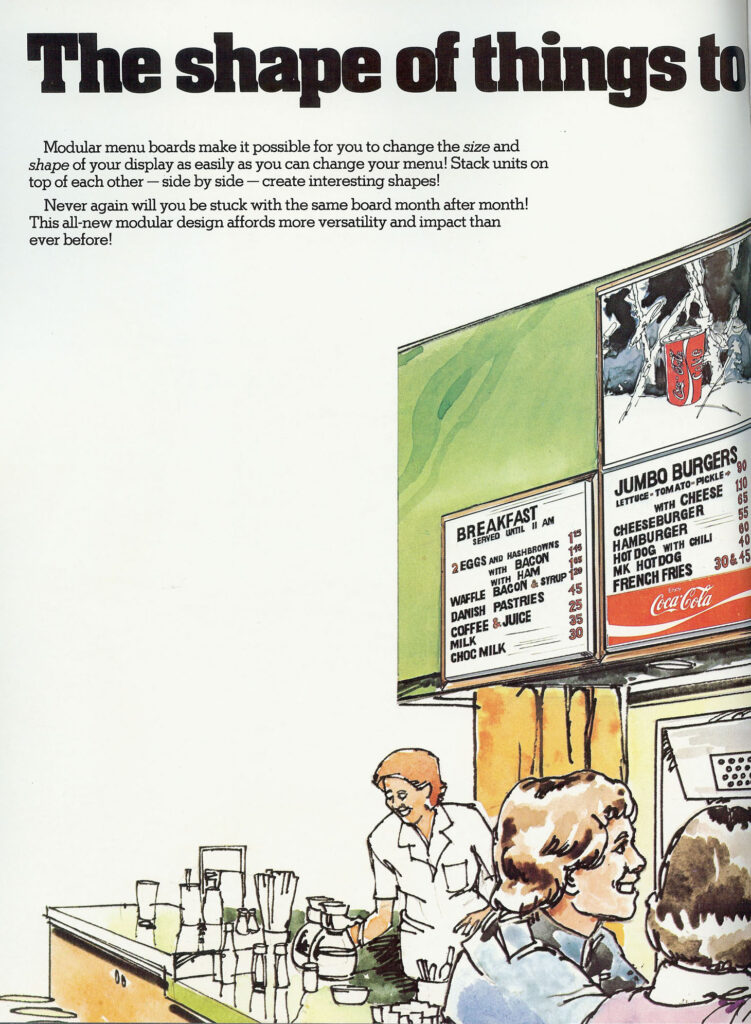
These were more than just static signs. Designed with interchangeable panels and crisp typography, they allowed restaurateurs to update menus daily, without needing a new board.
The Shape of Things to Come
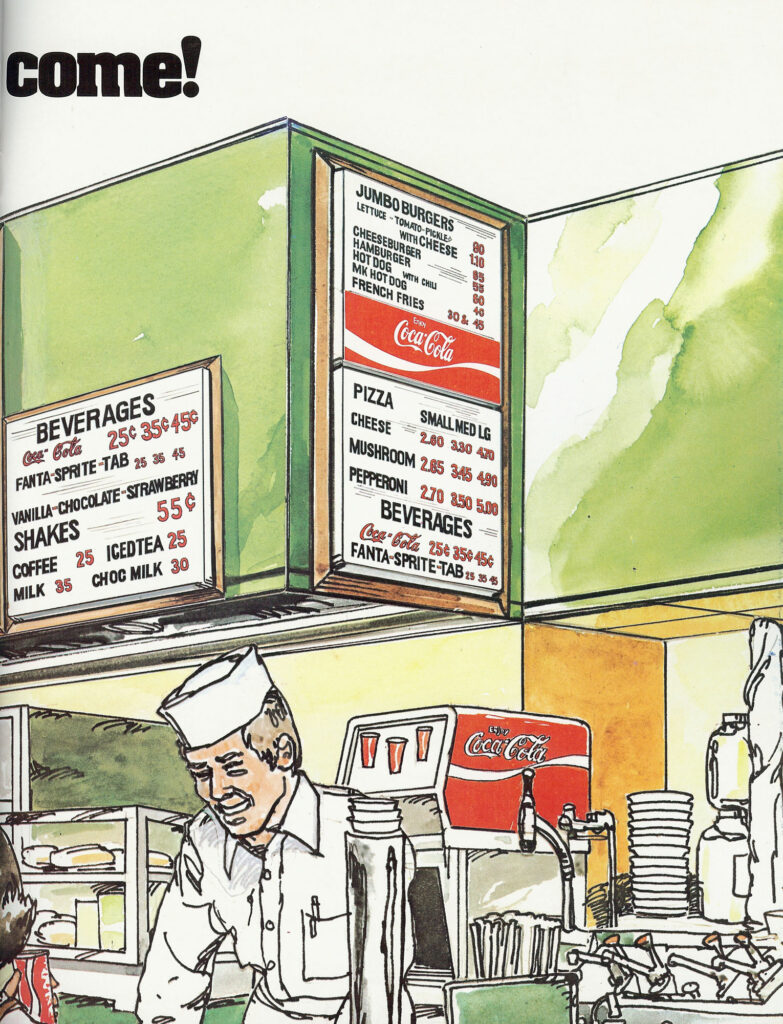
Illustrations in the catalog showed families enjoying burgers and fries under gleaming white menu boards with prices like:
- Jumbo Burger – 90¢
- Cheeseburger – $1.10
- French Fries – 30¢
The Coca-Cola logo, in its bold red script, anchored every board, linking quality beverages to hearty meals.
Customized Boards to Reflect Personality
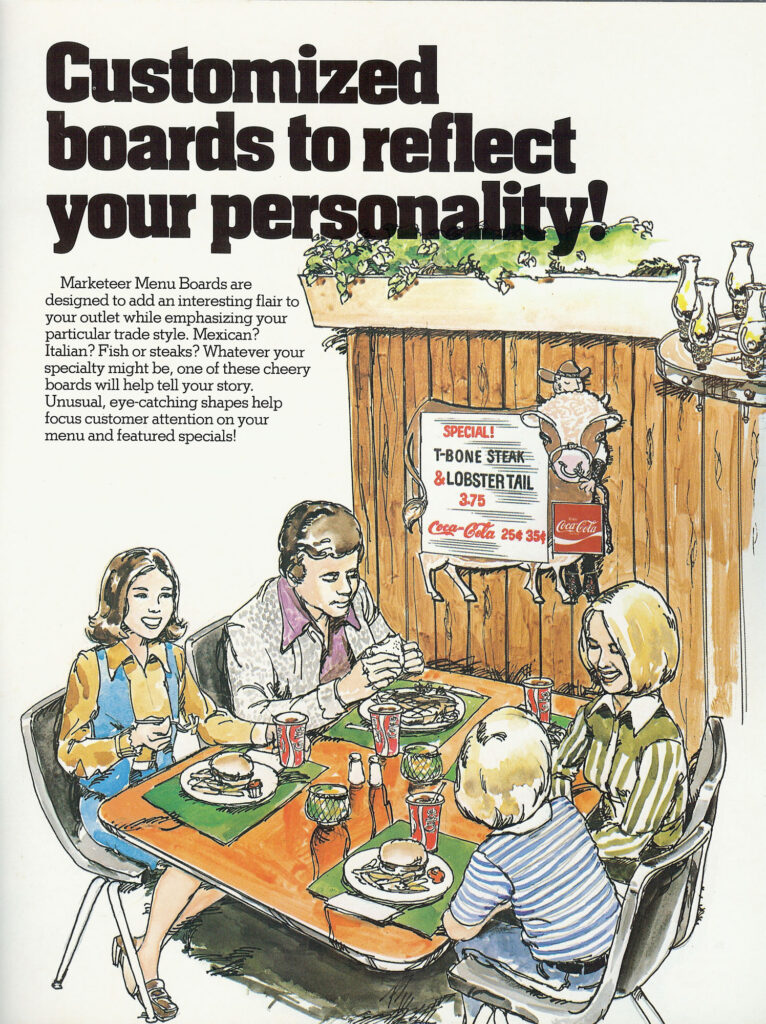
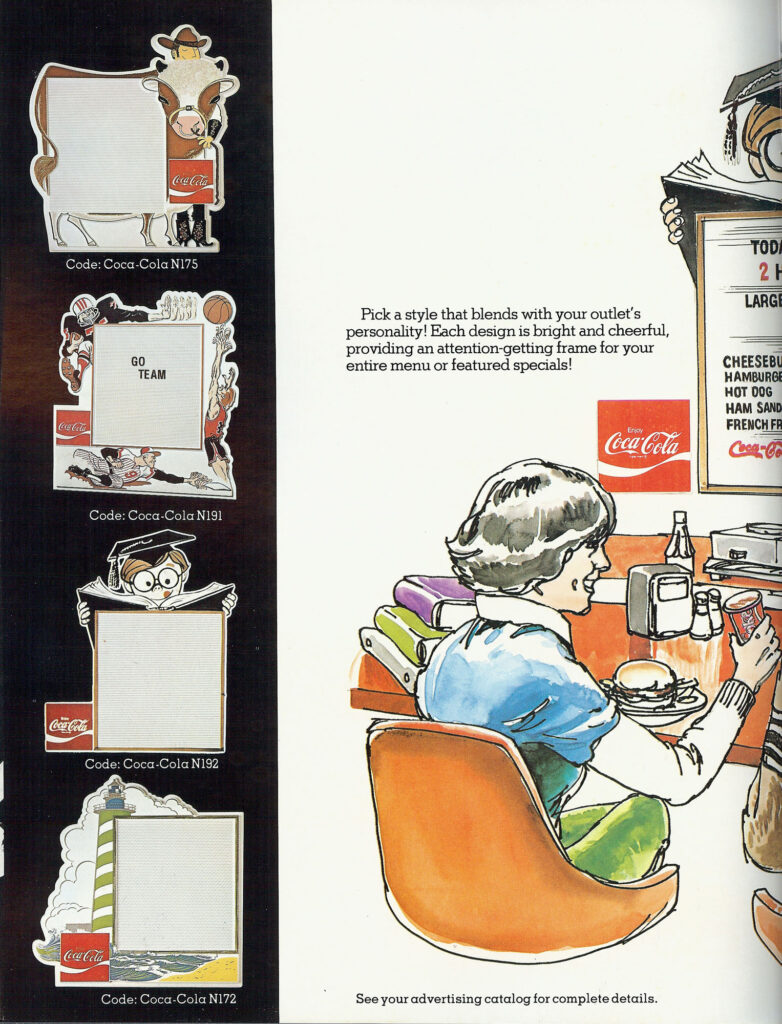
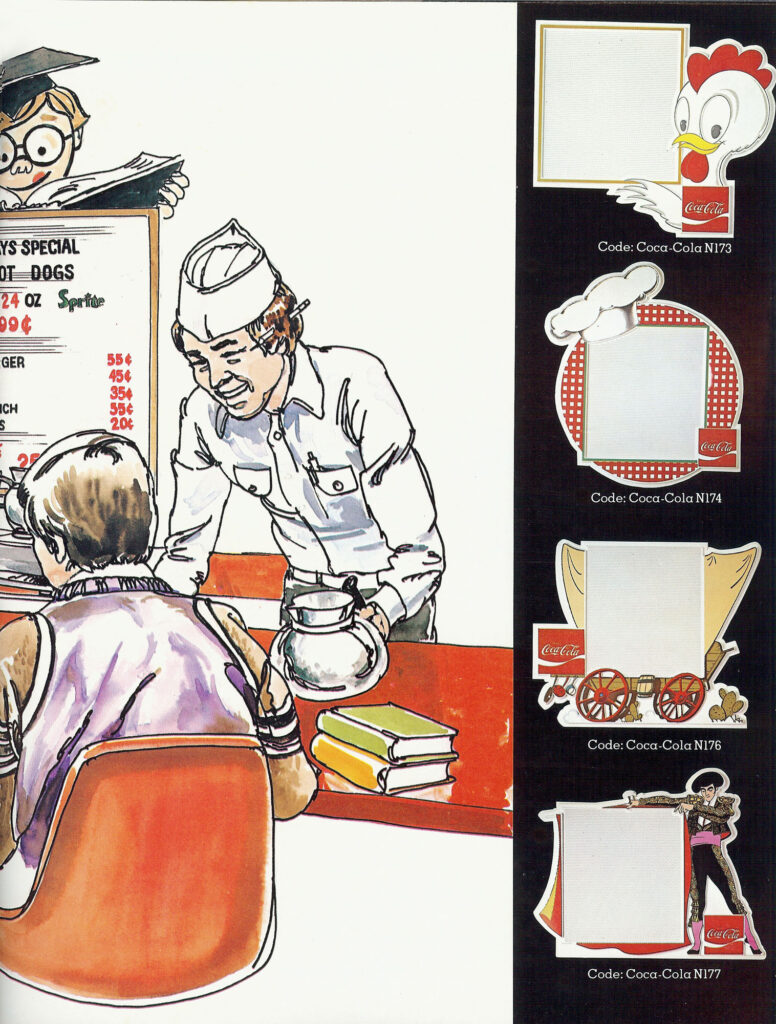
Themed frames gave eateries personality:
- 🐮 Cow-shaped boards for steakhouses
- 🏖️ Lighthouse motifs for coastal diners
- 🎓 Graduation caps for college cafés
- 🤠 Covered wagons for western BBQ joints
These designs weren’t just functional, they were marketing tools.
Quick Promotions, Big Returns
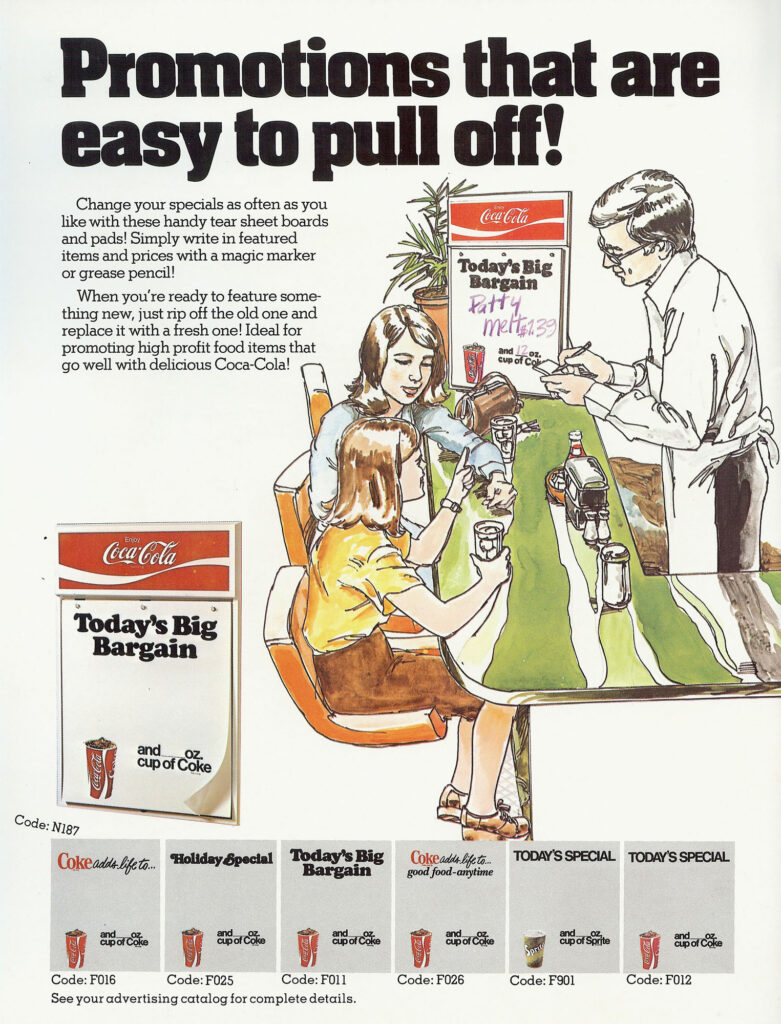
With tear-sheet boards and grease-pencil inserts, specials could be written and erased daily. A few of the combos featured:
- 🍗 Fried Chicken & Coke
- 🌮 Tacos & Coke
- 🍔 Patty Melt & Coke
Coca-Cola wasn’t just selling soda; they were selling higher margins and a branded experience.
Pictorial Inserts: Selling the Meal With the Drink
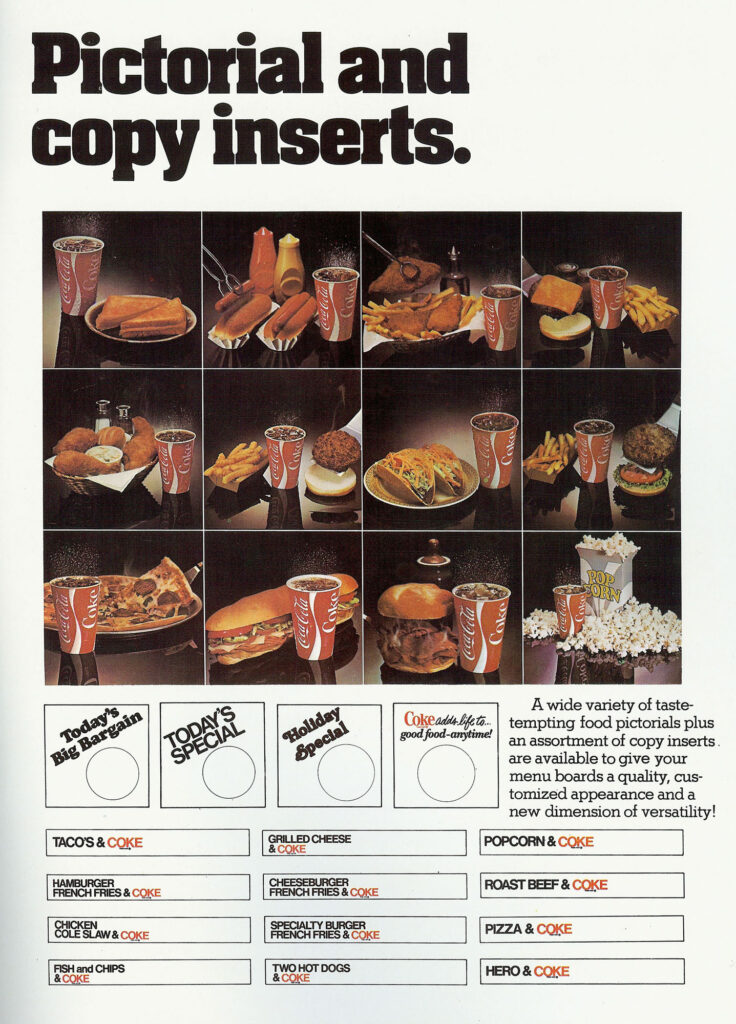
High-quality photo inserts showed:
- Golden fried chicken next to an ice-cold Coke.
- Pepperoni pizza paired with Coca-Cola.
- Burgers, fries, and paper Coke cups under bright diner lights.
These inserts helped even small diners look as professional as rising fast-food chains.
A Cultural Snapshot: Diners and Drive-Ins in the 1970s
Molded chairs, chrome soda fountains, paper hats, these visuals captured more than menus. They documented an era of community, affordability, and Americana, where a family meal out cost under $5.
Why the Mid-to-Late 1970s?
“Coke adds life” slogan debuted in 1976.
- TAB and Fanta branding mirror Coca-Cola’s 70s product lineup.
- Prices match pre-inflation dining costs.
- Soft watercolor illustrations echo 1970s advertising styles.
By 1982, digital menus and Diet Coke would usher in a new era. But in these pages, Coca-Cola reigned supreme.
Legacy of the Marketeer Menu Boards
Today, surviving examples of these boards are rare collectibles. Yet their influence lives on in digital menu systems and co-branded promotions worldwide.
Final Reflection: Today’s Special Forever
The Marketeer Menu Boards remind us of an age where even the simplest diner could feel modern, professional, and enticing, thanks to Coca-Cola.
“Today’s Special isn’t just on the plate, it’s on the wall, sparking cravings and sealing the deal with a Coca-Cola.”
Learn More About the Company Brand Featured in this Promotion
A vintage vending revolution was happening in mid-20th century America. Vending machines were more than just conveniences, they were cutting-edge tools for boosting sales. Among them, the Salesmaker vending machines, built by Highway Steel Products Company in Chicago Heights, Illinois, stood out for their sleek design and bold promises. As the popularity of Dr Pepper surged, vending machines became essential for reaching a wider audience.
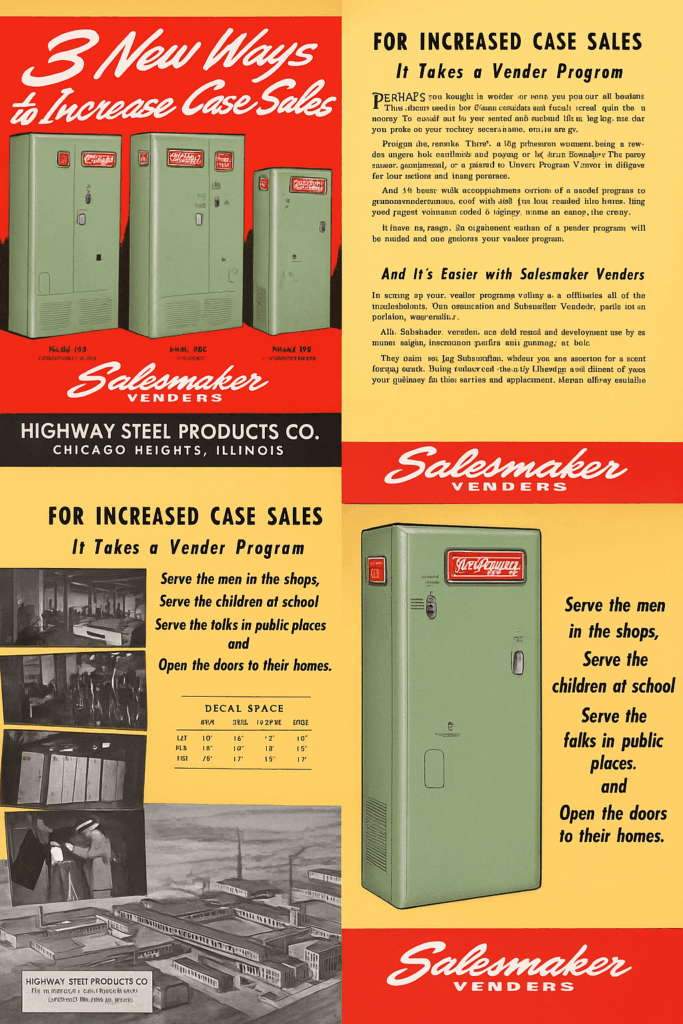
The vibrant Dr Pepper branding on these machines drew attention and increased sales for bottlers.
With their pale-green steel frames and the iconic red Dr Pepper logo, these machines became symbols of efficiency and modernity. Promising bottlers “3 New Ways to Increase Case Sales,” they offered a new vision in 1949 for soft drink distribution at factories, schools, and public spaces.
Table of Contents
- 1 The Chicago Heights Advantage: Highway Steel’s Industrial Hub
- 2 The Salesmaker Vender Program: A Game-Changer for Soda Bottlers
- 3 Why Dr Pepper Chose Salesmaker Venders
- 4 Built in Chicago Heights: Designed for Durability
- 5 “Serve the Men in the Shops…”
- 6 The Legacy of Salesmaker Vending Machines and Highway Steel
The Chicago Heights Advantage: Highway Steel’s Industrial Hub
Founded in 1924, Highway Steel Products Company grew up alongside Chicago’s rise as a national manufacturing powerhouse. Its factory in Chicago Heights, Illinois, a city 30 miles south of downtown Chicago, was perfectly situated in the dense web of railroads, highways, and industrial supply chains that defined the region.
Chicago Heights was a quintessential Rust Belt city, home to steel mills, foundries, and assembly plants. For Highway Steel, this meant access to skilled labor, raw materials, and shipping routes that could quickly move finished vending machines across the Midwest.
The company specialized in manufacturing durable metal products, and by the 1950s, its Salesmaker line had become a flagship offering. Every Salesmaker vending machine was stamped with this regional heritage: designed, tooled, and assembled under the same roof in Chicago Heights. This vertical integration allowed Highway Steel to control quality, reduce costs, and promise bottlers fast delivery, a critical edge in a competitive vending market.
The Salesmaker Vender Program: A Game-Changer for Soda Bottlers
The 1949 Salesmaker vending program wasn’t just about machines, it was a strategy. Highway Steel’s marketing directly addressed bottlers who had struggled with earlier vending efforts.
“Perhaps you bought a vender or two… and came up with a big red figure,” the copy confessed. Their solution? A full-scale “Vender Program” to deploy vending machines across key locations.
With options like the Model 197 (nine cases, one flavor), Model 297 (eight cases, two flavors), and Model 193 (four cases, one flavor), bottlers could tailor machine placement to different environments.
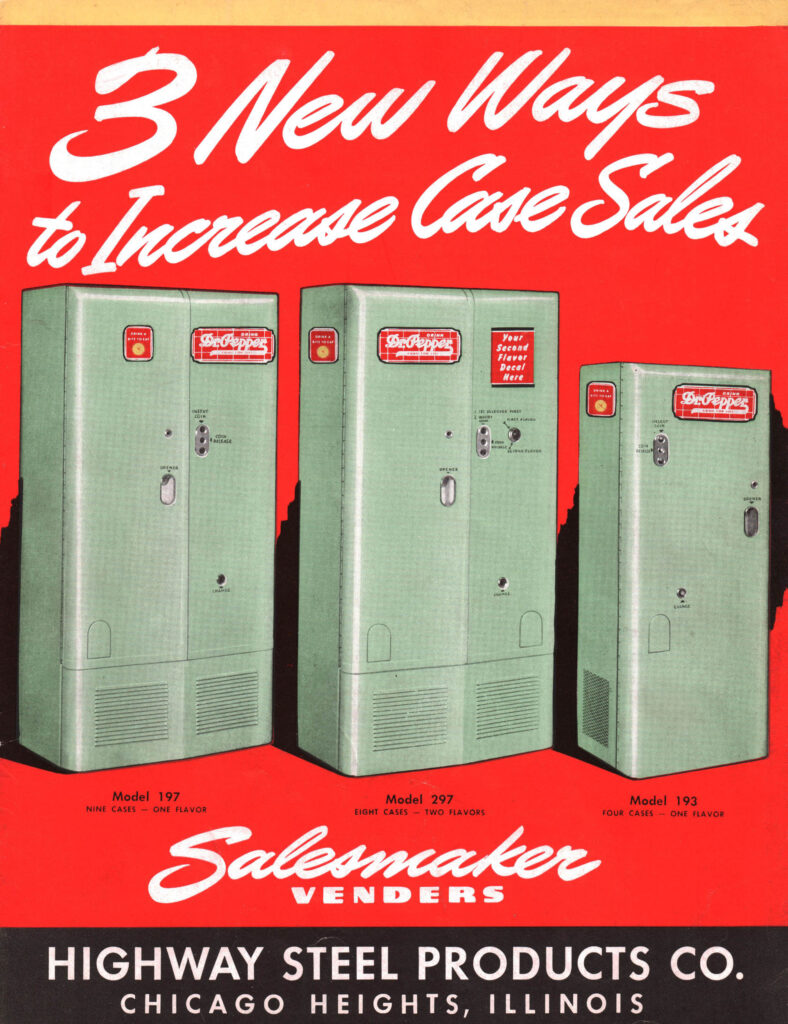
The unique flavors of Dr Pepper paired perfectly with the accessibility of vending machines. Featuring Dr Pepper prominently, these machines captured the interest of potential customers.
Why Dr Pepper Chose Salesmaker Venders
By the late 1940s, Dr Pepper was carving its niche in the competitive soda market. Its unique blend of 23 flavors and quirky marketing, including the famous “10-2-4” slogan, made it a natural fit for vending innovation.
Aligning with Highway Steel Products gave a chance to scale up. The Salesmaker vending machines placed the brand directly in the hands of workers on factory floors, students in school halls, and travelers in public spaces.
This partnership also anchored the expansion in the industrial Midwest. From Chicago Heights, Highway Steel shipped vending machines to bottlers nationwide, helping build a stronger presence in urban markets and small towns alike.
Built in Chicago Heights: Designed for Durability
Highway Steel’s Chicago Heights plant emphasized durability and design. Their machines featured:
✅ Interchangeable parts to simplify repairs
✅ Front-loading service panels for fast maintenance
✅ Heavy-gauge steel construction for years of service
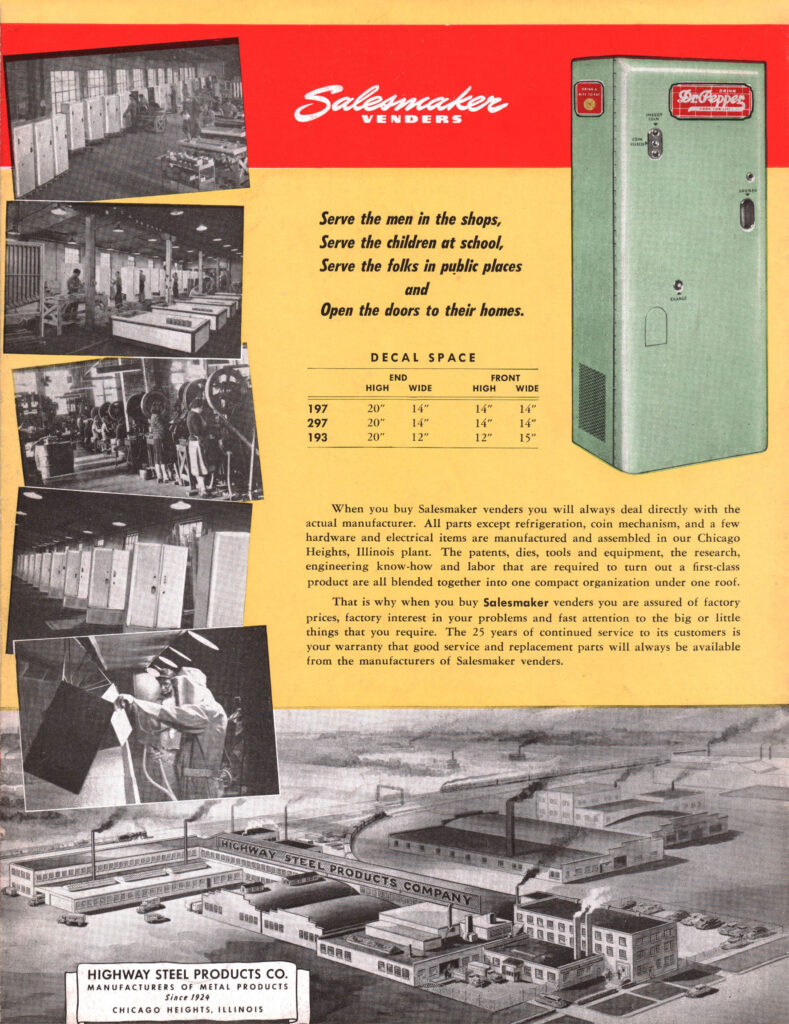
“All parts except refrigeration and coin mechanisms are manufactured in our Chicago Heights plant,” one ad declared. For bottlers, this meant fewer supply chain headaches and faster access to replacement parts.
The company claimed that with good locations, the machines could “pay for themselves in two years or less.” And their compact footprint made them ideal for smaller spaces, an asset in crowded urban environments like Chicago.
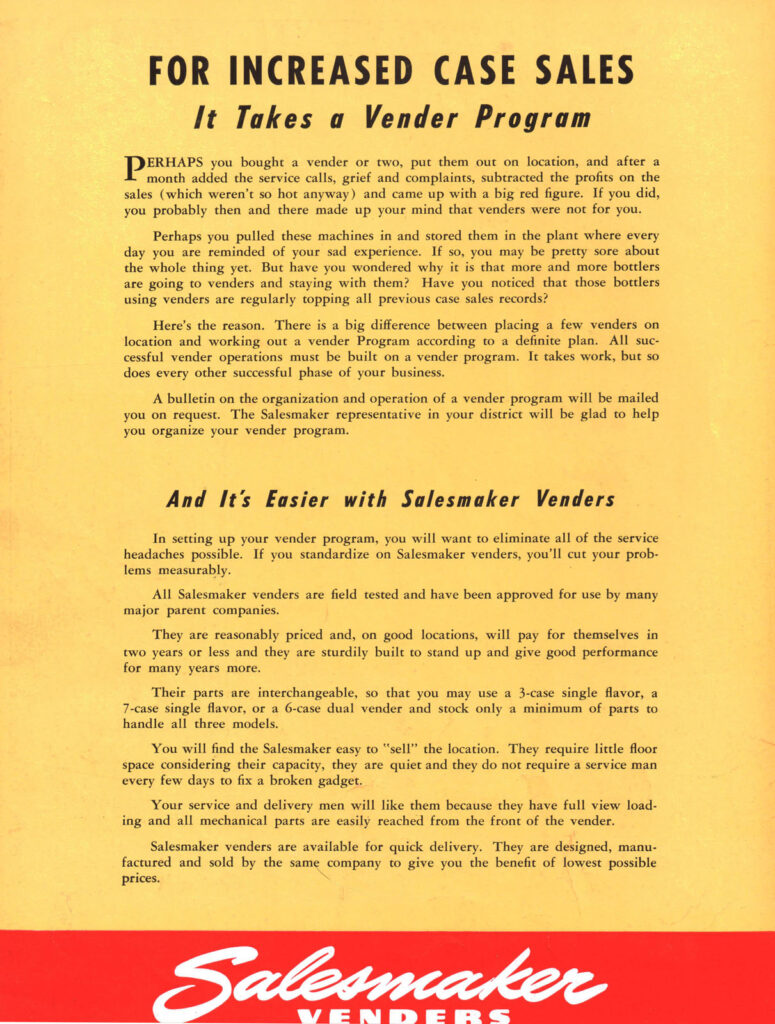
Sales of Dr Pepper flourished as machines became fixtures in various locations.
Dr Pepper remains a nostalgic favorite for those who remember using these vending machines.
“Serve the Men in the Shops…”
One memorable tagline summed up the mission:
“Serve the men in the shops, serve the children at school, serve the folks in public places and open the doors to their homes.”
While few machines ever made it into private homes, they became a fixture in workplaces and public venues. The strategy worked, driving Dr Pepper’s visibility in untapped markets and giving Highway Steel Products a firm foothold in the vending industry.
The Legacy of Salesmaker Vending Machines and Highway Steel
Today, surviving Salesmaker vending machines are rare and prized by collectors of vintage vending machines and memorabilia. Their mid-century aesthetic, muted green panels with red accents, evokes nostalgia for a time when steel and soda symbolized modernity.
The Highway Steel Products Company may no longer operate in Chicago Heights, but its impact lingers in these sturdy artifacts of mid-century design. These vending machines tell a larger story about American industry, how small city factories like those in Chicago Heights powered national brands and redefined daily life.
In many ways, Salesmaker venders were predecessors of today’s on-demand culture. They promised a seamless transaction: a nickel in, a cold drink out. That promise, both alluring and fragile, still resonates in our age of apps and instant delivery.
Discover the history of Coca-Cola’s iconic 2-liter Bonus Bottle campaign from the late 1970s. Learn how this bold marketing strategy changed beverage packaging forever and explore the point-of-sale (POS) materials that brought it to life in grocery stores across America. As part of this campaign, the Coca-Cola 2 liter bottle became a symbol of consumer value.
Table of Contents
The Spark of Innovation
The introduction of the Coca-Cola 2 liter bottle marked a significant shift in beverage packaging.
In 1979, America was in transition. The vibrant optimism of the early 1970s had given way to economic challenges, energy crises, and shifting consumer priorities. Amidst these changes, Coca-Cola prepared to launch one of its most ambitious innovations yet: the 2-liter glass Bonus Bottle.
Shoppers quickly recognized the benefits of the Coca-Cola 2 liter bottle for family gatherings.It offered a practical solution for families, making the coca-cola 2 liter bottle a staple in homes.

It became synonymous with festive gatherings, where the Coca-Cola 2 liter bottle was often the drink of choice.
By the late 1970s, Coca-Cola had been a household name for nearly a century, but the beverage industry was evolving. Competitors like Pepsi were advancing with campaigns such as the “Pepsi Generation,” while private-label sodas chipped away at Coca-Cola’s market share with aggressive pricing.
The coca-cola 2 liter bottle quickly became a favorite for parties and events.
People loved the Coca-Cola 2 liter bottle for its affordability and convenience.
Consumers were also seeking more convenience and value, larger packages for family use, bulk savings, and products designed for a home-centered lifestyle. Coca-Cola needed a marketing strategy that could address these needs and cement its position as the market leader.
The solution was the 2-liter glass bottle, unprecedented in size for soft drinks. Heavy and substantial, it offered 5% more soda than the popular 64-ounce size for the same price, appealing to value-conscious shoppers.
The Marketing Campaign
The Coca-Cola 2 Liter Bottle: A Game Changer in Beverage Packaging
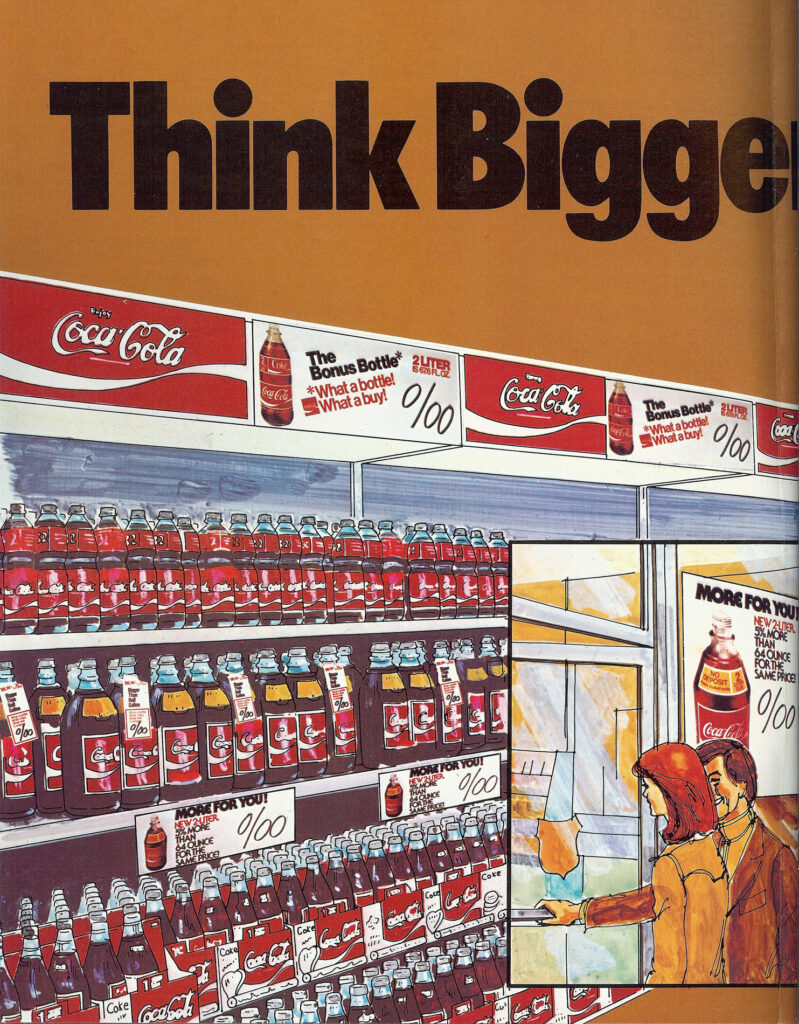
To introduce the Bonus Bottle, Coca-Cola launched a bold point-of-sale (POS) marketing campaign under the slogan “Think Bigger.”
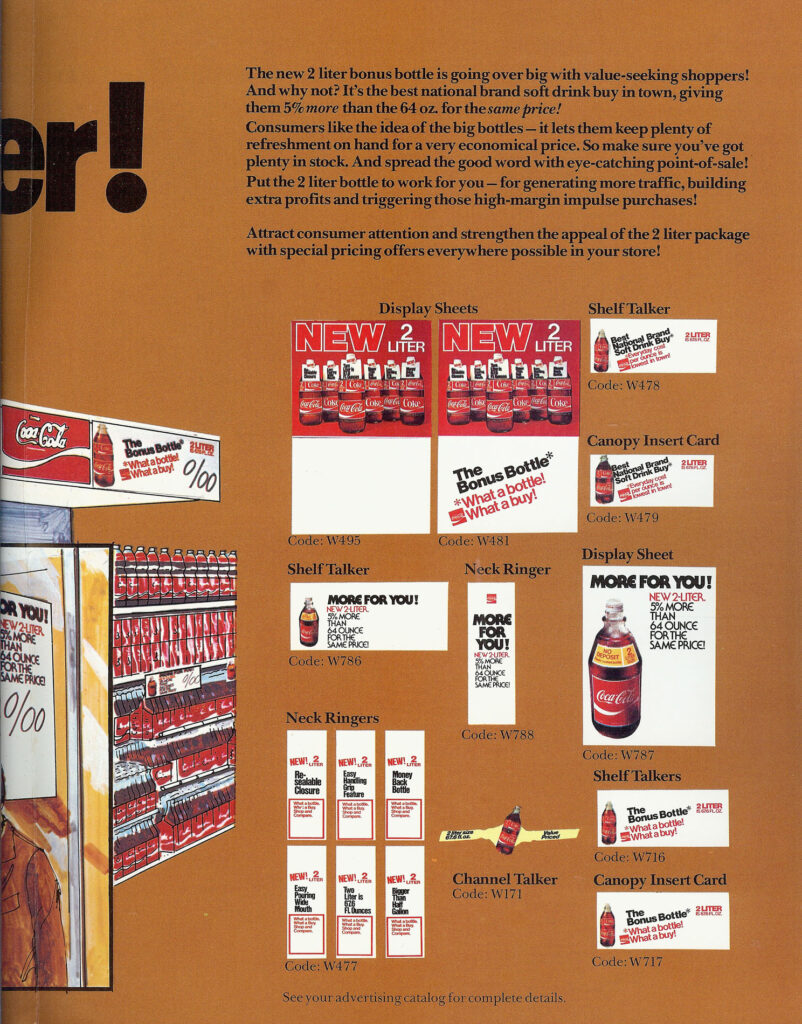
This was not just an advertising effort aimed at consumers; it was a comprehensive merchandising strategy for retailers. Coca-Cola provided an array of promotional materials to transform store displays into attention-grabbing marketing zones:
- Shelf Talkers – Eye-catching signs for grocery shelves.
- Neck Ringers – Promotional tags placed around bottle necks.
- Canopy Insert Cards – Visuals for coolers and aisles.
- Display Sheets – Posters and banners encouraging multi-bottle purchases.
Each item carried catalog codes like W478 (shelf talker), W479 (canopy insert), and W786 (the iconic “MORE FOR YOU!” signage).
Today, the Coca-Cola 2 liter bottle remains a nostalgic reminder of the past.
The messaging was designed to resonate with shoppers:
“The Bonus Bottle. What a bottle! What a buy!”
“More for you! New 2 Liter—5% more than 64 oz. for the same price!”
Supermarkets across North America were encouraged to create bold, high-visibility displays of 2-liter glass Coca-Cola bottles, ensuring the Bonus Bottle was impossible to overlook.
The Grocery Store Revolution
As the campaign rolled out, the 2-liter Coca-Cola bottles began appearing in aisles from coast to coast. They were stacked under large “Think Bigger” banners, creating a striking visual presence.
The bottles themselves were distinctive. Made of thick, returnable glass, each one featured an embossed message around its neck: “RETURN FOR DEPOSIT.” The substantial weight and cool surface gave the impression of quality and abundance.
This packaging wasn’t merely functional; it became a symbol of value and family togetherness during a period of rising grocery bills and cultural shifts toward bulk purchasing.
The POS advertising materials reinforced Coca-Cola’s branding at every shopper touch point, from store entrances to checkout lanes.
Cultural Shifts in Beverage Marketing
The appeal of the Coca-Cola 2 liter bottle transcended generations, remaining popular among new consumers.
As trends shifted, the Coca-Cola 2 liter bottle still held its ground as a consumer favorite.
It continues to represent value in the beverage market, the Coca-Cola 2 liter bottle is still recognized for its size and affordability.
The Bonus Bottle campaign wasn’t just a marketing triumph; it reflected broader changes in American consumer habits. The preference for larger sizes paralleled trends in other consumer goods as families sought to stretch budgets and reduce shopping frequency.
However, while the 2-liter glass bottle succeeded in creating impact, it also revealed challenges. Its weight and fragility complicated transportation and storage. By 1982–1983, Coca-Cola and competitors began transitioning to lighter, unbreakable PET plastic bottles, signaling another packaging revolution.
Despite its relatively short lifespan, the glass 2-liter left a strong impression. Its hefty, the sound of glass clinking in shopping carts, and the ritual of twisting open its cap became part of household memories.
The Legacy of Coca-Cola’s “Think Bigger” Campaign
Ultimately, the Coca-Cola 2 liter bottle has left an indelible mark on beverage history.
As we reflect on its legacy, the Coca-Cola 2 liter bottle will always be part of our collective memories.
Today, the “Think Bigger” campaign is remembered as a pivotal moment in Coca-Cola’s history. It showcased the company’s ability to innovate both in product packaging and retail merchandising.
Collectors prize original POS materials from the campaign, shelf talkers, neck ringers, and banners, as artifacts of a bygone era. These items reflect the design language of the late 1970s, with bold sans-serif fonts, warm earthy colors, and hand-drawn illustrations of bustling grocery aisles.
The Bonus Bottle also represents a time when glass dominated the beverage industry, just before plastic transformed into how the world consumed soft drinks.
A Snapshot in Coca-Cola History
The 2-liter Bonus Bottle and its accompanying POS marketing materials stand as snapshots of a cultural and commercial moment. They represent not just a new package size but a strategic response to a changing world.
In retrospect, the campaign’s success lies in its simplicity and boldness, proof that even a century-old brand could “Think Bigger” and redefine its place in the market.
Learn More About the Company Brand Featured in this Promotion
In August of 1959, the Outdoor Advertising Incorporated (OAI) company released its latest promotion for the Fall of 1959. This promotion aimed to promote Coca-Cola through outdoor advertising and billboards featuring the iconic 1959 Coke Billboards.
The promotion was called Star Performers Build Sales for You. It highlighted that in the Fall of 1959, the bright lights of the entertainment industry and outdoor advertising would team up as the McGuire Sisters to sell Coca-Cola to America.
By blending the 3 McGuire Sisters singers with the selling power of outdoor advertising, the Coca-Cola Company aimed to create a powerful combination for their outdoor posters.
Table of Contents
- 1 Posters that Build Sales of Coca-Cola
- 2 All Year Long Around the Clock Star Performers Sell for You
- 3 Outdoor Posters Create Top Level Readership
- 4 Posters Advertising Coca-Cola Outscored Other Posters by 32% in First Half of 1959
- 5 Posters with Real Consumer Impact – The 1959 Line Up
- 6 Learn More About the Company Brand Featured in this Promotion
Posters that Build Sales of Coca-Cola
The 1959 Coke Billboards became a symbol of the advertising strategies employed by Coca-Cola to capture the attention of consumers and create lasting impressions.
The promotion was targeted at Coca-Cola bottlers. An introduction to the promotion detailed the history of Coca-Cola using outdoor poster advertising.
Because their audience grows automatically with population increases, 24-sheet posters are uniquely inexpensive compared to other media.
In 1925, The Coca-Cola Company first offered Bottlers of Coca-Cola a chance to participate in an advertising medium. This medium consisted of 24-sheet posters, with total expenditure amounting to $453,886.76. This offer has never been withdrawn, and spending grew to $3,372,412.19 by 1958.
This history represents the most consistent use of any advertising medium, with expenses shared between The Coca-Cola Company and the Bottlers of Coca-Cola.
There must be some kind of reason for such consistency, and there was. Posters have proven to be unique in several respects and have successfully served Coca-Cola.
For instance, they are the only medium that allows advertisers to capture consumer attention while they move from inside their homes to the point-of-sale.
Their size gives advertisers like The Coca-Cola Company a highly desirable dominance and prestige. Their distribution allows the message to stay with consumers while they move about outdoors.
Additionally, their use of full-color printing presents the product in a realistic and appetizing manner.
The Outdoor Advertising Incorporated company felt that the decade of the fabulous 1960s would see disposable income growing by leaps and bounds and advertising’s responsibility to secure a fair share for Coca-Cola becoming increasingly heavy. Under such circumstances, they felt that any advertiser would find themselves particularly obligated to look at the poster medium as not only one of the most effective media but, in all probability, the most economical one for doing this kind of job.
The Outdoor Advertising Incorporated company anticipated that the fabulous 1960s would see disposable income growing significantly. They believed advertising’s responsibility to secure a fair share for Coca-Cola would become increasingly critical.
Under such circumstances, they felt any advertiser would find themselves particularly obligated to consider the poster medium as one of the most effective and economical options for this task.
All Year Long Around the Clock Star Performers Sell for You
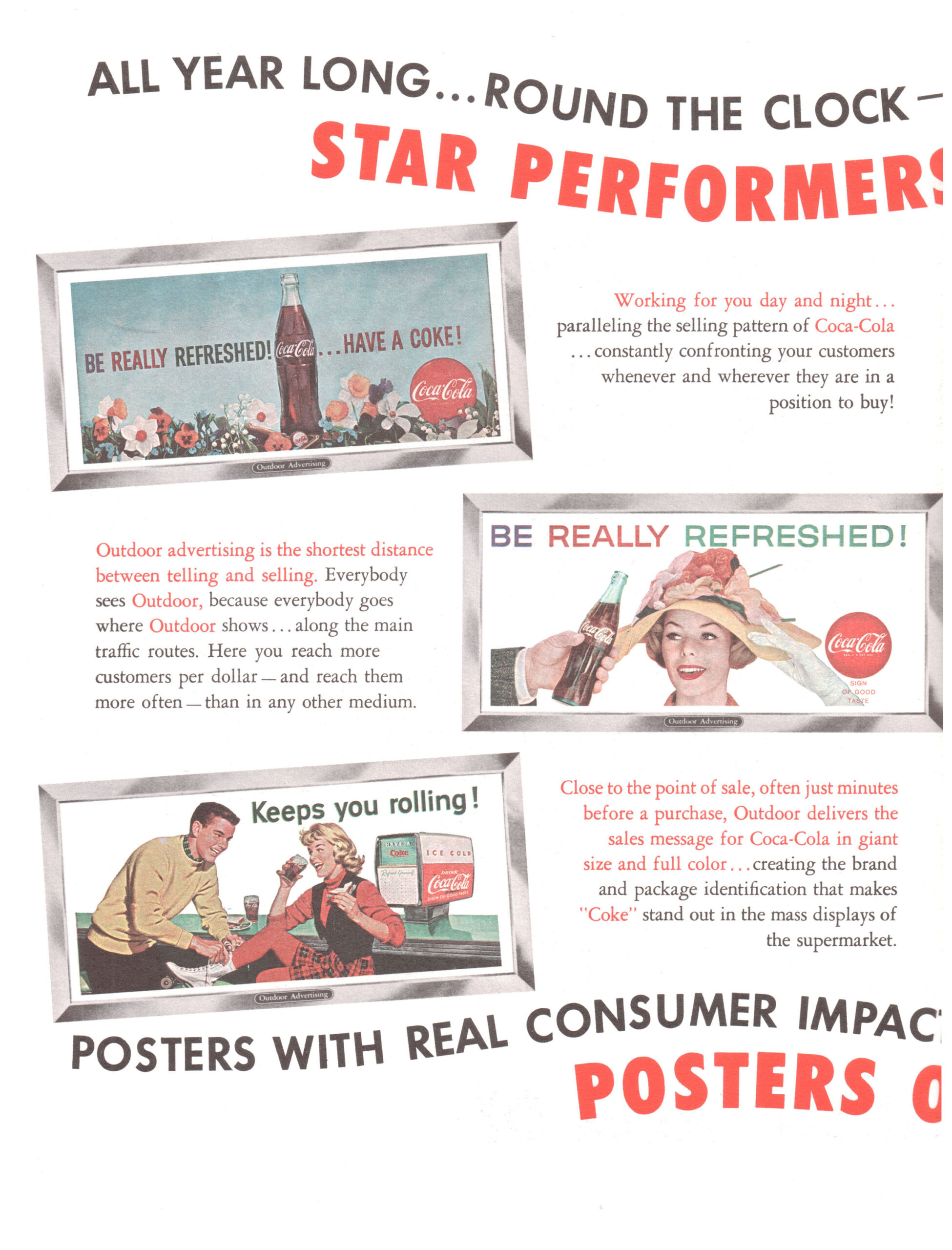
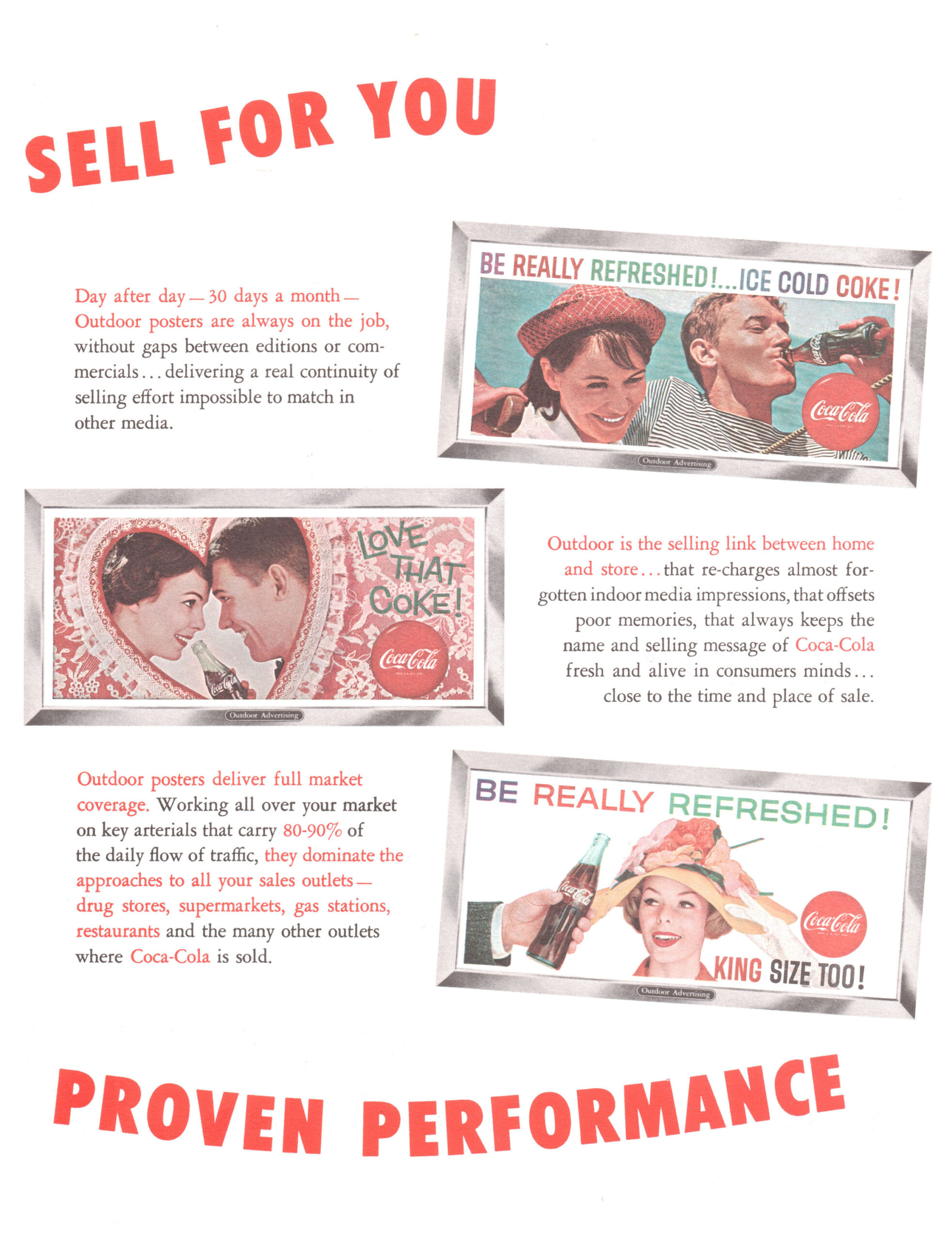
To encourage Coca-Cola bottlers to purchase the outdoor billboards in this promotion, the Outdoor Advertising Incorporated company used taglines like:
- “Working for you day and night”
- “Day after day, 30 days a month, outdoor posters are always on the job”
- “Outdoor advertising is the selling link between home and store”
Within these taglines, they showcased six new outdoor billboards.
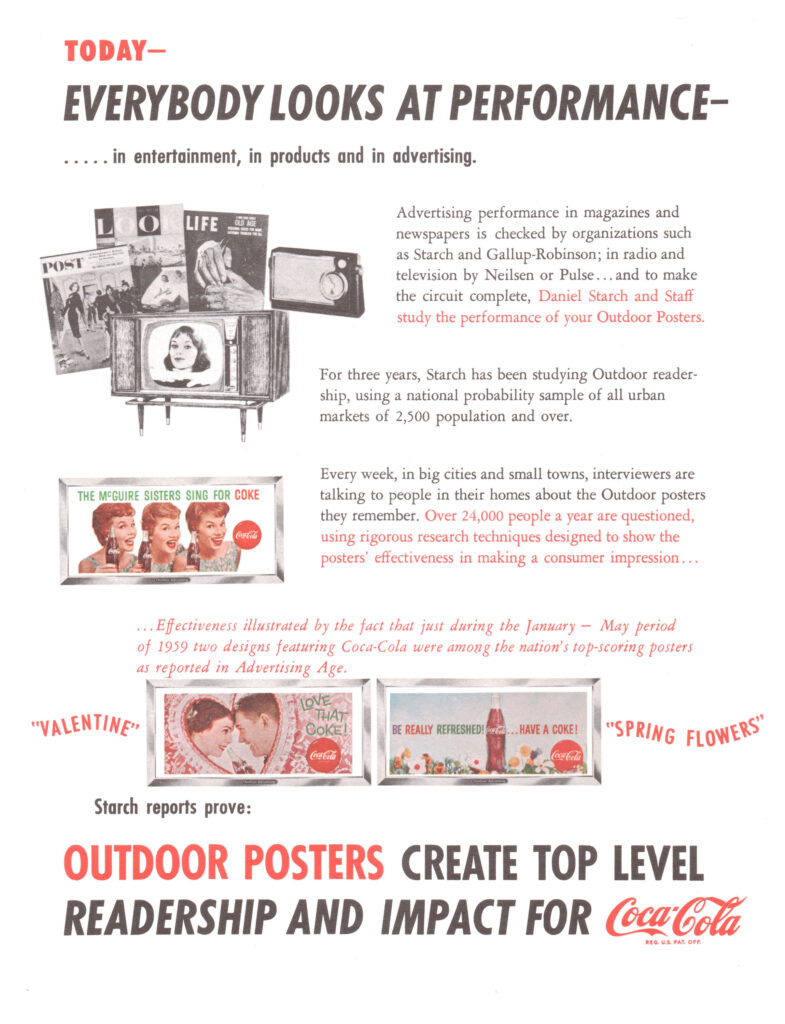
Outdoor Posters Create Top Level Readership
To further support why Coca-Cola bottlers should purchase the billboards in the “Star Performers Build Sales for You” promotion, information on outdoor readership was provided. This information demonstrated the benefits of outdoor performance.
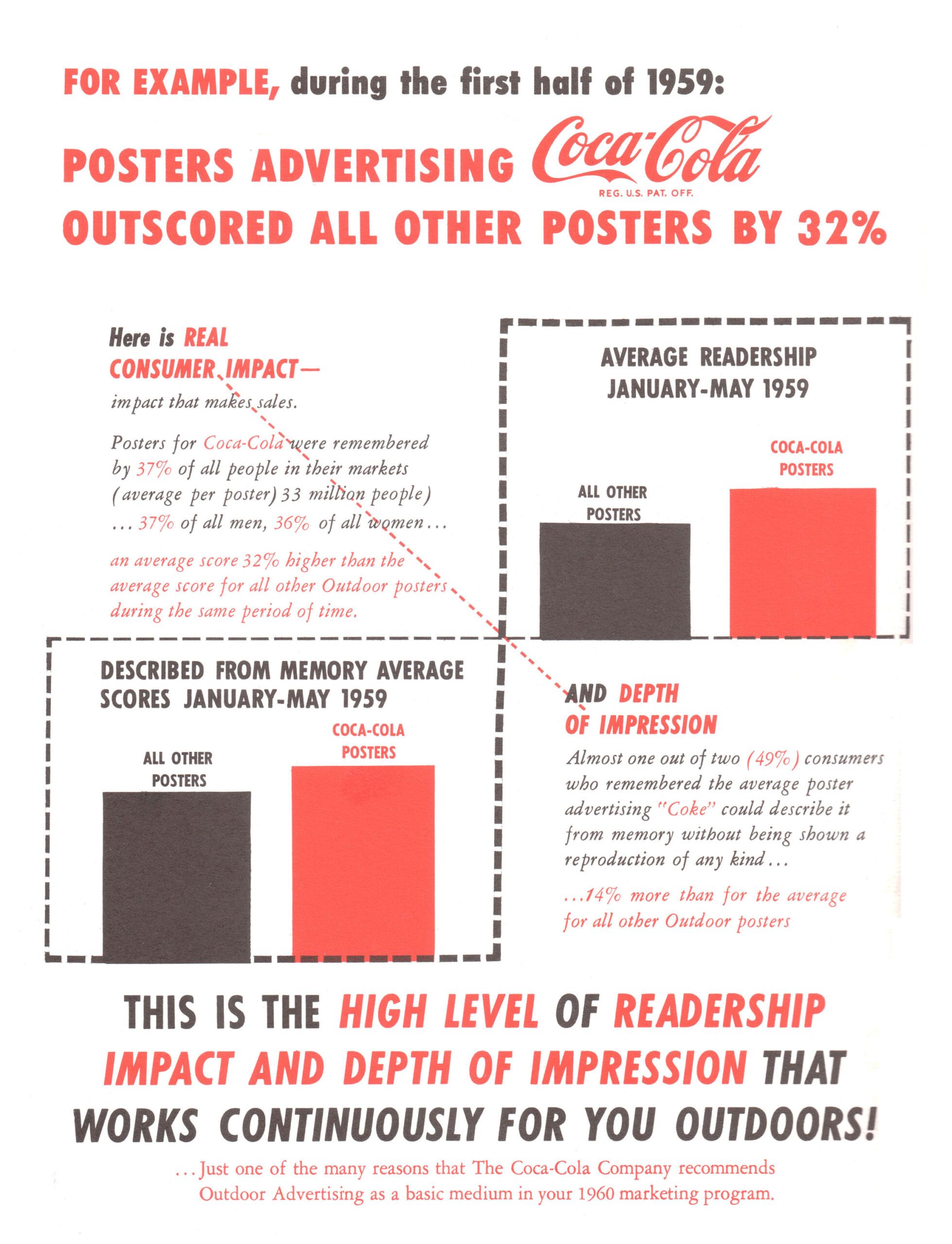
Posters Advertising Coca-Cola Outscored Other Posters by 32% in First Half of 1959
To further support why Coca-Cola bottlers should purchase the billboards in the promotion, information regarding readership impact and depth of impression was presented.
Posters with Real Consumer Impact – The 1959 Line Up
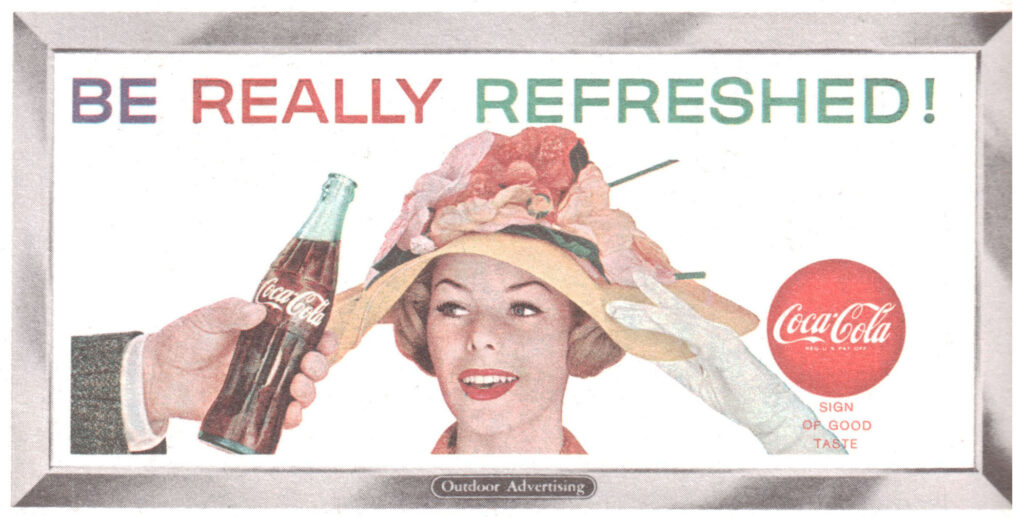
The following outdoor poster billboards were used in this promotion:
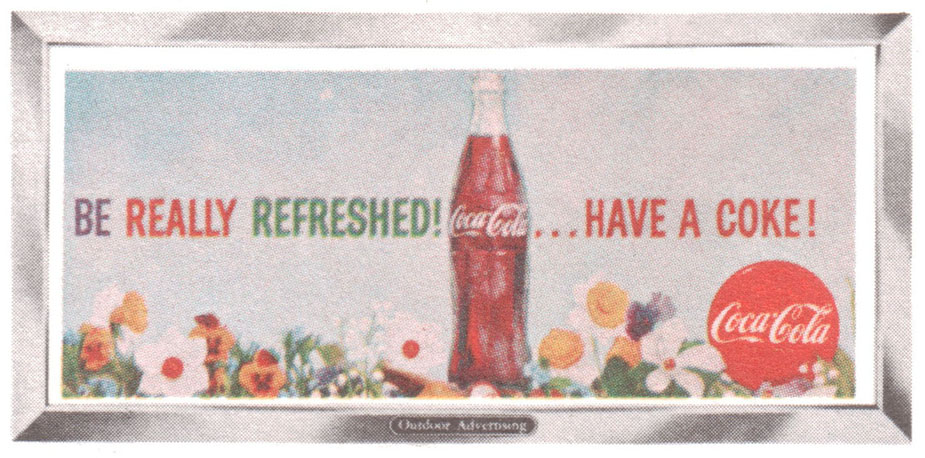
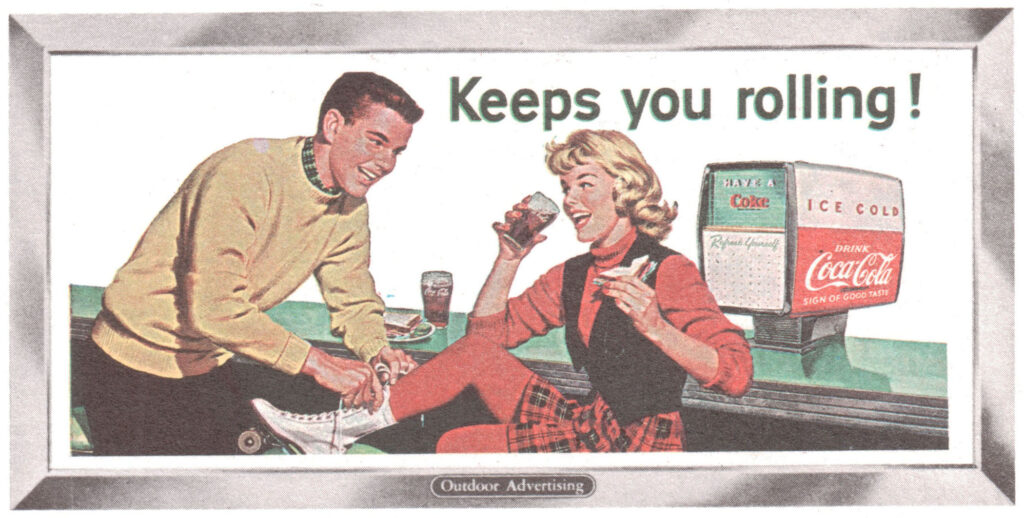
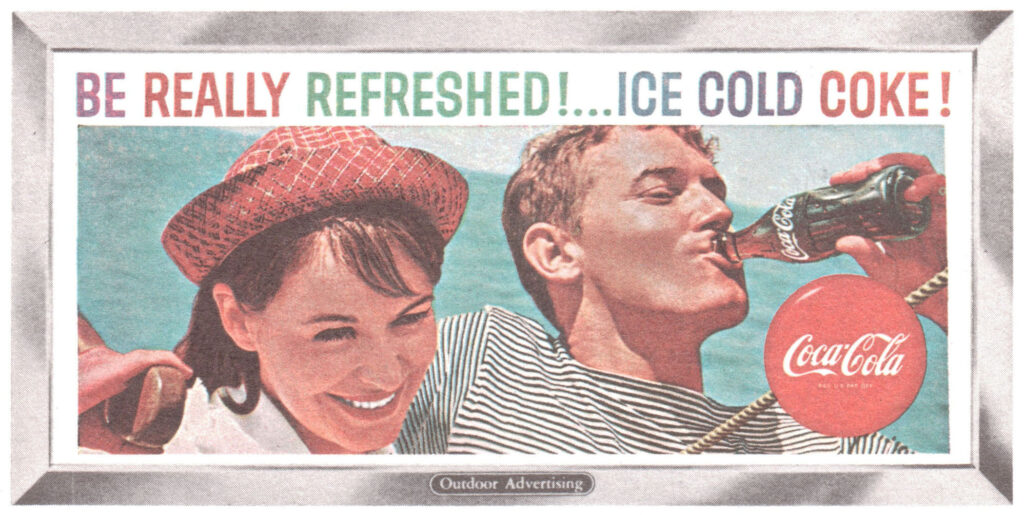
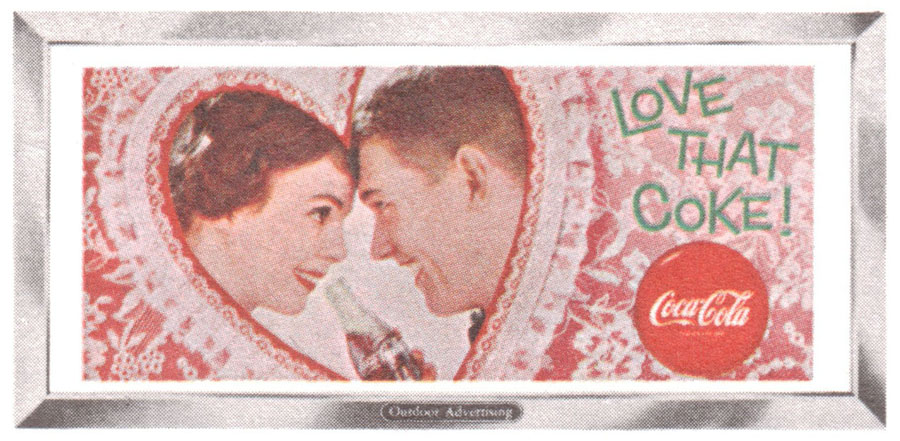
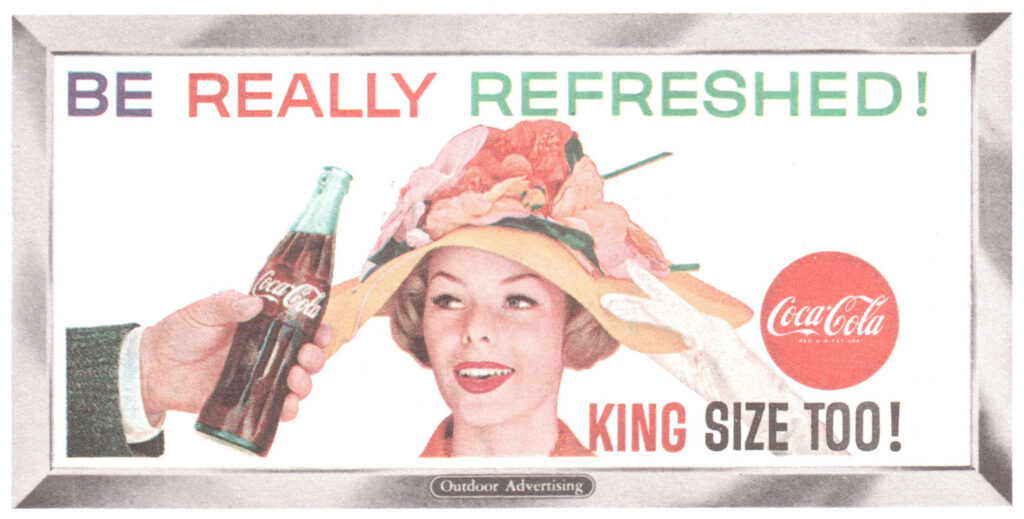
- The Be Really Refreshed Have a Coke outdoor advertising billboard featured a bottle of Coca-Cola sitting in a field of flowers with a trademark Coca-Cola disc in the lower right corner.
- The Be Really Refreshed outdoor advertising billboard featured a woman with a brown and pink hat being handed a regular size bottle of Coca-Cola with a trademark Coca-Cola disc in the lower right corner.
- The Keeps you Rolling outdoor advertising billboard featured a man and woman at an ice skating rink drinking glasses of Coca-Cola next to a fountain dispenser.
- The Be Really Refreshed Ice Cold Coke outdoor advertising billboard featured a man and woman on a boat with a trademark Coca-Cola disc in the lower right corner.
- The Love that Coke outdoor advertising billboard featured a man and woman drinking a bottle of Coca-Cola over a heart-shaped background with a trademark Coca-Cola disc in the lower right corner.
- The Be Really Refreshed King Size Too outdoor advertising billboard featured a the same woman with a brown and pink hat being handed a King size bottle of Coca-Cola with a trademark Coca-Cola disc in the lower right corner.
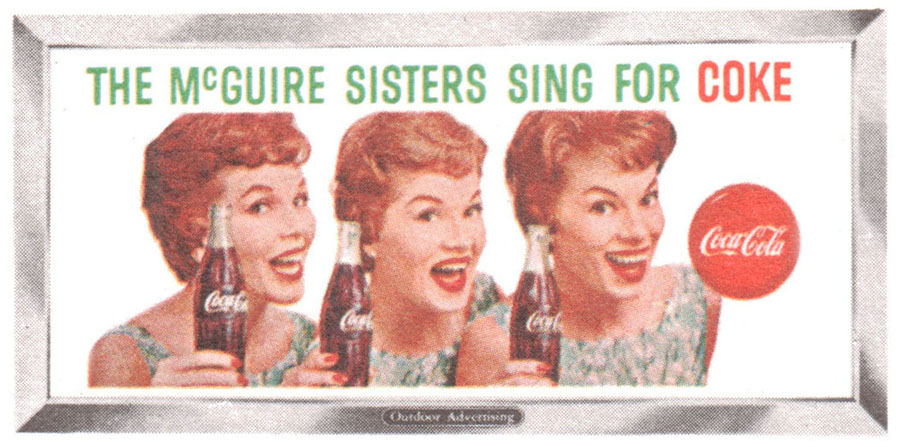
- The McGuire Sisters Sing for Coke outdoor advertising billboard featured the McGuire sisters singing group each holding a bottle of Coca-Cola with a trademark Coca-Cola disc to their right.
Learn More About the Company Brand Featured in this Promotion
The Cavalier Corporation had a long-standing history of providing high-quality vending solutions that catered to various beverage markets. Their commitment to innovation and excellence positioned them as a leader in the cooler industry.
The Coca-Cola Company, known for its iconic branding and global reach, has maintained a significant presence in the beverage industry. Their partnership with manufacturers like Cavalier ensured that customers received quality products that aligned with the Coca-Cola brand’s high standards.
Marrying the two together, it made sense that in April 1958, the Cavalier Corporation proudly unveiled a revolutionary series of nine coolers and merchandising vendors specifically designed for Coca-Cola. While a few upright models from this new series were initially released in 1957, this official launch marked the first comprehensive lineup offered by the company.
Each model represented a blend of style and functionality, delivering on the promise of quality that Cavalier was known for.
The new coolers featured a distinctive white top on the round-top upright models, a design that not only caught the eye but also set a new standard in cooler aesthetics. As part of the launch campaign, the company implemented four promotional ads from 1958 to 1959, showcased in multiple editions of The Coca-Cola Bottler magazine, the authoritative publication for Coca-Cola bottlers.
This marketing strategy aimed to highlight the innovative features and quality of the coolers while reinforcing brand loyalty among Coca-Cola distributors and vendors.
Table of Contents
- 1 A Complete Line of Quality Coca-Cola Coolers
- 2 Have a Coke in Exclusive Point-of-Purchase Merchandising on Cavalier Select Models
- 3 Proven Trouble-Free
- 4 Products Featured in the Point-of-Purchase Merchandising Product Line
- 5 Learn More About the Manufacturer and the Company Brand Featured in This Promotion
A Complete Line of Quality Coca-Cola Coolers
The inaugural ad campaign commenced in April 1958, prominently featured in The Coca-Cola Bottler magazine. This advertisement introduced an exciting new product line of high-quality coolers, designed to enhance sales for dealers, bottlers, and installation sites.
The cooler lineup included six upright round-top models adorned with fresh white top trim, two striking red and white floor models, and the portable “Carry-Cooler Junior,” which was perfect for on-the-go use. Each cooler was backed by a robust five-year warranty, showcasing the company’s commitment to quality and reliability.
The advertisement emphasized the coolers’ ability to deliver superior service to locations, their potential to significantly boost Coca-Cola sales, and the peace of mind provided by the five-year warranty. This influential advertisement was also reprinted in the June edition of The Coca-Cola Bottler, ensuring widespread visibility.
Have a Coke in Exclusive Point-of-Purchase Merchandising on Cavalier Select Models
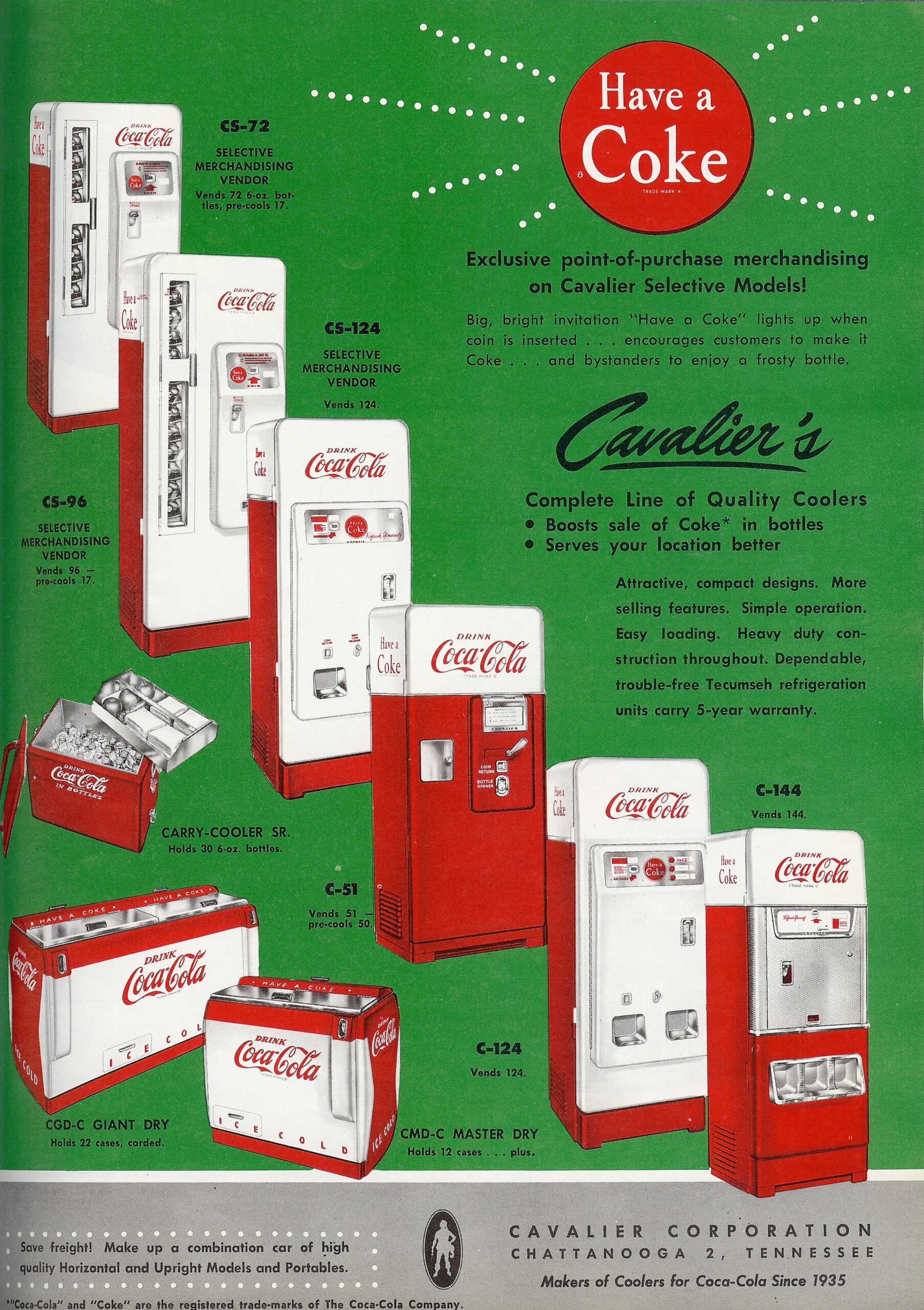
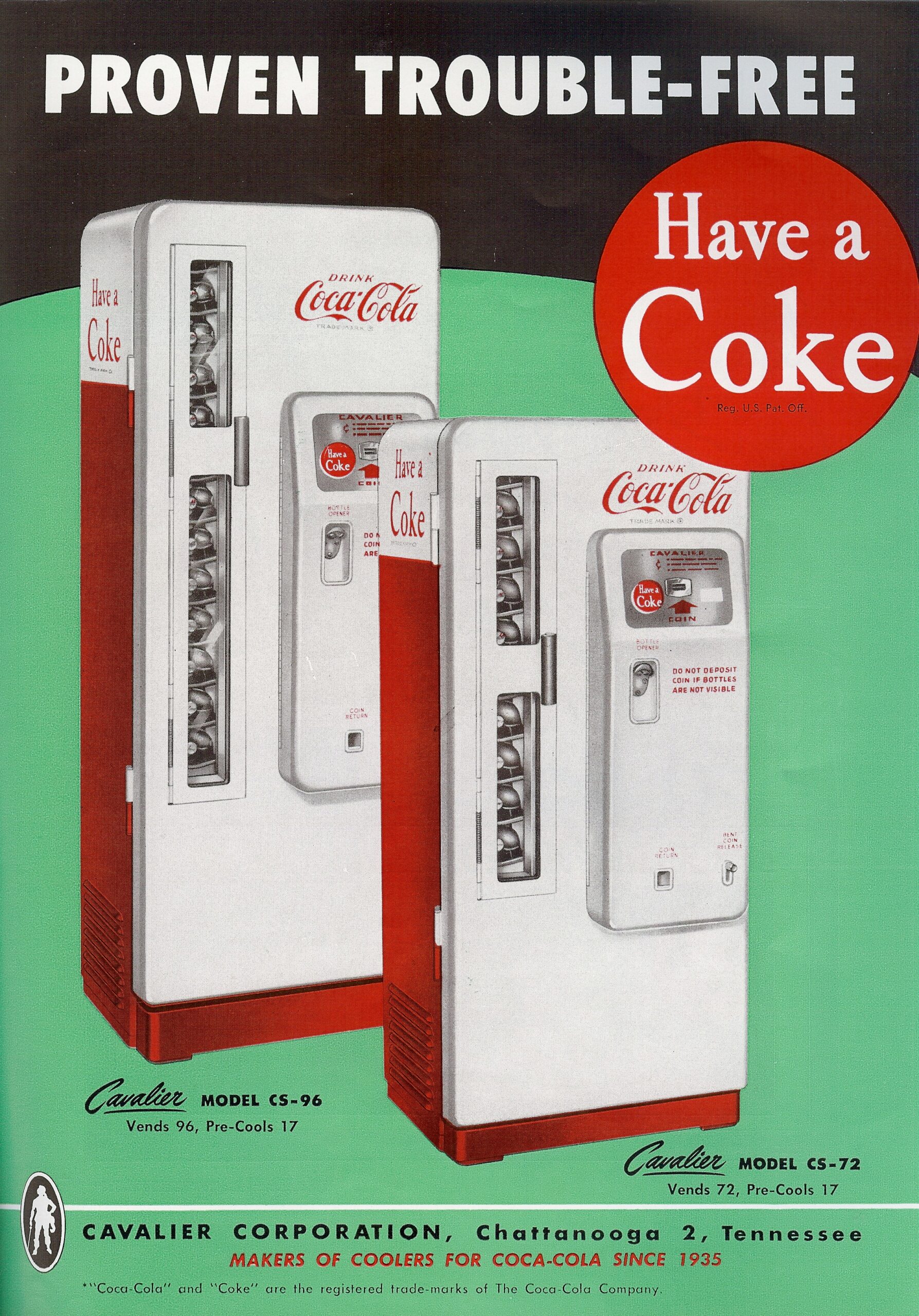
As the calendar turned to 1959, the company reintroduced their advertisement in the February issue of The Coca-Cola Bottler magazine. This strategic move aimed to solidify their branding message, prominently featuring the renowned “Have a Coke” dial at the top of the advertisement.
This innovative feature was included in five new cooler models, designed to illuminate upon the insertion of a coin, thereby attracting the attention of consumers and enhancing the vending experience. The dial not only served as a functional element but also became a symbol of the Coca-Cola brand’s commitment to quality service.
Proven Trouble-Free
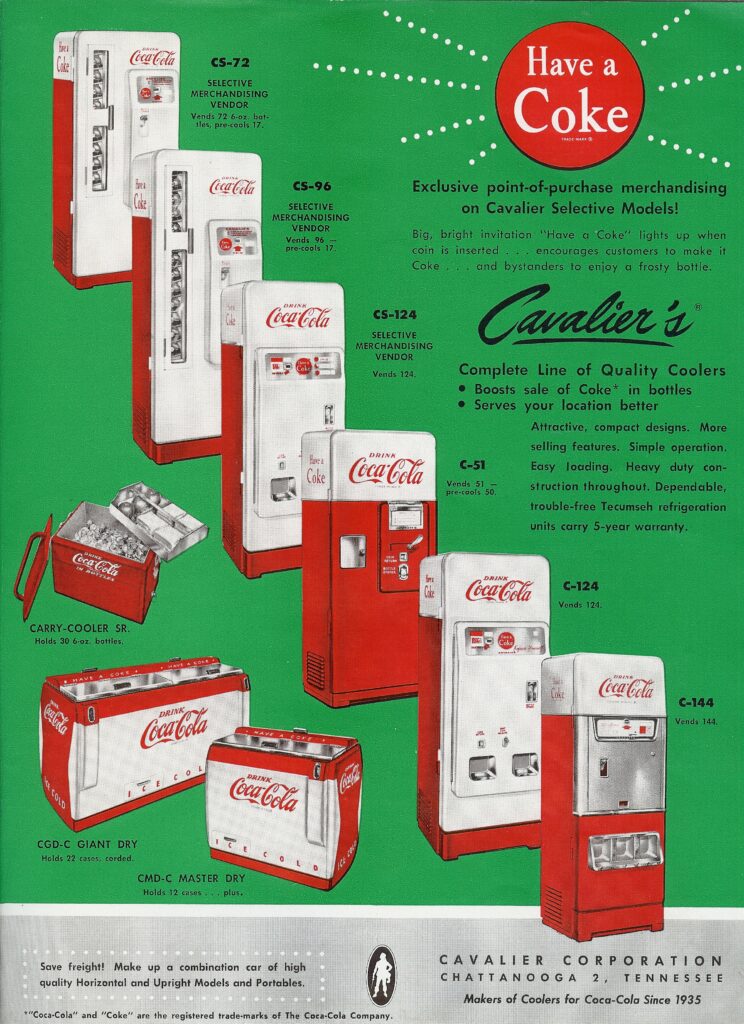
Following a successful introduction over a year earlier, the company was able to showcase in their advertisements how two of the standout models in the new product line, the CS-72 and the CS-96, had proven to be trouble-free for bottlers and retail outlets where they had been installed.
These models were highlighted for their reliability and ease of use, which significantly contributed to the positive brand perception among users. This advertisement served as the final promotion for 1959 before the company shifted their focus to the advertising of their new 1960 product line, which exclusively featured upright Coca-Cola coolers with a modern square top design.
Products Featured in the Point-of-Purchase Merchandising Product Line
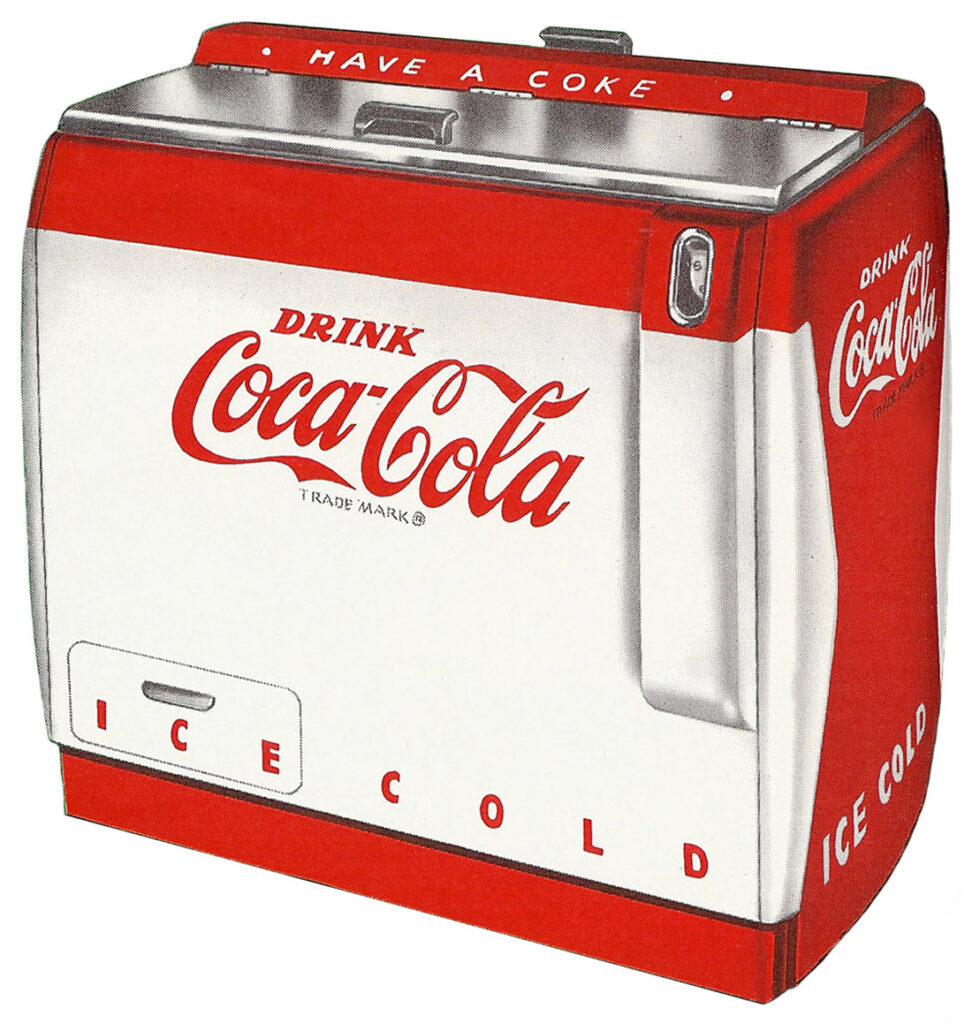
The product line and corresponding advertisements prominently featured nine new coolers, each designed to dispense or store Coca-Cola bottles effectively. Each model in this series was crafted with the intention of enhancing the customer experience while ensuring optimal storage solutions for Coca-Cola products.
These innovative coolers not only boasted aesthetic appeal but also functionality that catered to the needs of both users and vendors.
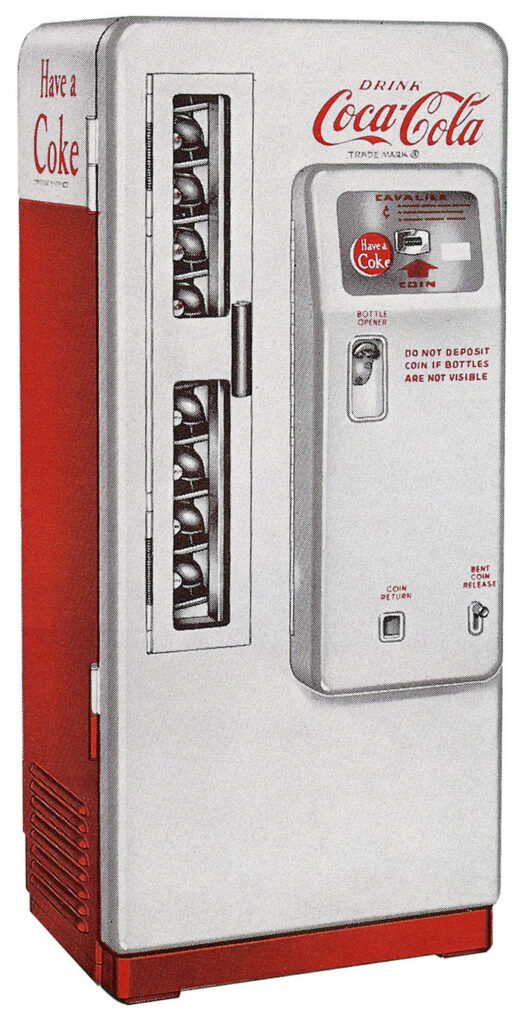
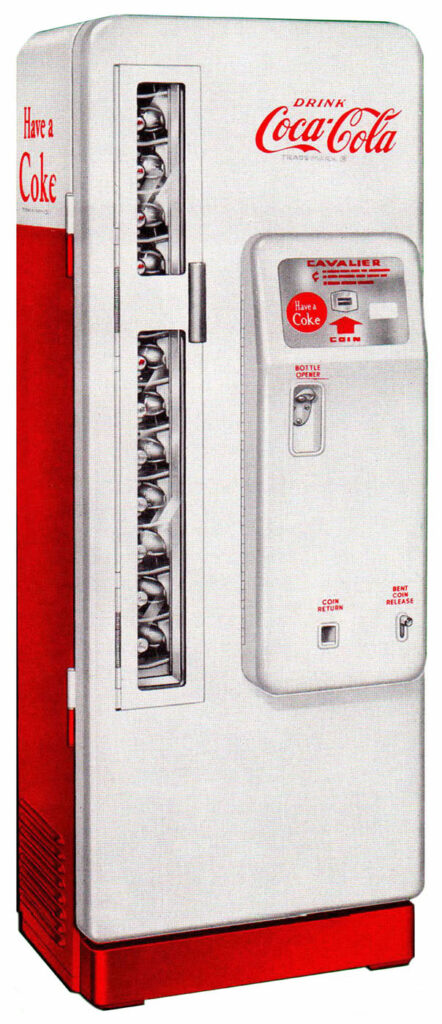
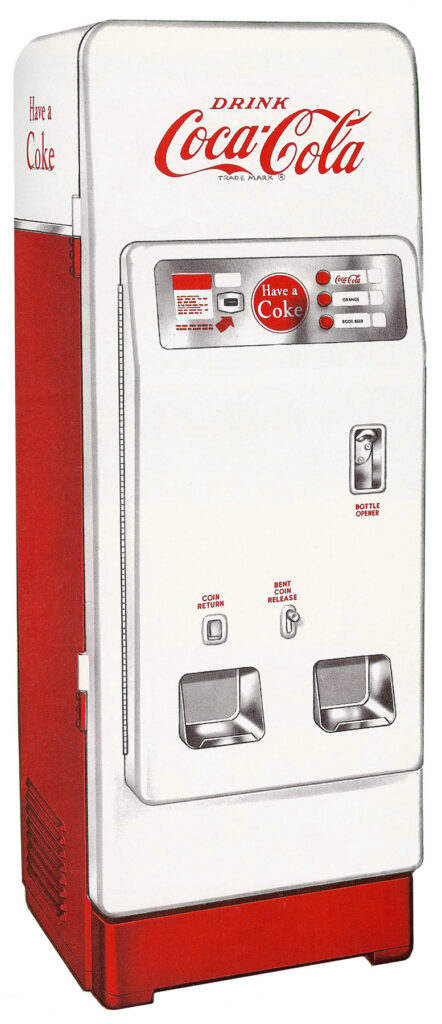

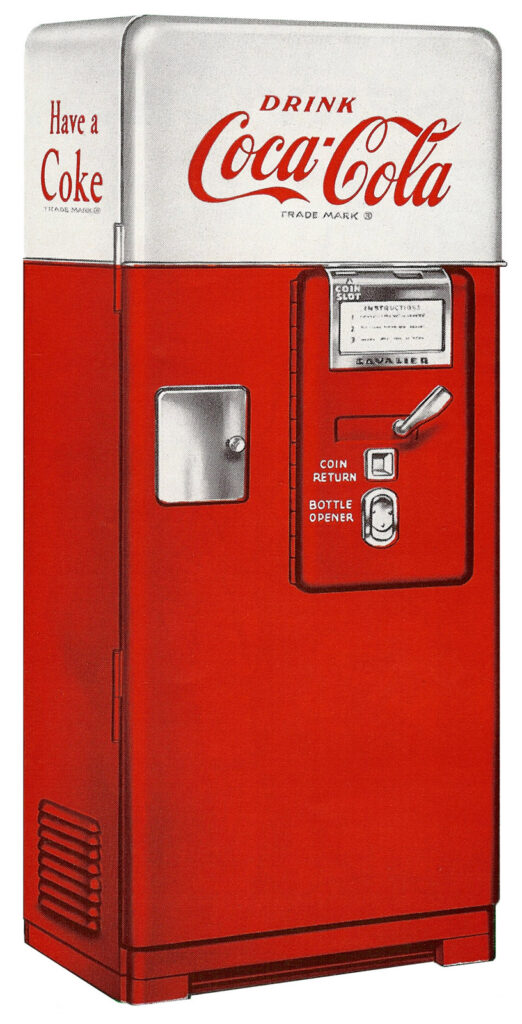
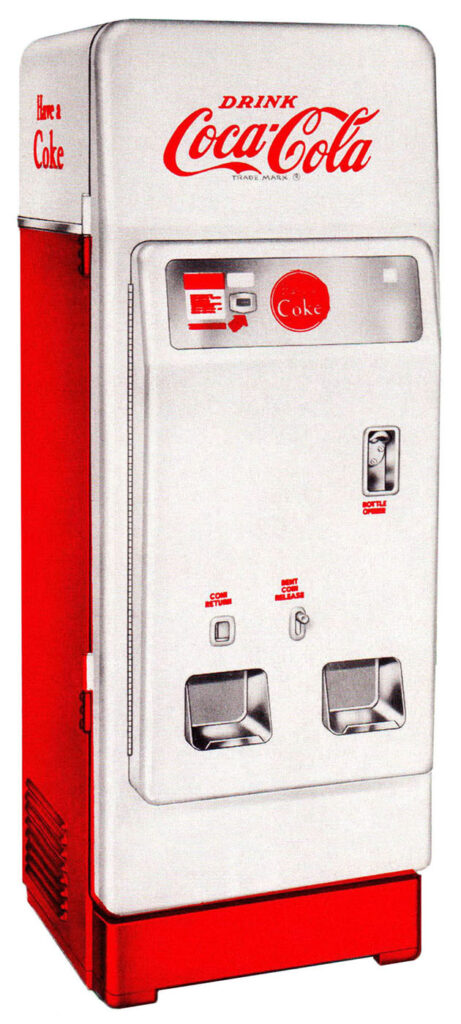
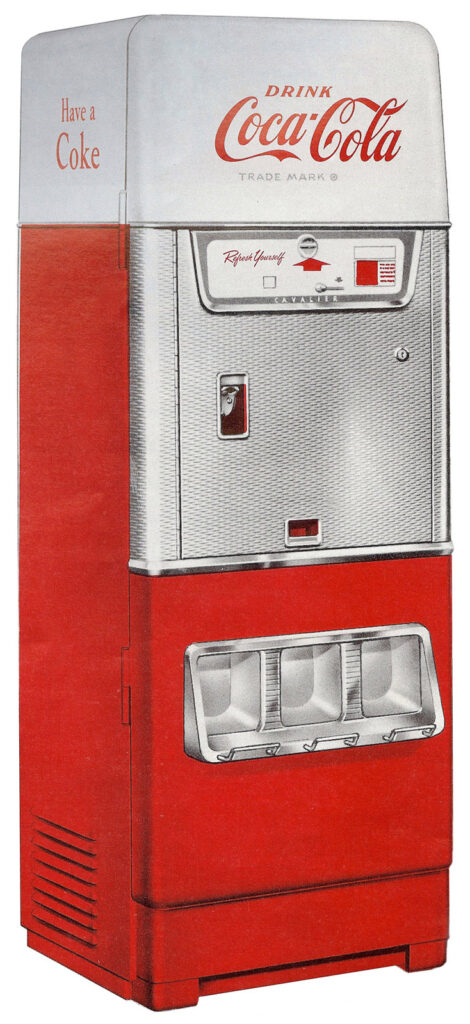
- The CS-72 Selective Merchandising Vendor with the “Have a Coke” emblem that flashes when a coin is deposited and vended 72 bottles while pre-cooling 17 bottles
- The CS-96 Selective Merchandising Vendor with the “Have a Coke” emblem that flashes when a coin is deposited and vended 96 bottles while pre-cooling 17 bottles
- The CS-124 Selective Merchandising Vendor with the “Have a Coke” emblem that flashes when a coin is deposited and vended 124 bottles
- The CGD-C Horizontal Giant Dry Cooler that held 22 cases of Coca-Cola
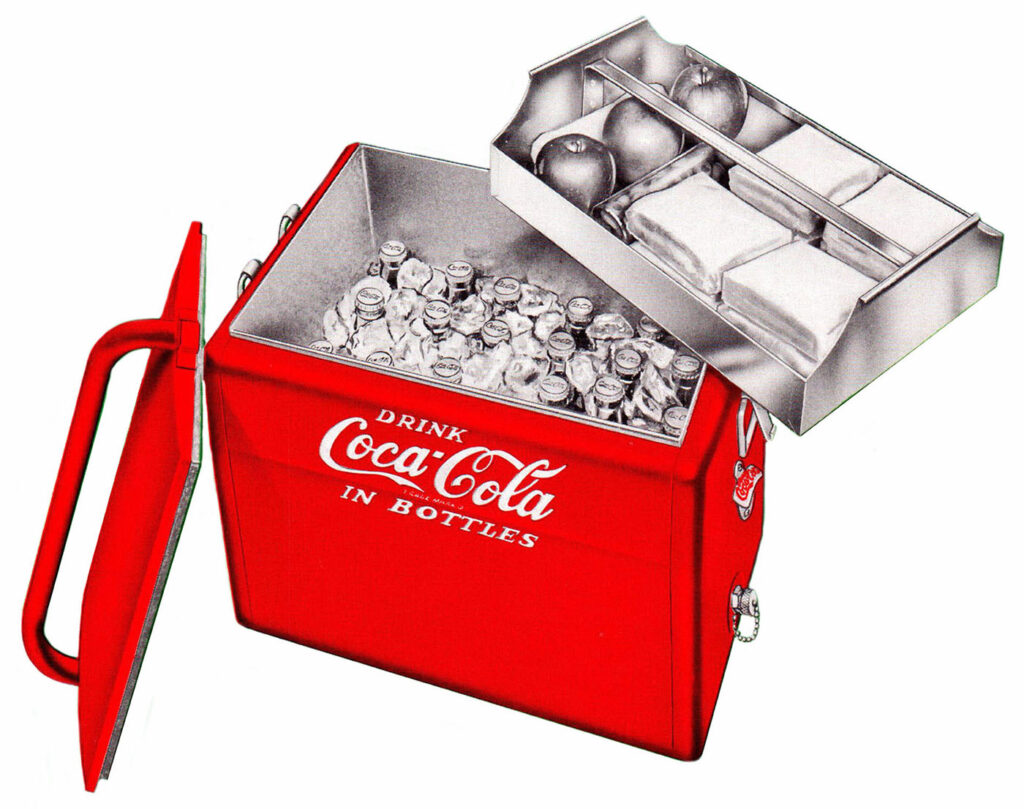
- The Carry Cooler Senior Portable Cooler that held 30 bottles of Coca-Cola
- The CMD-C Horizontal Master Dry Cooler that held 12 cases of Coca-Cola
- The C-51 Vendor that vended 51 bottles while pre-cooling 50 bottles
- The C-124 Merchandising Vendor with the “Have a Coke” emblem that flashes when a coin is deposited and vended 124 bottles
- The C-144 Merchandising Vendor that vended 144 bottles
Each cooler in this innovative lineup was engineered with unique features tailored to meet diverse consumer needs. For example, the CS-72 Selective Merchandising Vendor was designed to vend 72 bottles while pre-cooling an additional 17 bottles, ensuring that beverages were always served at the optimal temperature. Meanwhile, the CS-96 variant not only held a similar capacity but also enhanced user interaction with its flashing “Have a Coke” emblem, which illuminated when a coin was deposited, making the vending experience more engaging. Similarly, the CS-124 model was crafted to vend 124 bottles, showcasing the company’s commitment to providing solutions that catered to different scales of operation.
Moreover, the CGD-C Horizontal Giant Dry Cooler held an impressive 22 cases of Coca-Cola, making it an ideal solution for high-demand locations. Its spacious interior combined with energy-efficient cooling technology provided not only convenience but also cost-effectiveness.
For more portable needs, the Carry Cooler Senior Portable Cooler could hold up to 30 bottles of Coca-Cola, making it a favorite for events and outdoor gatherings.
The CMD-C Horizontal Master Dry Cooler, designed to hold 12 cases of Coca-Cola, exemplified the versatility of the product lineup. Its design allowed for easy access while maintaining optimal cooling conditions, ensuring that Coca-Cola products were always ready to serve.
The C-51 Vendor, capable of vending 51 bottles while pre-cooling 50, showcased the company’s attention to detail and commitment to usability.
On the other hand, the C-124 Merchandising Vendor, with its eye-catching “Have a Coke” emblem, was designed to vend 124 bottles efficiently, further enhancing the point-of-sale experience for retailers.
Lastly, the C-144 Merchandising Vendor, which vended 144 bottles, rounded out the lineup with its robust design and capacity.
Learn More About the Manufacturer and the Company Brand Featured in This Promotion
For more information about their extensive product range, visit Cavalier Corporation.
To learn more about their history and product offerings, visit The Coca-Cola Company.
In January 1957, the Vendorlator Manufacturing Company, commonly known as VMC or Vendorlator, launched a series of six new coin-operated coolers, including the VMC Coin Cooler, for Coca-Cola. They conducted three promotional campaigns throughout the year to highlight the features of these coolers in the January, the February, and the May 1957 issues of The Coca-Cola Bottler magazine, targeting Coca-Cola bottlers.
Table of Contents
- 1 Start Calling Now to Make 1957 Your Greatest Profit Year
- 2 For a More Successful Treasure Hunt use VMC Coin Coolers
- 3 Modern Upright VMC Coin Coolers Give You King Size Capacity
- 4 Products Featured in the VMC Product Line
- 5 Learn More About the Manufacturer and the Company Brand Featured in this Promotion
Start Calling Now to Make 1957 Your Greatest Profit Year
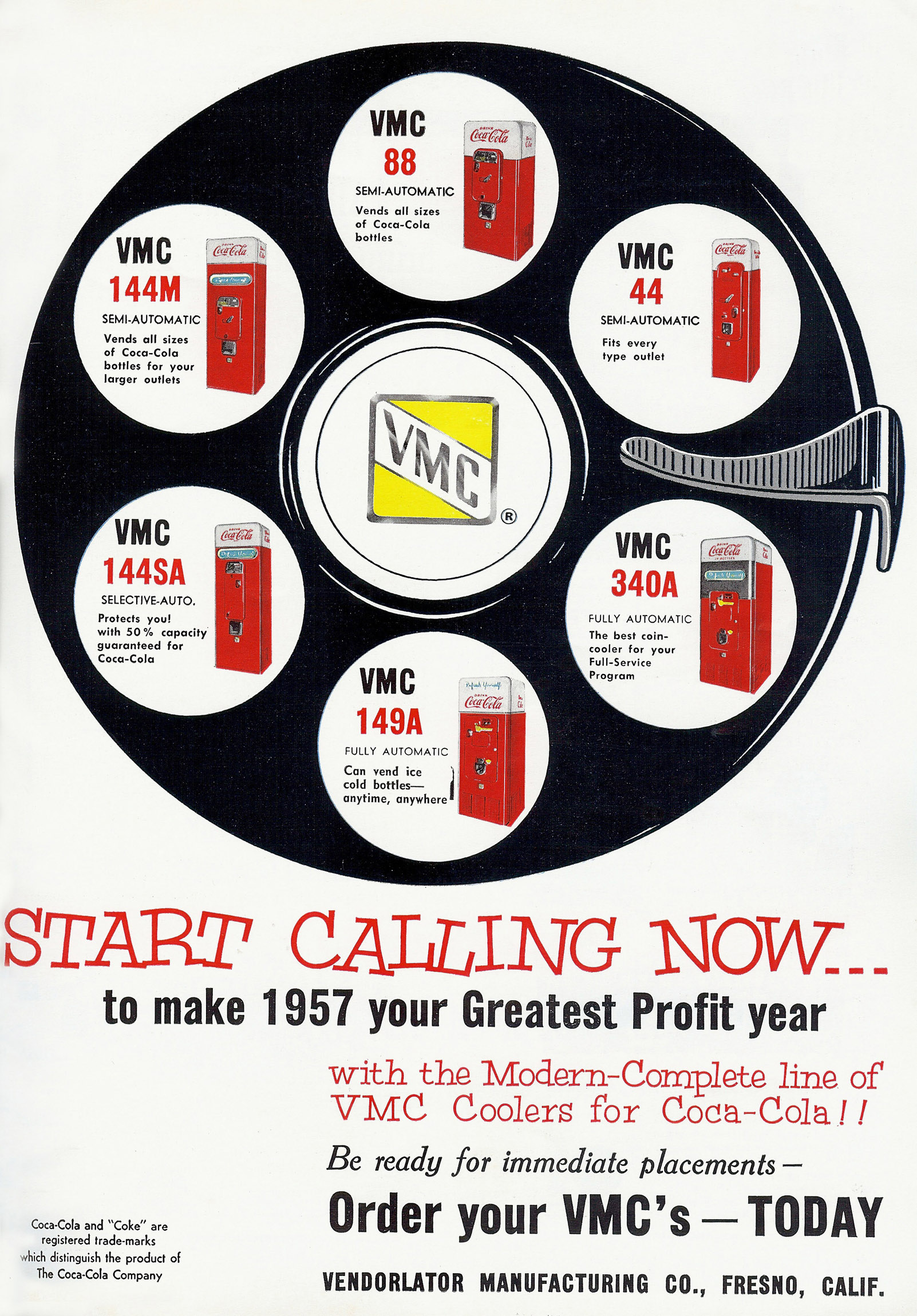
The inaugural promotion for the new 1957 VMC complete product line, including the VMC Coin Cooler, was titled “Start Calling Now… to Make 1957 Your Greatest Profit Year.” This campaign appeared in the January 1957 edition of The Coca-Cola Bottler magazine, targeting Coca-Cola bottlers. It showcased a rotary dial phone with the six new VMC coin-operated coolers for Coca-Cola integrated into the dial and the yellow Vendorlator Manufacturing Company logo at the dial’s center. The promotion highlighted the coolers’ modernity and their readiness for immediate installation in retail locations.
For a More Successful Treasure Hunt use VMC Coin Coolers
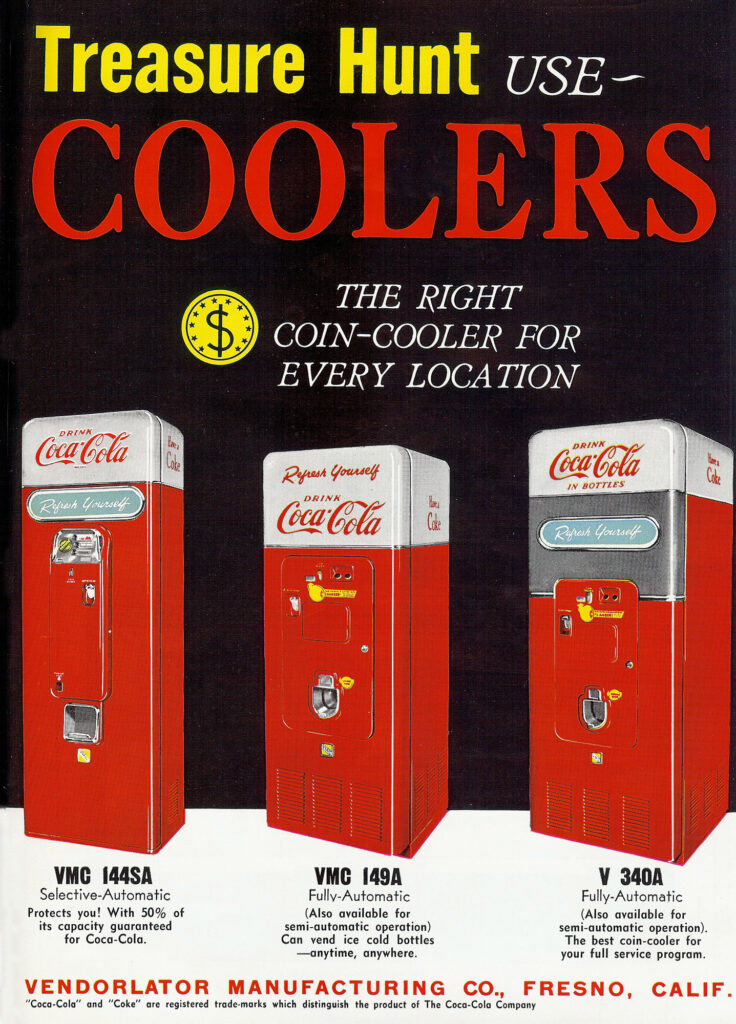
The second promotion for the new 1957 VMC complete product line was titled “For a More Successful Treasure Hunt Use VMC Coin Coolers.” Featured in the February 1957 edition of The Coca-Cola Bottler magazine, this two-page advertisement was aimed at Coca-Cola bottlers. It showcased all six new coin coolers, emphasizing their readiness for shipment as part of a treasure hunt campaign. The promotion also highlighted that each cooler would be more cost-effective and space-efficient for dealers or outlets. Additionally, it provided an overview and the dispensing capacities for each cooler model.
Modern Upright VMC Coin Coolers Give You King Size Capacity
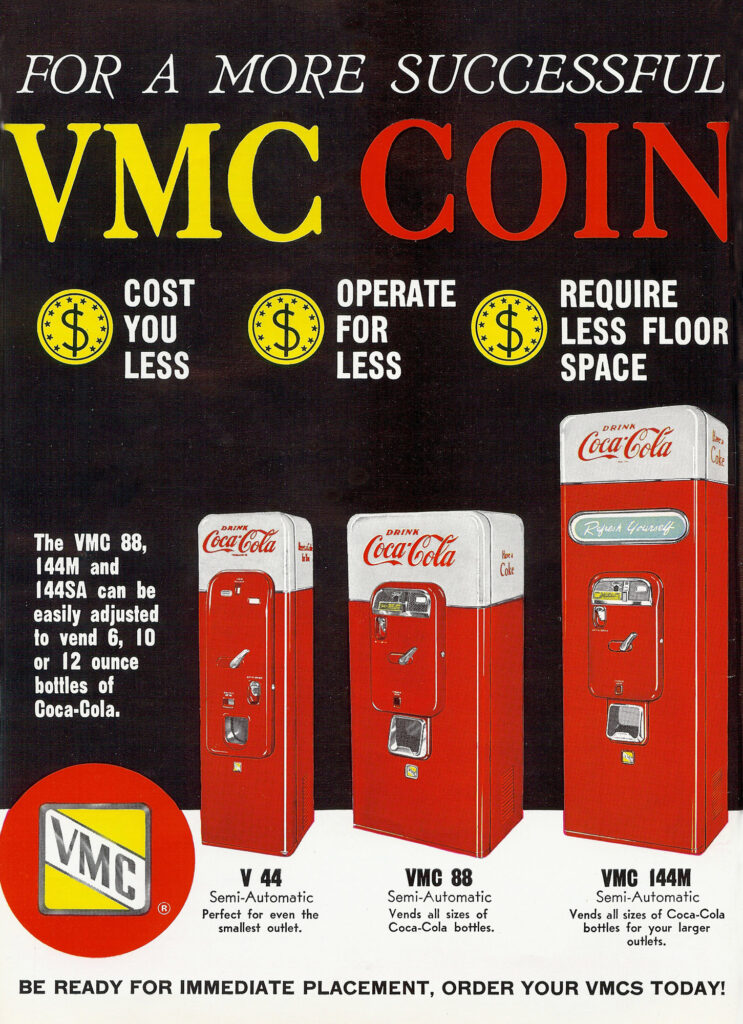
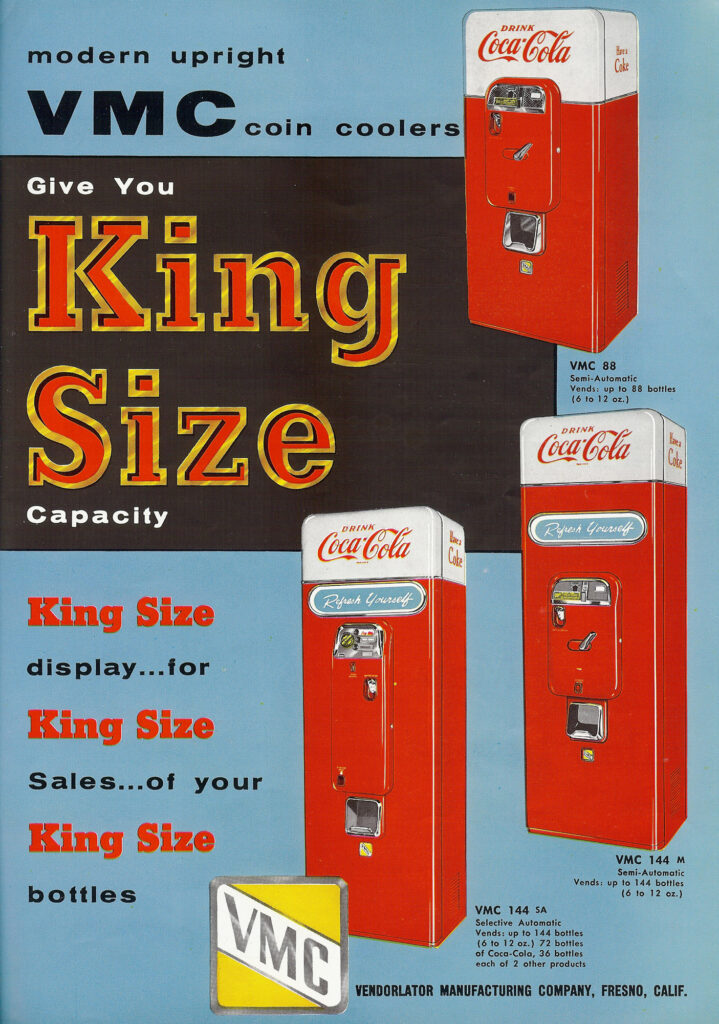
The third promotion featured an advertisement from Coca-Cola, showcasing three out of six new coin-operated coolers, emphasizing their capability to dispense King Size Coca-Cola bottles.
Products Featured in the VMC Product Line
The VMC product line and supporting promotions featured 6 new coolers dispensing bottles of Coca-Cola.
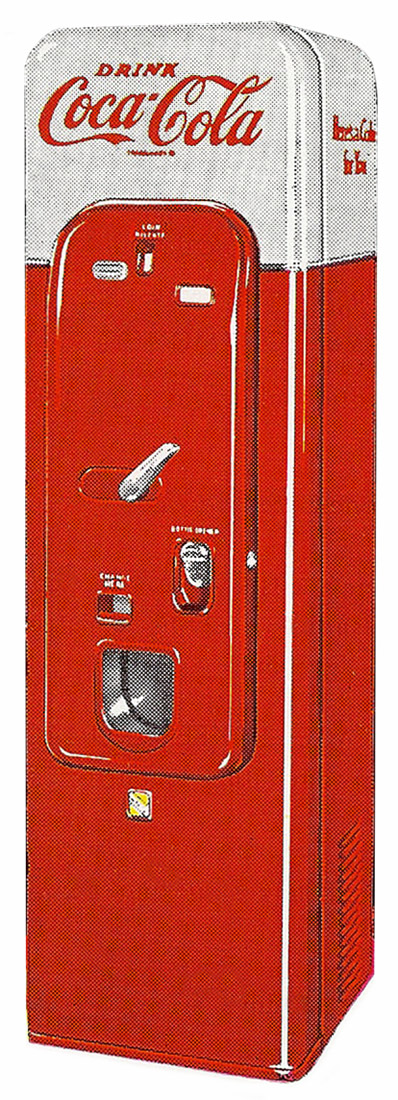
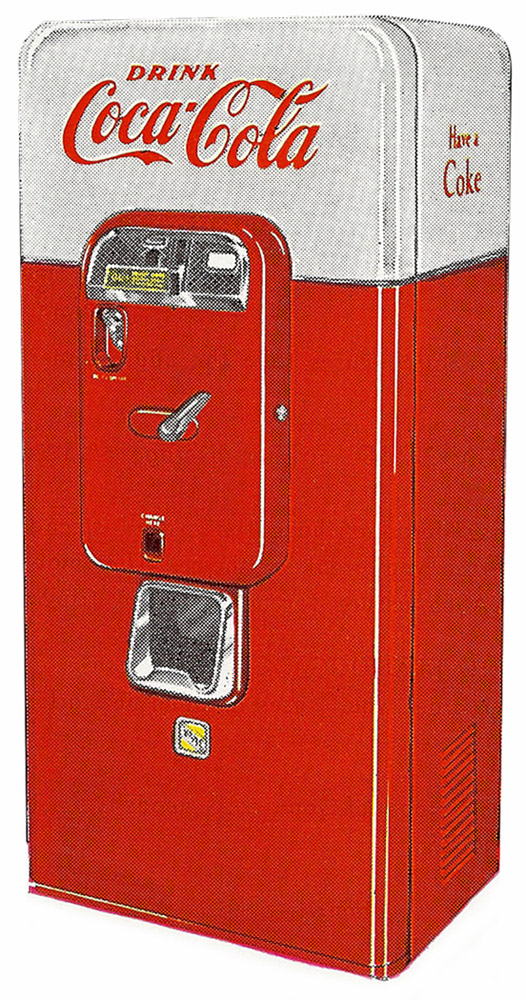
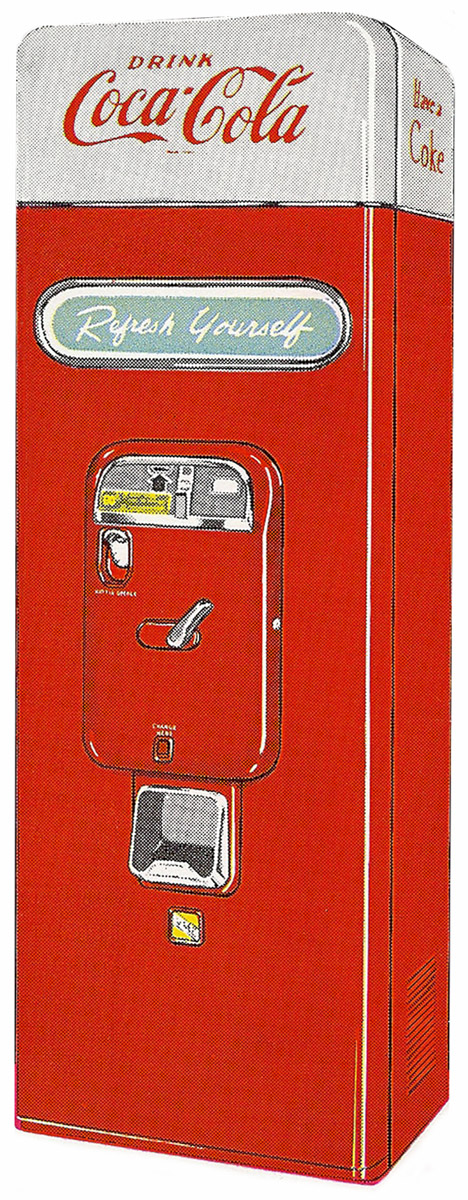
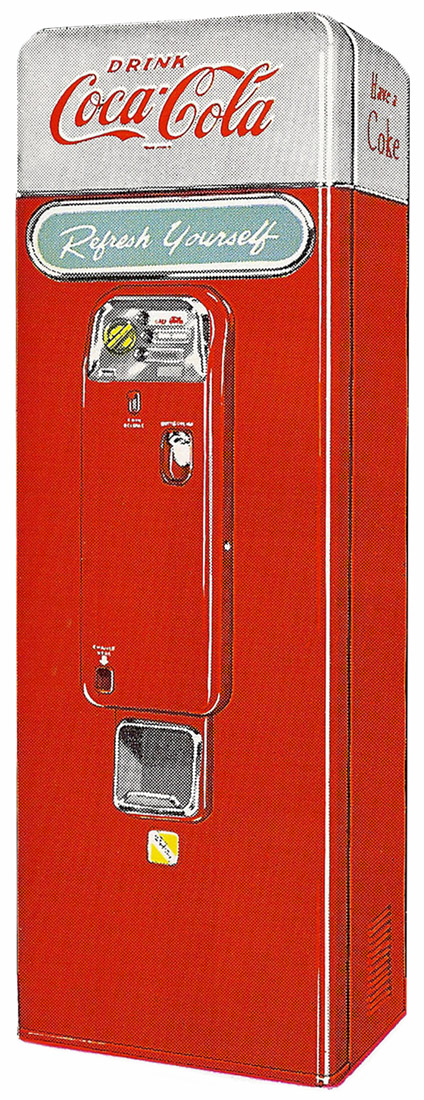
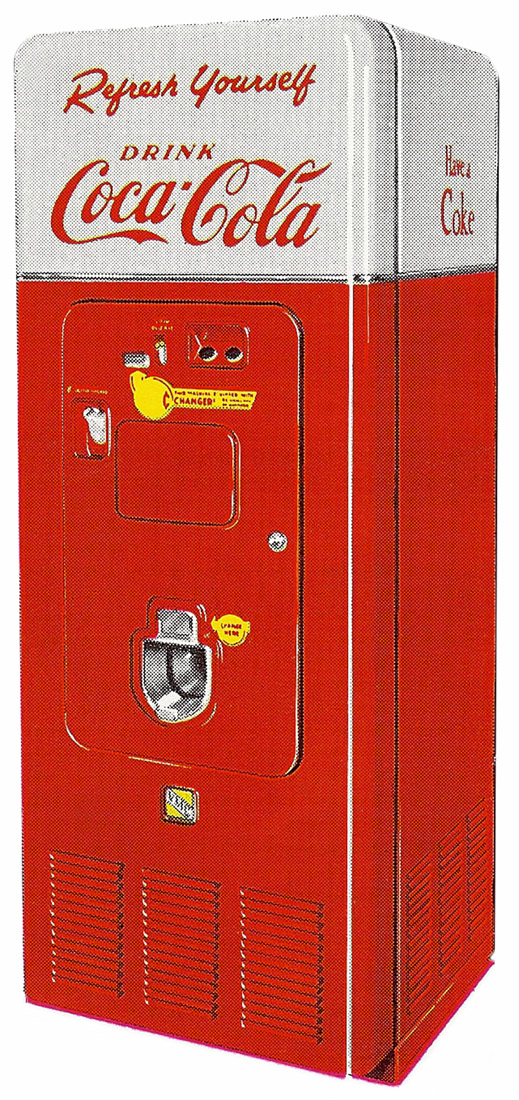
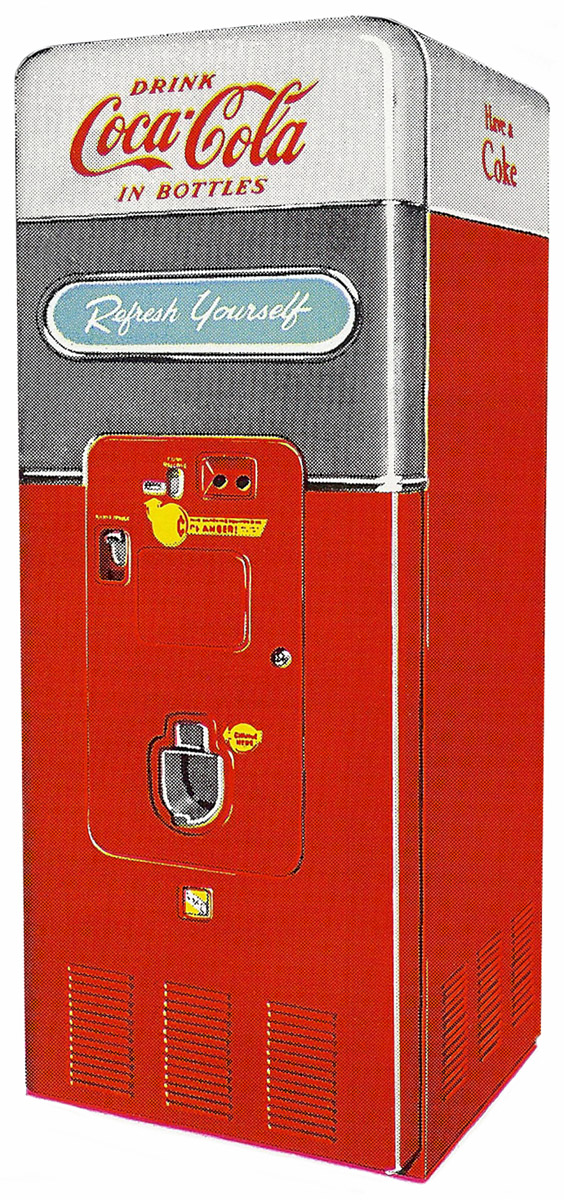
- The VMC V44 Semi-Automatic Coca-Cola Coin Cooler was perfect for the smallest outlet.
- The VMC 88 Semi-Automatic Coca-Cola Coin Cooler which could vend all sizes of Coca-Cola bottles.
- The VMC 144M Semi-Automatic Coca-Cola Coin Cooler was ideal for larger outlets needing to vend different sizes of bottles.
- The VMC 144SA Selective-Automatic Coca-Cola Coin Cooler was guaranteed for 50% capacity.
- The VMC 149A Fully-Automatic Coca-Cola Coin Cooler was able to vend bottles of Coca-Cola anywhere, anytime.
- The VMC 304A Fully-Automatic Coca-Cola Coin Cooler was the best cooler for a full-service program.
Learn More About the Manufacturer and the Company Brand Featured in this Promotion
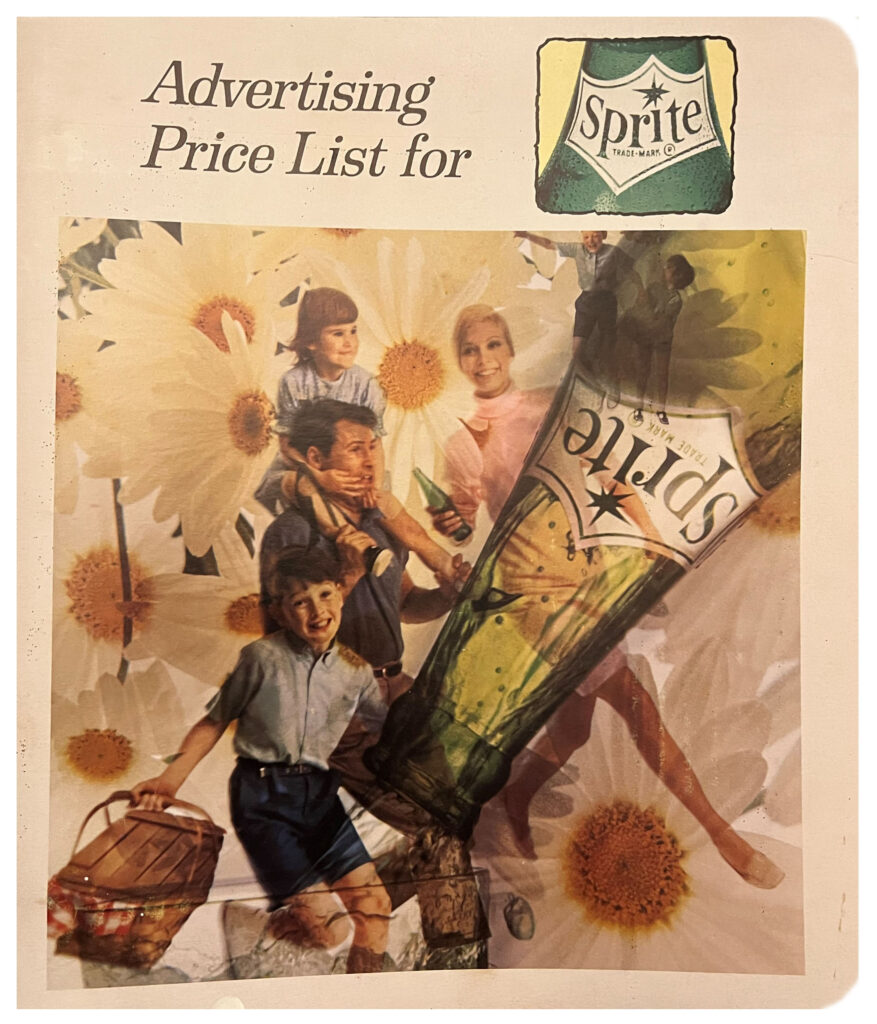
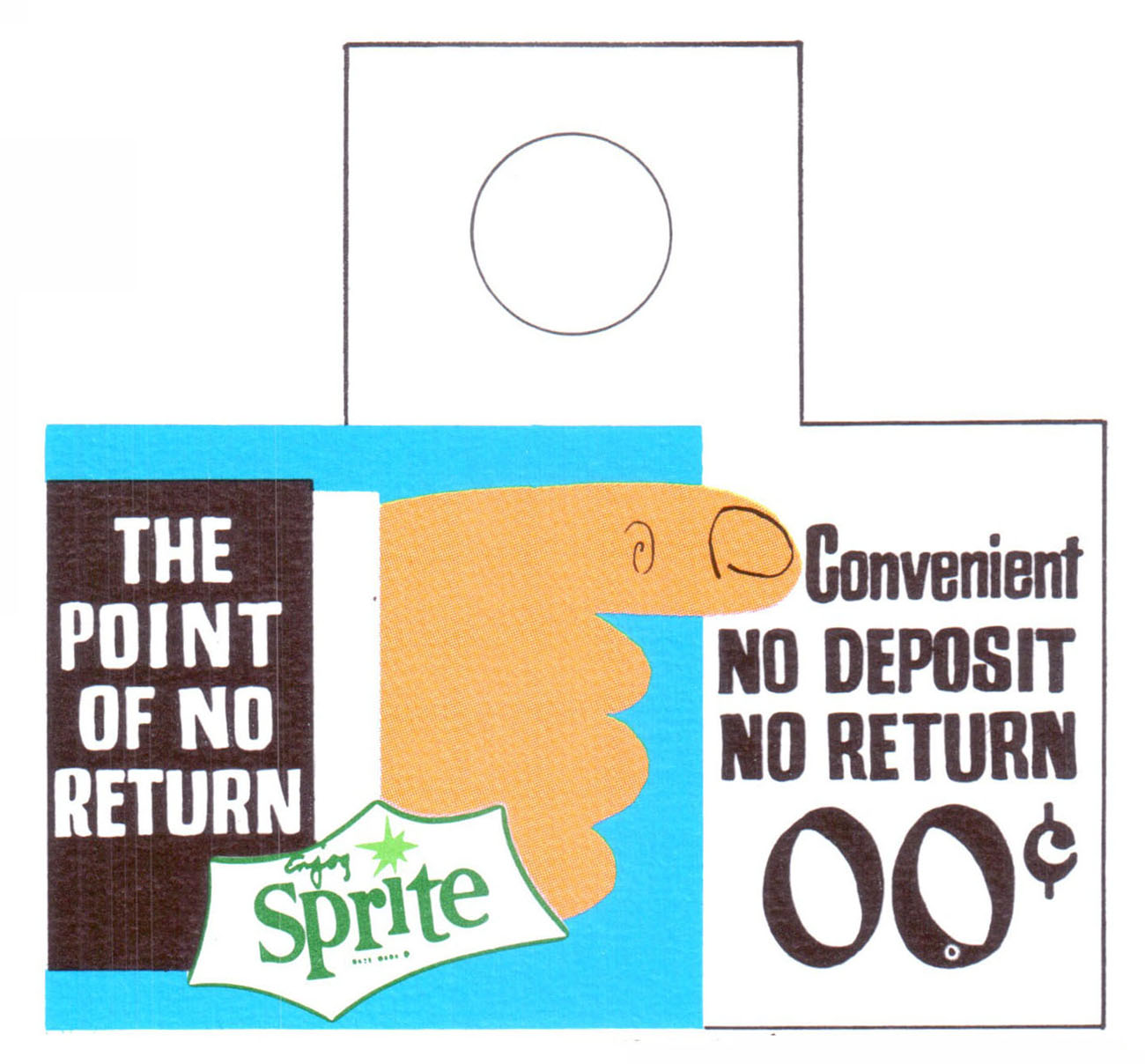
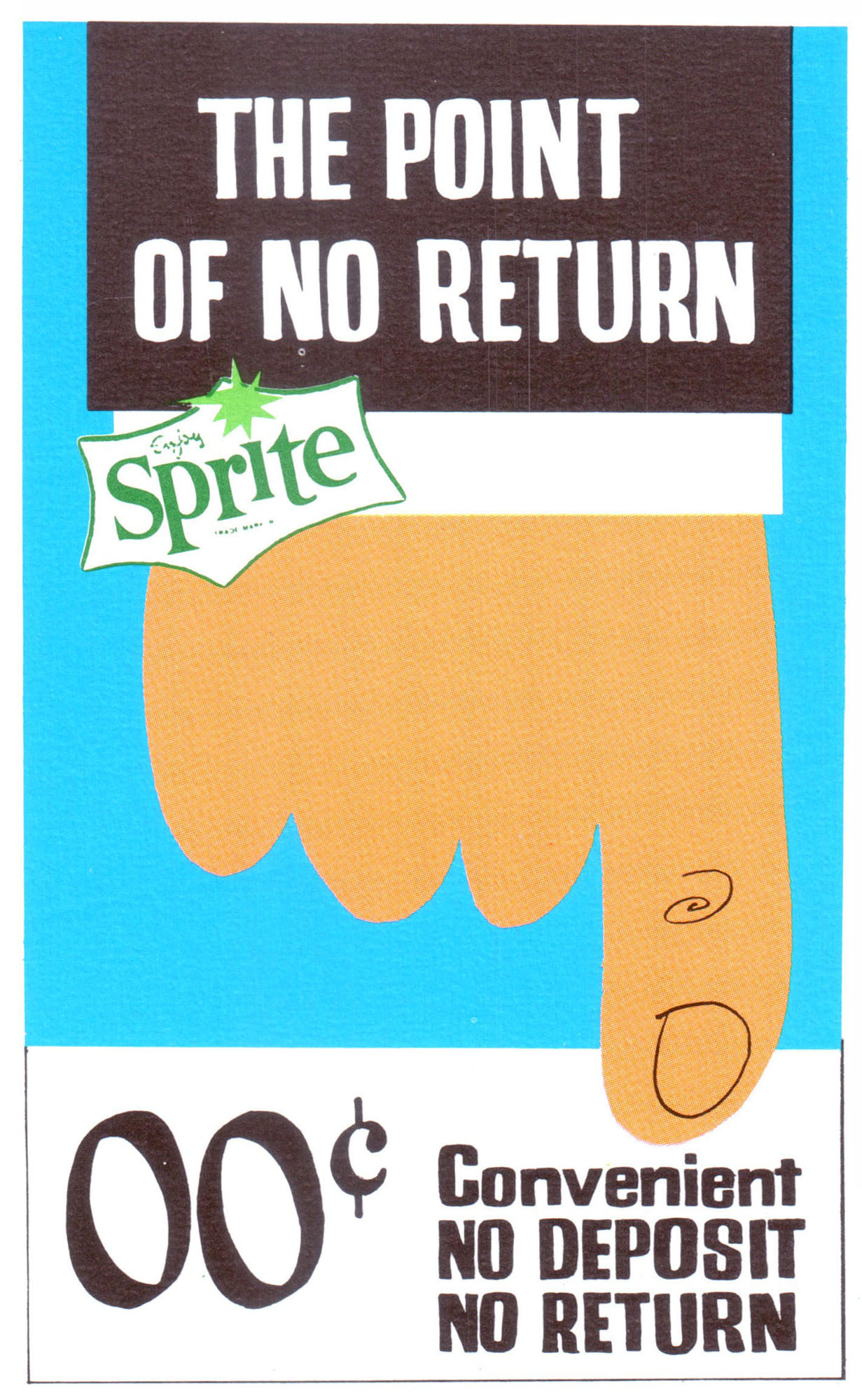
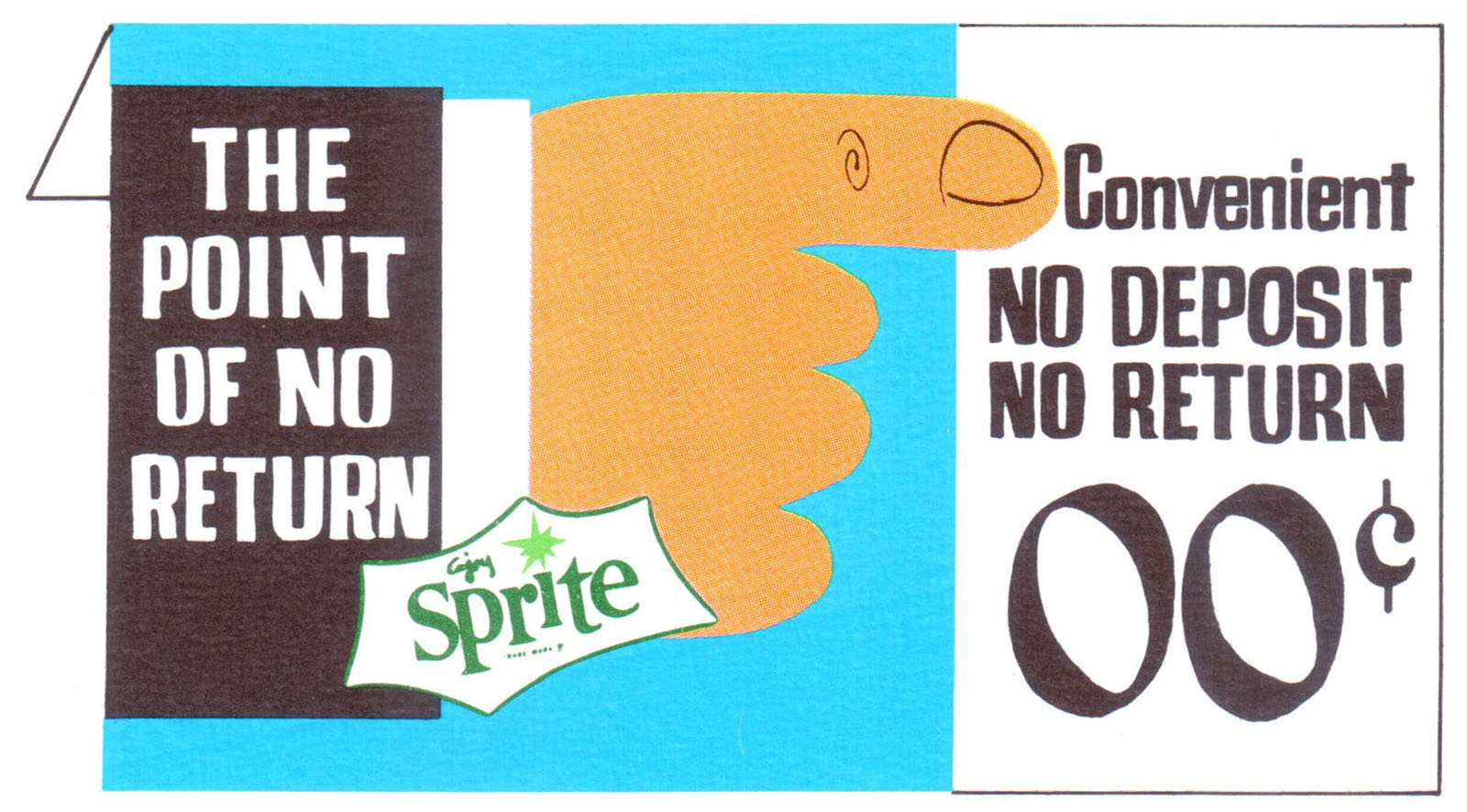
In July of 1968, The Coca-Cola Company introduced a promotion called “The Point of No Return” to attract outlets to increase sales of Sprite by offering them a convenience package message. The promotion appeared as part of the inside advertising promotions for the summer in the 1968 Advertising Price List.
This summer, enjoy the refreshing taste of Sprite, perfect for any occasion!
Table of Contents
Enjoy Sprite: It’s a Natural Refreshment!
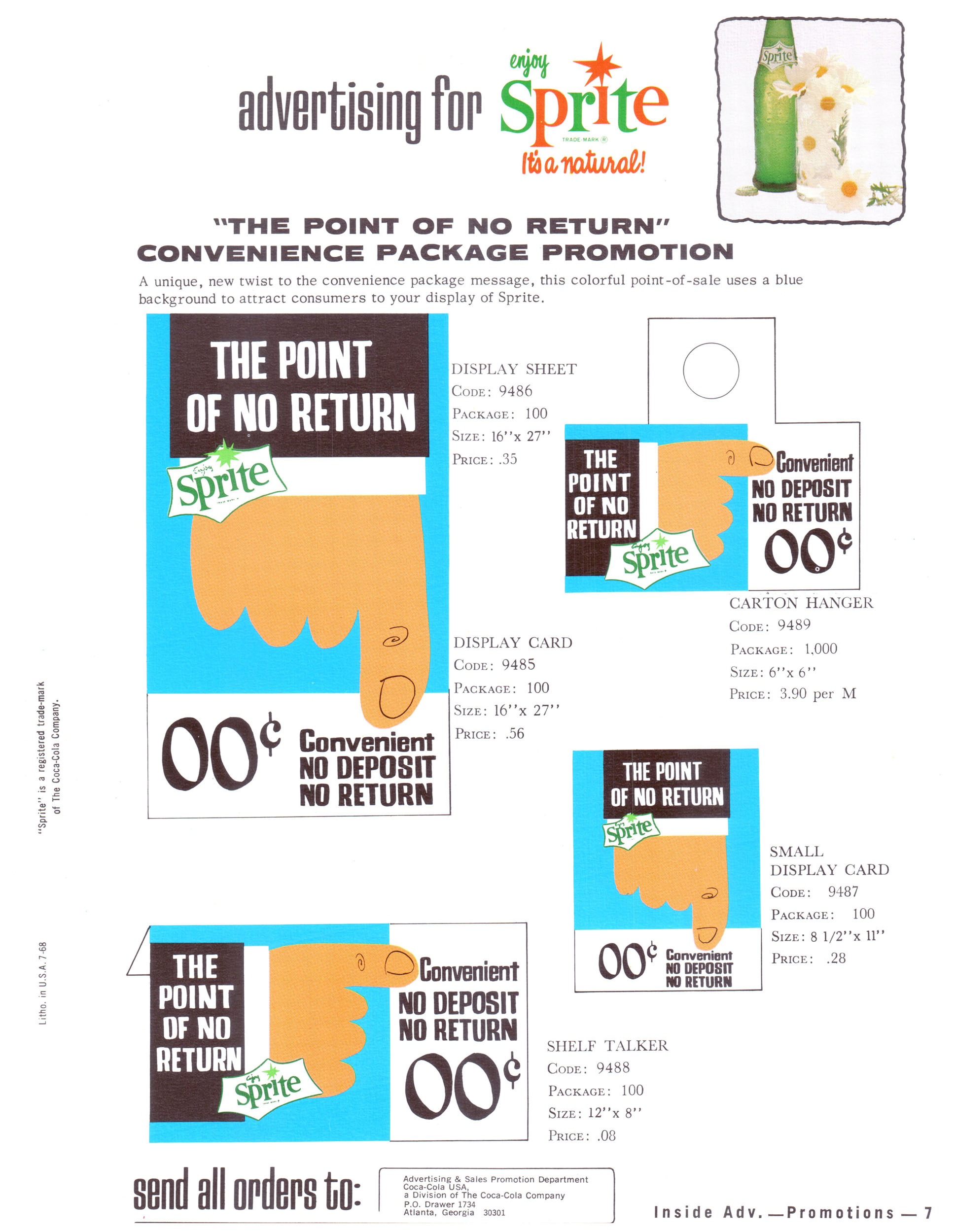
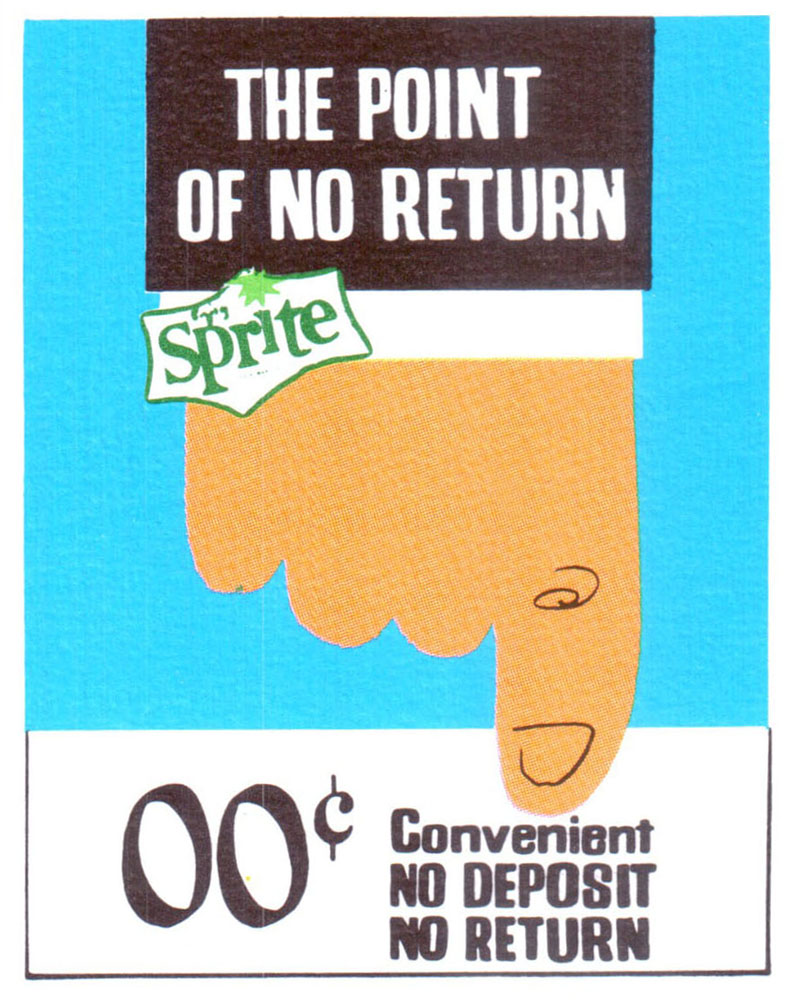
The promotion featured a finger pointing in different directions over a blue background towards no deposit no return bottles and offered 4 different types of sales aids. The outlet could then write in their own pricing for each of the sales aids.
Types of Products Featured in this Promotion
This promotion featured 5 different types of sales aids (1 display sheet, 2 display cards, a shelf talker, and a carton hanger).
A shelf talker is a promotional tool used in retail environments, typically found in supermarkets, bookstores, or other retail outlets. It is a small sign or label attached to the edge of a shelf, usually near the product it promotes. Shelf talkers are designed to catch the attention of shoppers and provide additional information about the product, such as its benefits, special features, or promotional pricing. They often include eye-catching graphics, persuasive language, and sometimes customer reviews or endorsements to encourage purchases. Shelf talkers are effective in influencing consumer decisions at the point of purchase by highlighting key selling points directly where the product is displayed.
A carton hanger is a marketing and promotional tool used in retail environments, especially in supermarkets and stores where products are displayed on shelves. It is typically a cardboard or plastic piece that hangs from the edge of a shelf or a pegboard display, designed to hold and display a product’s packaging (carton) in a prominent position.
A display card is a promotional or informational tool used in retail settings to showcase products effectively. It typically consists of a sturdy piece of cardboard or paper, designed to be placed near or on a product display. Display cards can vary in size and shape but are generally larger than shelf talkers or carton hangers.
A display sheet is a promotional tool that provides details about a product or service, including pricing, features, benefits, and promotional messages. It is placed near the product to attract customer attention and inform potential buyers
Products Featured in this Promotion
The promotion was marketed as a way to offer a new twist to the convenience package message through a colorful point-of-sale blue background. The promotion specifics offered:
Learn More About the Company Brand Featured in this Story
In October of 1957, Vendo introduced a groundbreaking promotion targeted at Coca-Cola bottlers and dealers to effectively sell their innovative line of 1957 coolers and pre-mix equipment. This promotion was prominently featured in The Coca-Bottler magazine, a key publication for bottlers during that period. The advertisement highlighted the excitement surrounding vending equipment treasures that were waiting to be discovered by dealers and other locations across the country. Many dealers had not even considered the potential for these treasures, which included a range of new and advanced cooling solutions from Vendo, designed to enhance the vending experience and attract more customers.
This promotion not only encouraged the sale of coolers but also emphasized the importance of strategic marketing in the vending industry. By educating dealers on effective sales techniques and customer engagement strategies, Vendo aimed to foster a stronger connection between the products and the end consumers. The initiative was well-timed, coinciding with the growing popularity of Coca-Cola products, making it an opportune moment for dealers to capitalize on the trend and increase their sales significantly.
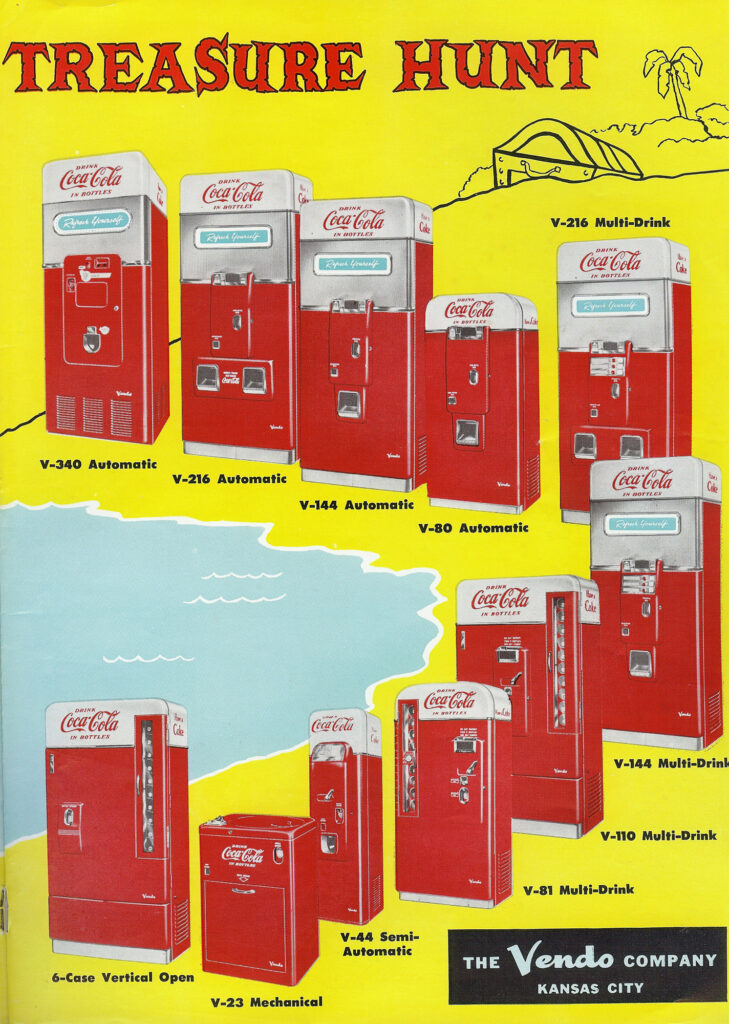
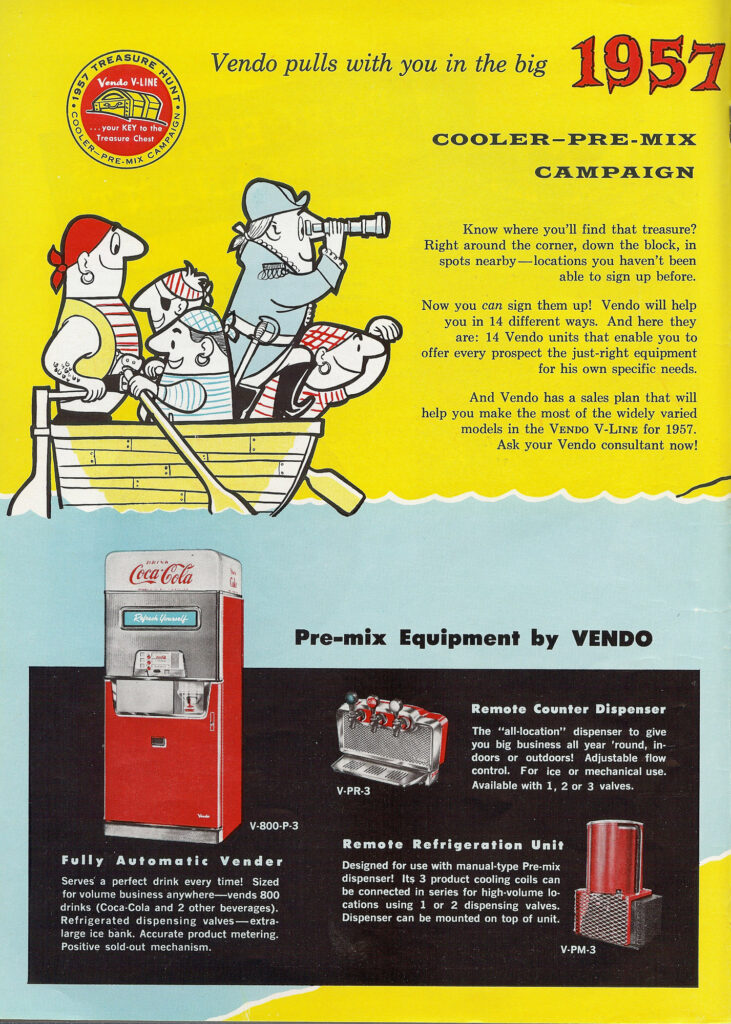
Table of Contents
V-Line for 1957: An Innovative Approach to Vending
The promotion aimed to provide dealers with comprehensive assistance, encouraging them to reach out to a dedicated consultant for personalized guidance. This support was designed to help dealers maximize the sales potential of the 14 new products introduced in the V-Line, which were specifically tailored to meet the evolving needs of consumers seeking convenient access to refreshing beverages.
Products Featured in this Promotion
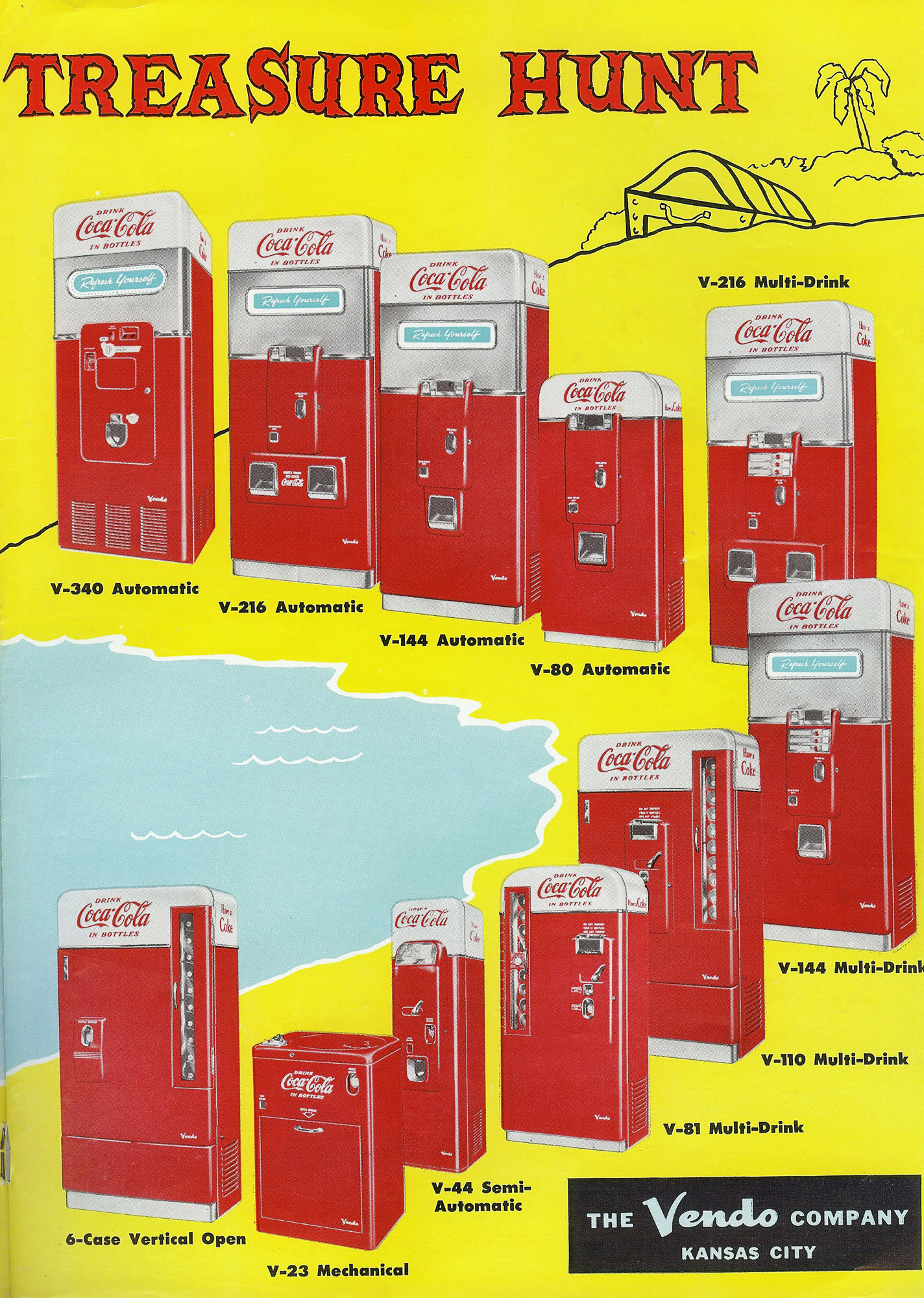
This promotion prominently featured a diverse lineup of 14 different types of coolers. Each model was specifically designed to support dealers in attracting customers and signing them up for the treasure hunt campaign. The coolers were not only functional but also aesthetically pleasing, ensuring they fit seamlessly into various retail environments. Their innovative designs catered to different customer preferences, thus enhancing the overall vending experience.
Moreover, each cooler in the lineup was equipped with modern features that set them apart from previous models. For instance, the V-340 Automatic Coca-Cola Cooler boasted advanced refrigeration technology, ensuring that beverages were kept at the optimal temperature for customer enjoyment. The design also allowed for easy accessibility, encouraging higher sales volumes as customers could quickly grab their favorite drinks on the go.
Additionally, the V-216 Multi-Drink Coca-Cola Cooler offered versatility, allowing dealers to stock a variety of beverages, appealing to a broader customer base. This adaptability was crucial during a time when consumer preferences were rapidly changing, making it essential for vending solutions to keep pace with demand.
The V-144 Multi-Drink Coca-Cola Cooler featured a sleek design that not only attracted attention but also blended well with modern retail aesthetics. Its successful reception among dealers showcased the effectiveness of the promotional strategies, which highlighted the unique selling points of each cooler.
As consumer demands evolved, the V-80 Automatic Coca-Cola Cooler addressed the need for speed and convenience. Its user-friendly interface and quick cooling capabilities made it a popular choice among busy consumers, further reinforcing the importance of understanding market trends.
The Vendo V-110 Multi-Drink Coca-Cola Cooler was equipped with enhanced security features, preventing tampering and ensuring that product integrity was maintained. This aspect resonated well with dealers, who could assure customers of the quality and safety of the drinks they were purchasing.
Meanwhile, the V-110 Multi-Drink Coca-Cola Cooler was equipped with enhanced security features, preventing tampering and ensuring that product integrity was maintained. This aspect resonated well with dealers, who could assure customers of the quality and safety of the drinks they were purchasing.
The V-44 Semi-Automatic Coca-Cola Cooler provided a balance between manual and automatic operation, allowing dealers to tailor their vending approach based on their specific business needs and customer preferences.
Additionally, the V-23 Mechanical Coca-Cola Cooler showcased a classic design that appealed to nostalgic customers, capitalizing on the vintage aesthetics that were becoming trendy during that era.
The Vendo 6-Case Vertical Open Coca-Cola Cooler was designed for high-volume locations, featuring an open front that allowed for easy access to multiple products, making it suitable for busy environments such as convenience stores and gas stations.
The Fully Automatic Coca-Cola Vender was a game-changer in the vending industry, allowing for seamless transactions and reducing wait times for customers. Its advanced technology was a significant selling point during the promotion.
Lastly, the Vendo Remote Counter Dispenser and the Vendo Remote Refrigeration Unit provided flexible solutions for dealers, allowing them to offer a variety of beverage options without the need for extensive space. This adaptability was a crucial aspect of the promotion, enabling dealers to cater to diverse customer needs effectively.
Learn More About the Manufacturer and the Company Brand Featured in this Promotion
For those interested in the legacy and innovation of vending solutions, The Vendo Company stands as a key player in the industry, committed to delivering high-quality products that enhance consumer convenience.
Additionally, The Coca-Cola Company has a rich history of branding and marketing that has shaped the beverage industry, making it a fascinating subject for further exploration by those curious about its impact on consumer culture.
