As restaurants sought to enhance their customer experience, they turned to vintage Coca-Cola menu boards to capture the essence of this iconic brand. The 1970s were a golden age for American diners. Stainless steel counters, jukeboxes humming Fleetwood Mac, and families gathering around orange vinyl booths defined an era. But a quiet revolution was happening on the walls of these establishments, led by Coca-Cola. Enter the Marketeer Menu Boards, Coca-Cola’s mid-1970s innovation that promised versatility, style, and increased sales for restaurants of all sizes and transformed diner menus forever.
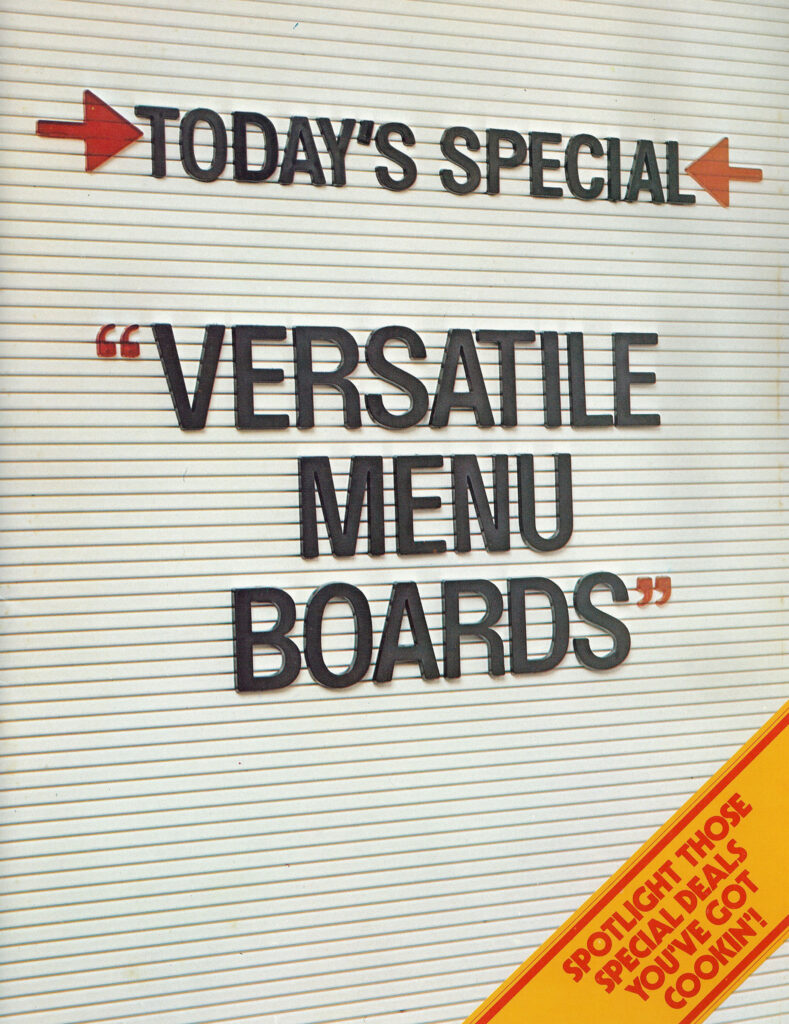
Today’s Special: Versatile Menu Boards
Coca-Cola’s trade catalog from the era proudly declared:
“Today’s Special: Versatile Menu Boards”
These were more than just static signs. Designed with interchangeable panels and crisp typography, they allowed restaurateurs to update menus daily, without needing a new board.
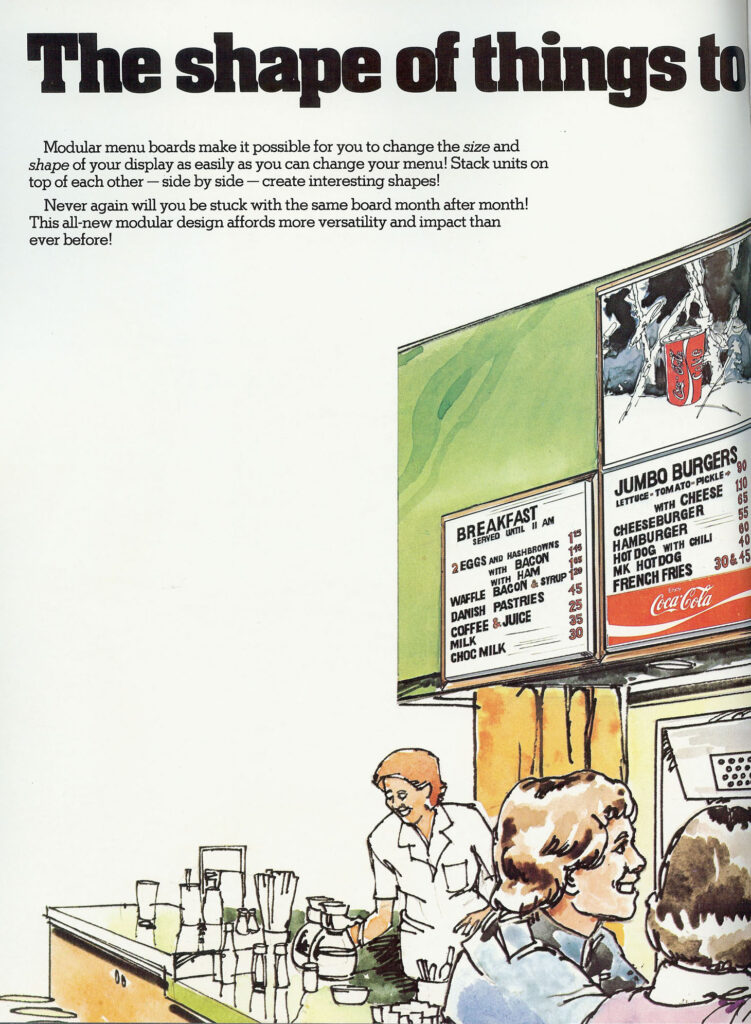
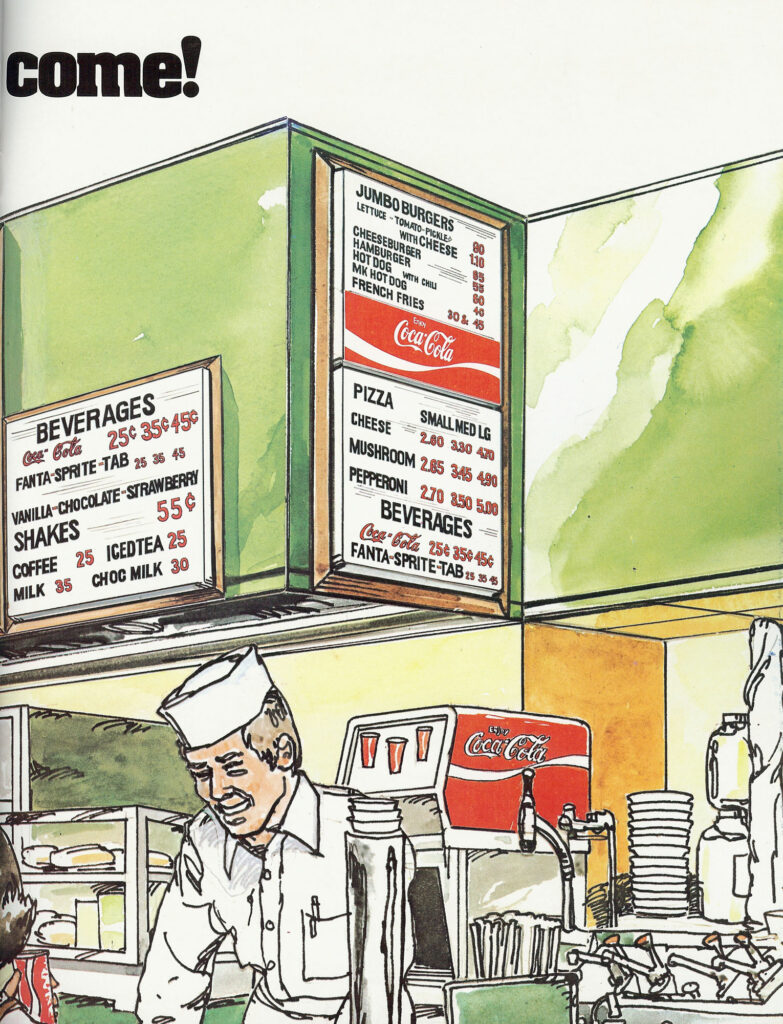
The Shape of Things to Come
Illustrations in the catalog showed families enjoying burgers and fries under gleaming white menu boards with prices like:
- Jumbo Burger – 90¢
- Cheeseburger – $1.10
- French Fries – 30¢
The Coca-Cola logo, in its bold red script, anchored every board, linking quality beverages to hearty meals.
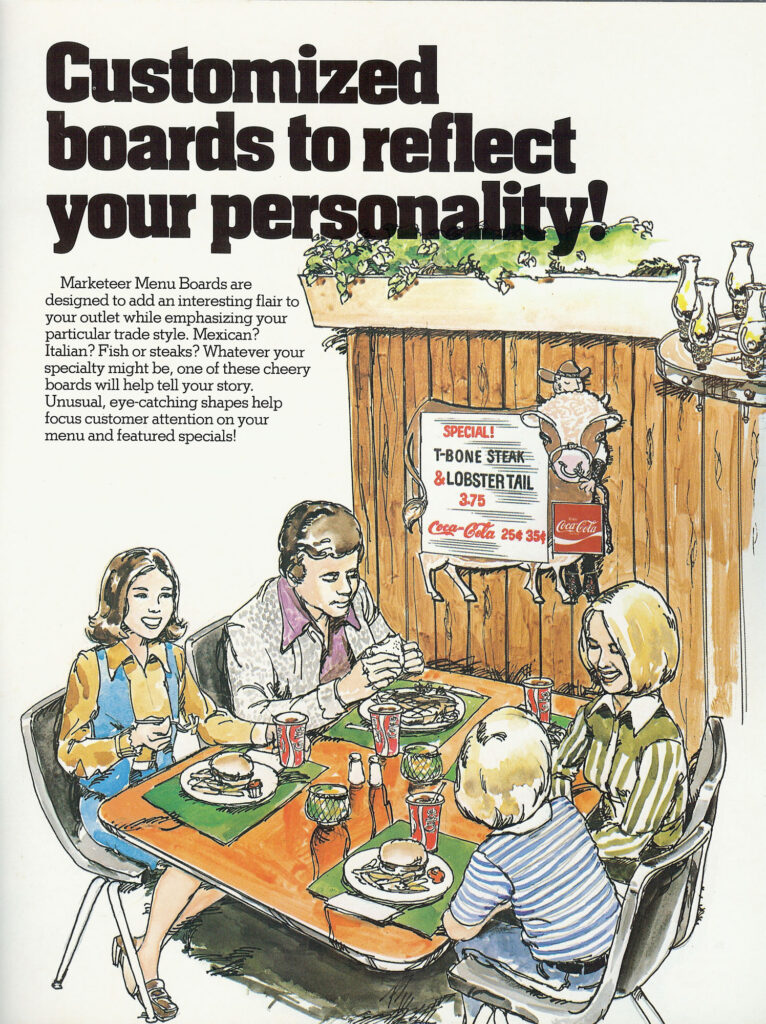
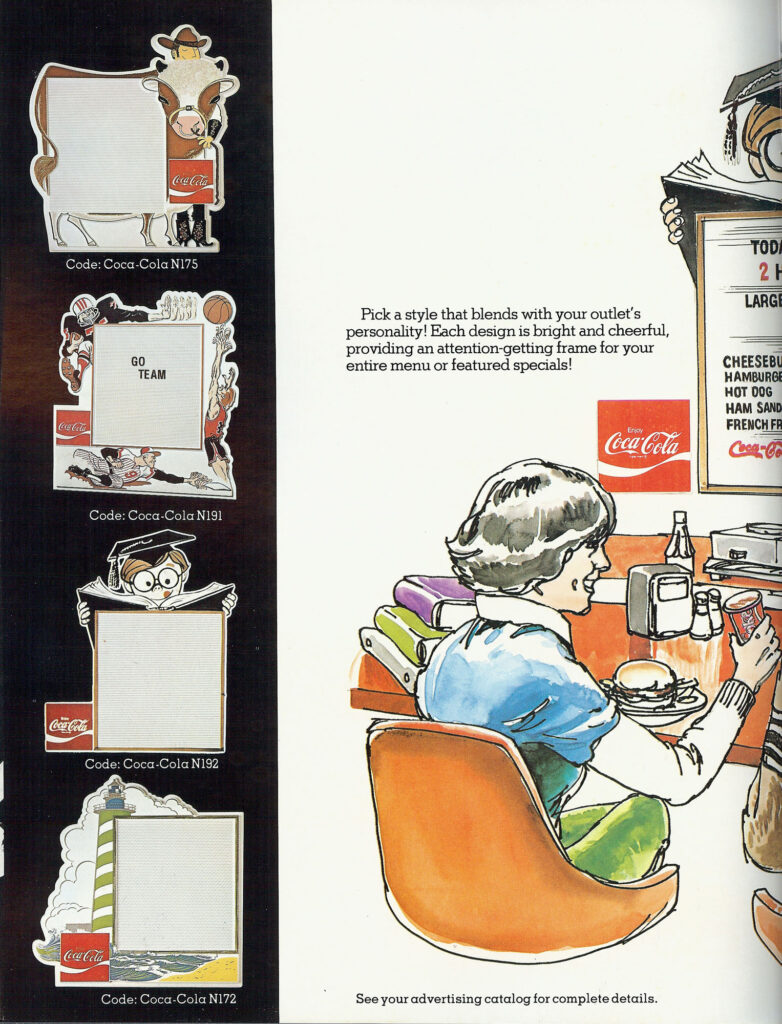
Customized Boards to Reflect Personality
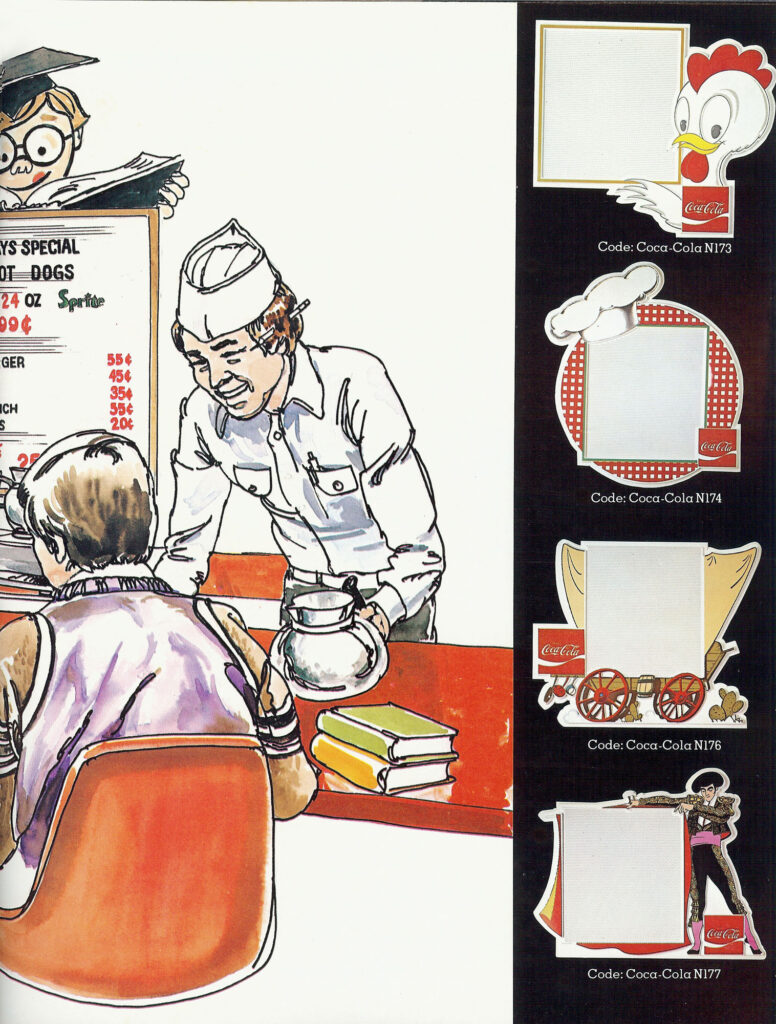
Themed frames gave eateries personality:
- 🐮 Cow-shaped boards for steakhouses
- 🏖️ Lighthouse motifs for coastal diners
- 🎓 Graduation caps for college cafés
- 🤠 Covered wagons for western BBQ joints
These designs weren’t just functional, they were marketing tools.
Quick Promotions, Big Returns
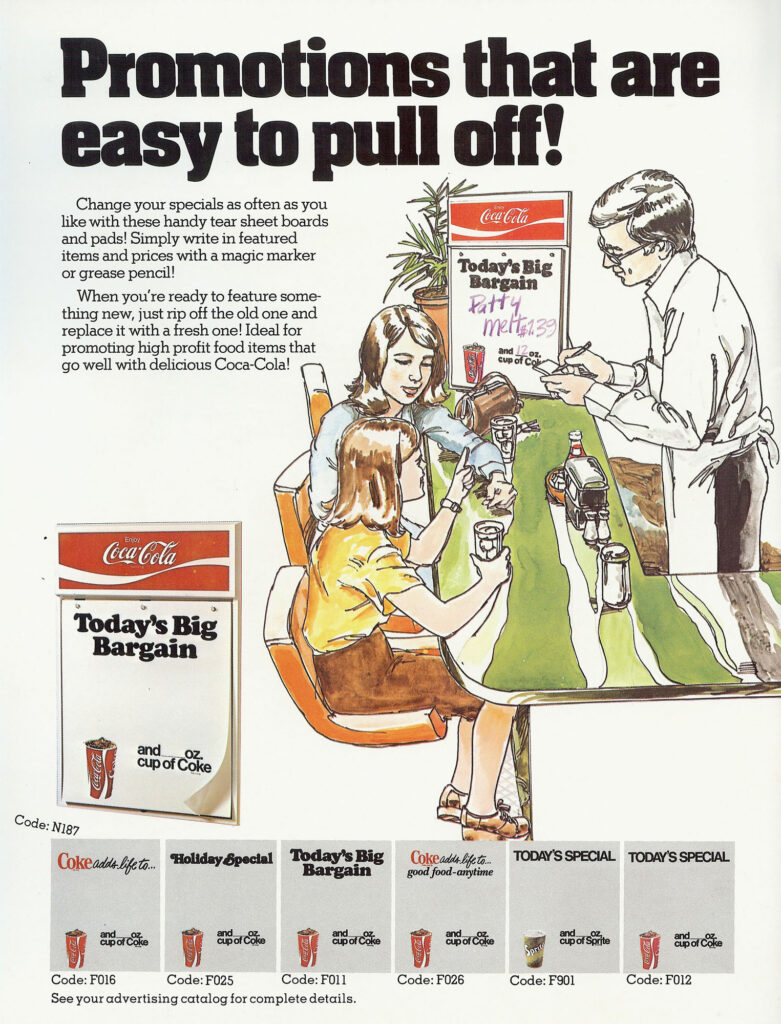
With tear-sheet boards and grease-pencil inserts, specials could be written and erased daily. A few of the combos featured:
- 🍗 Fried Chicken & Coke
- 🌮 Tacos & Coke
- 🍔 Patty Melt & Coke
Coca-Cola wasn’t just selling soda; they were selling higher margins and a branded experience.
Pictorial Inserts: Selling the Meal With the Drink
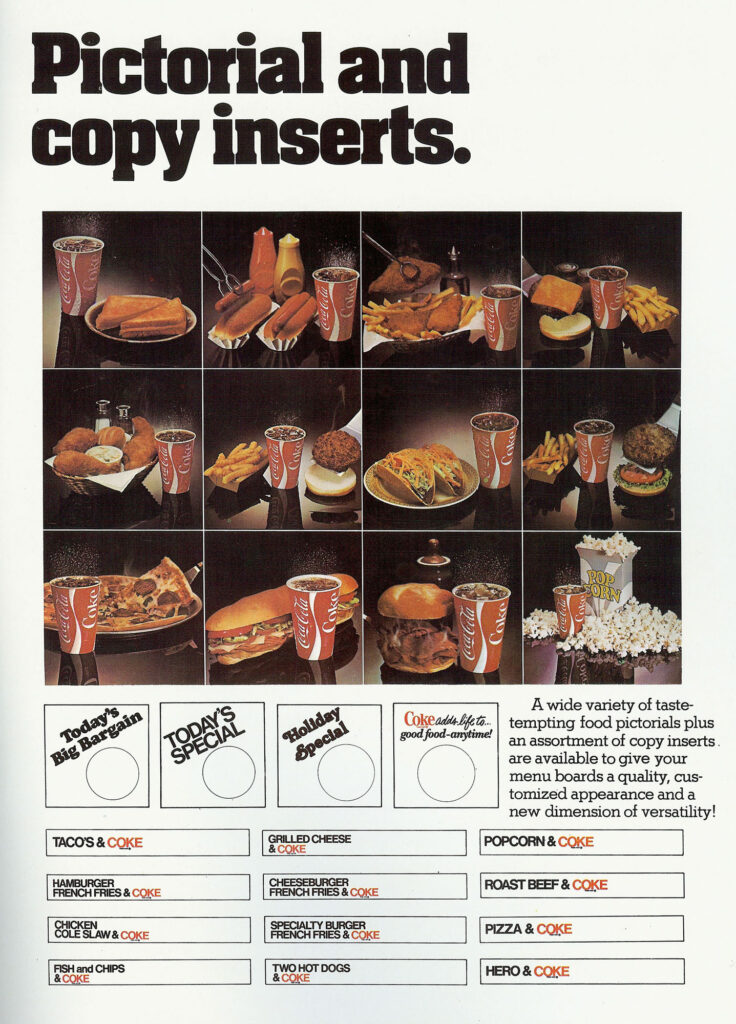
High-quality photo inserts showed:
- Golden fried chicken next to an ice-cold Coke.
- Pepperoni pizza paired with Coca-Cola.
- Burgers, fries, and paper Coke cups under bright diner lights.
These inserts helped even small diners look as professional as rising fast-food chains.
A Cultural Snapshot: Diners and Drive-Ins in the 1970s
Molded chairs, chrome soda fountains, paper hats, these visuals captured more than menus. They documented an era of community, affordability, and Americana, where a family meal out cost under $5.
Why the Mid-to-Late 1970s?
“Coke adds life” slogan debuted in 1976.
- TAB and Fanta branding mirror Coca-Cola’s 70s product lineup.
- Prices match pre-inflation dining costs.
- Soft watercolor illustrations echo 1970s advertising styles.
By 1982, digital menus and Diet Coke would usher in a new era. But in these pages, Coca-Cola reigned supreme.
Legacy of the Marketeer Menu Boards
Today, surviving examples of these boards are rare collectibles. Yet their influence lives on in digital menu systems and co-branded promotions worldwide.
Final Reflection: Today’s Special Forever
The Marketeer Menu Boards remind us of an age where even the simplest diner could feel modern, professional, and enticing, thanks to Coca-Cola.
“Today’s Special isn’t just on the plate, it’s on the wall, sparking cravings and sealing the deal with a Coca-Cola.”
Learn More About the Company Brand Featured in this Promotion
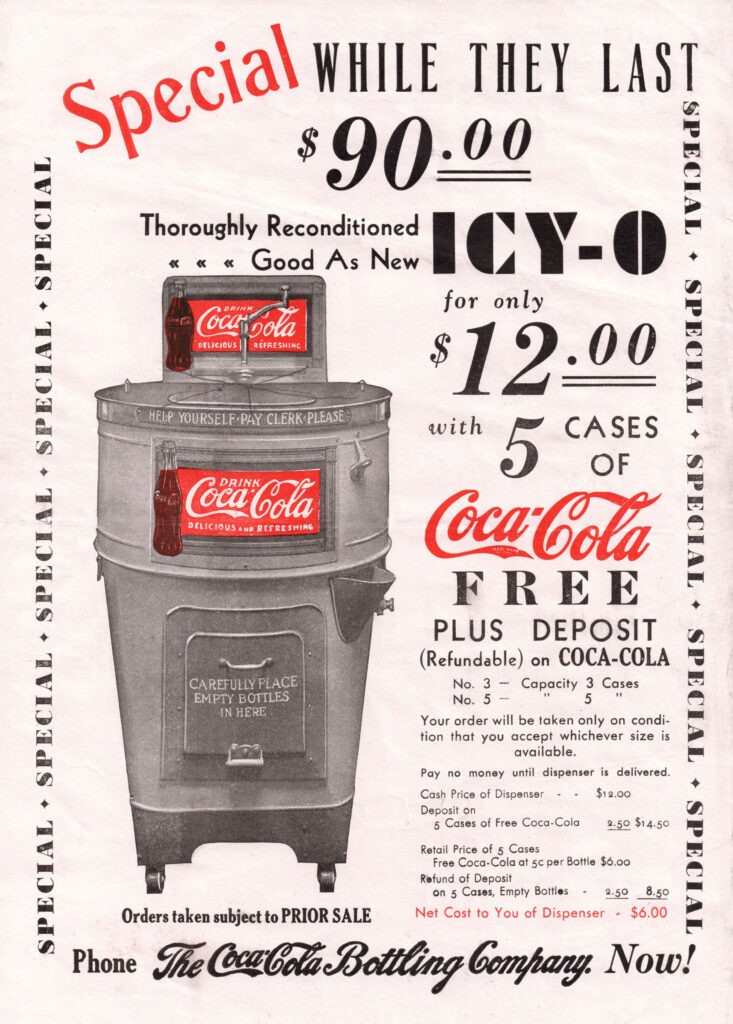
This 1920s Coca-Cola advertisement for the ICY-O dispenser, with its bold promise of a reconditioned unit “Good As New” for $90.00, is more than a simple sales pitch. It is a window into an America on the brink of transformation, a nation defined by Prohibition, technological leaps, and a cultural obsession with speed and convenience. This ad not only marketed a product but also reflected the sweeping societal changes of the Jazz Age.
The eye-catching headline “Special While They Last”, flanked by repeated “SPECIAL” markers, speaks volumes about the urgency Coca-Cola instilled in their marketing. But beyond these bold claims lies a deeper narrative about how Coca-Cola, the bottled drink that began in soda fountains, expanded its empire by making refreshment instantly available, everywhere.
A Barrel of Cool Refreshment
In the early 1920s, the ICY-O dispenser symbolized modernity. Shaped like a metallic barrel and designed to keep bottled Coca-Cola icy cold, it was utilitarian and unpretentious. On the surface, it invited customers to engage with it directly: “Help Yourself – Pay Clerk Please.” For store owners, it meant tapping into a cultural shift toward immediacy and autonomy.
The dispenser’s appeal was clear. With its internal ice compartment and capacity to hold three to five cases of Coca-Cola, it brought the soda fountain experience to any retail setting, from corner groceries to train stations. Its promise of refreshment was simple, efficient, and above all, self-serve.
At $90.00, a substantial sum at the time., the dispenser came with five free cases of Coca-Cola, turning the purchase into a long-term investment for merchants eager to meet growing demand.
The 1920s and Coca-Cola’s Golden Opportunity
The 1920s was an era defined by contradictions: while the U.S. government banned alcohol through Prohibition (1920-1933), Americans developed an insatiable appetite for other forms of refreshment. Soft drinks like Coca-Cola surged in popularity as they filled the void left by shuttered saloons.
The Prohibition Effect
During Prohibition, soda fountains and bottlers seized their chance. Bars converted into “soda shops,” and Coca-Cola’s bottling plants increased exponentially. By 1929, the company boasted more than 1,000 bottling plants, reflecting their aggressive push to make Coke available anywhere.
The ICY-O catered perfectly to this landscape. It offered storekeepers a means to capitalize on the beverage’s popularity without installing a full soda fountain, which required counter space and staff.
Urbanization and Changing Lifestyles
As millions flocked to cities, the demand for convenient, affordable refreshments grew. The rise of the automobile also made roadside commerce viable, and cold bottled Coca-Cola became the drink of choice for travelers needing a quick stop.
A Shift Toward Self-Service
The ICY-O reflects a broader cultural pivot toward self-service retailing. While today it feels second nature to grab a bottle from a cooler, in the 1920s, this was a novel concept. Coca-Cola was teaching America to trust itself in this new consumer landscape.
The ICY-O Company of Charlotte, North Carolina: A Crucial Partner
While Coca-Cola was busy expanding its bottling empire, the dispensers themselves were produced by The ICY-O Company of Charlotte, North Carolina. Founded in the early 20th century, ICY-O specialized in innovative refrigeration solutions designed to hold ice and keep bottled beverages cold for hours.
ICY-O became a natural collaborator for the soft drink giant. Their dispensers were rugged and functional, using insulated metal barrels that merchants could refill with ice daily. These devices became a fixture in general stores, train depots, and filling stations across the South and eventually nationwide.
The partnership illustrates Coca-Cola’s genius for collaboration with local manufacturers. Instead of designing and producing dispensers in-house, Coca-Cola worked with ICY-O to distribute thousands of these machines, effectively embedding Coca-Cola branding into ICY-O’s very product design. The result was a mutually beneficial relationship: ICY-O enjoyed steady business supplying dispensers, while Coca-Cola expanded its reach with minimal overhead.
The ICY-O Company itself contributed to the early refrigeration revolution in America, helping to transition businesses from block ice chests to insulated, self-contained units.
Functional Elegance with Urgent Messaging
The ad’s design is straightforward but effective. Oversized fonts scream “$90.00”, “$12.00”, and “FREE”, while Coca-Cola’s red script logo provides instant brand recognition. The repeated “SPECIAL” down both margins functions almost like a neon sign, an attention-grabbing tactic for busy shopkeepers flipping through trade journals.
Unlike later mid-century Coca-Cola ads that leaned into lifestyle imagery, this ad is strictly business. It’s a utilitarian pitch aimed squarely at merchants, highlighting practical details like the refundable deposit and machine capacity.
Why This Ad? Why This Moment?
Coca-Cola’s approach with the ICY-O demonstrates their keen understanding of the era’s retail challenges. Instead of relying solely on soda fountains, then the primary venue for soft drink sales—they equipped merchants to meet consumers where they were. This strategy expanded their footprint and reduced dependence on counter service.
It also points to Coca-Cola’s early mastery of vertical integration. By controlling the bottling, distribution, and retail equipment (with help from companies like ICY-O), Coca-Cola ensured that a cold Coke was never out of reach.
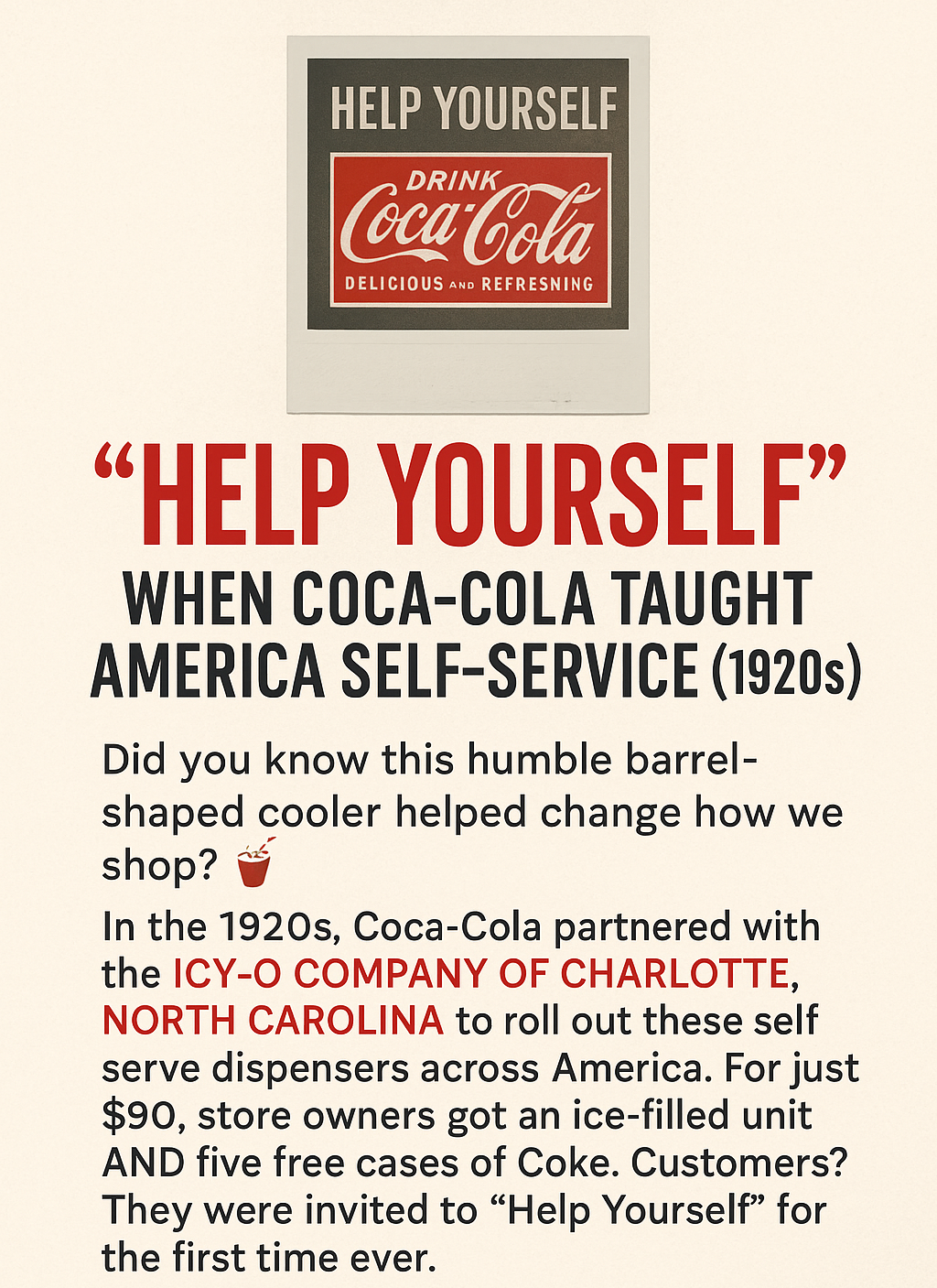
The ICY-O wasn’t just a dispenser; it was part of Coca-Cola’s broader effort to modernize refreshment and drive bottling sales. It combined the allure of chilled soda with the practicality of self-service, offering store owners a chance to engage a customer base that increasingly prized speed and convenience.
This ad reflects a pivotal moment when Coca-Cola transitioned from a pharmacy fountain drink to a bottled icon of mass consumption.
ICY-O’s Legacy
The ICY-O Company faded from prominence as refrigeration technology evolved, but its influence remains. These early dispensers taught Americans the ritual of reaching into a cooler for a cold drink, a behavior that Coca-Cola leveraged into dominance throughout the 20th century. By democratizing access to cold soda, ICY-O dispensers transformed corner stores and roadside stands into vital nodes in Coca-Cola’s distribution web. This collaboration helped solidify Coca-Cola’s reputation as the drink of choice for a nation on the move.

Legacy Takeaway
Nearly a century later, the ICY-O seems quaint, yet it symbolizes Coca-Cola’s foresight and ICY-O’s role in refrigeration history. This ad wasn’t just selling a machine, it was selling a future where refreshment was instant and ubiquitous.
For Coca-Cola, the strategy worked. By 1929, despite the looming Great Depression, the brand’s reach was unrivaled. The ICY-O had done its part, proving that with the right tools and a little ice, even the smallest shop could become a Coca-Cola outlet. The ad’s simple message, “Help Yourself” was prophetic. It anticipated an America that would come to embrace convenience and autonomy as hallmarks of modern consumer culture.
